Ash dieback and oak processionary moth represent the most destructive tree health threats facing the UK and mainland Europe in 2026. Hymenoscyphus fraxineus—the fungus behind ash dieback—has killed millions of ash trees since 2012. Oak processionary moth larvae strip foliage from oaks and cause severe allergic reactions in humans and animals. Both are notifiable to the Forestry Commission, requiring specific biosecurity measures under the Plant Health Act 1967 and updated regulations enforced through 2026.
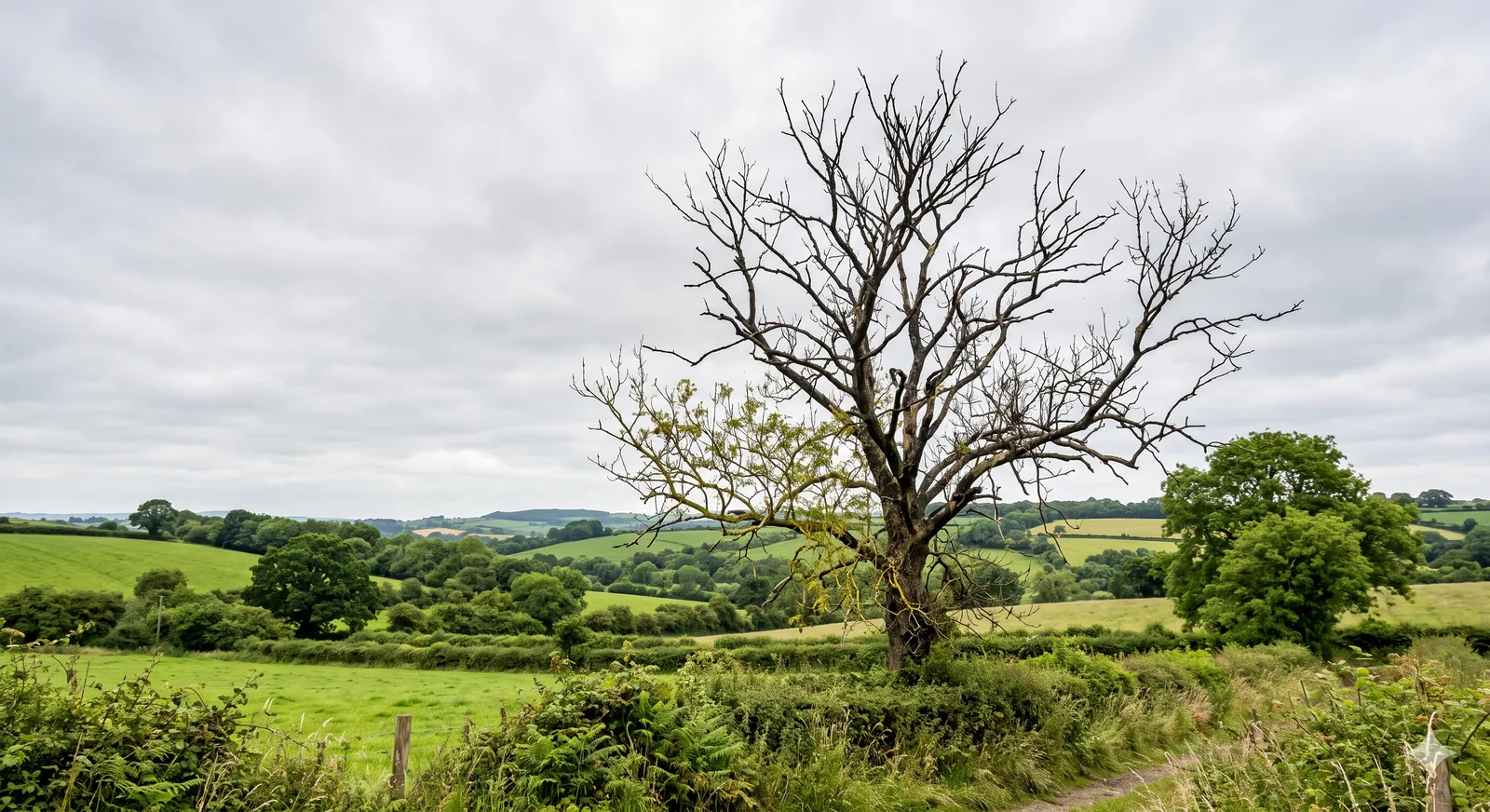
Ash dieback – a fatal fungal disease caused by Hymenoscyphus fraxineus that blocks water transport in ash trees, leading to crown dieback, stem lesions, and death within 3–10 years of infection (Forestry Research UK, 2026).
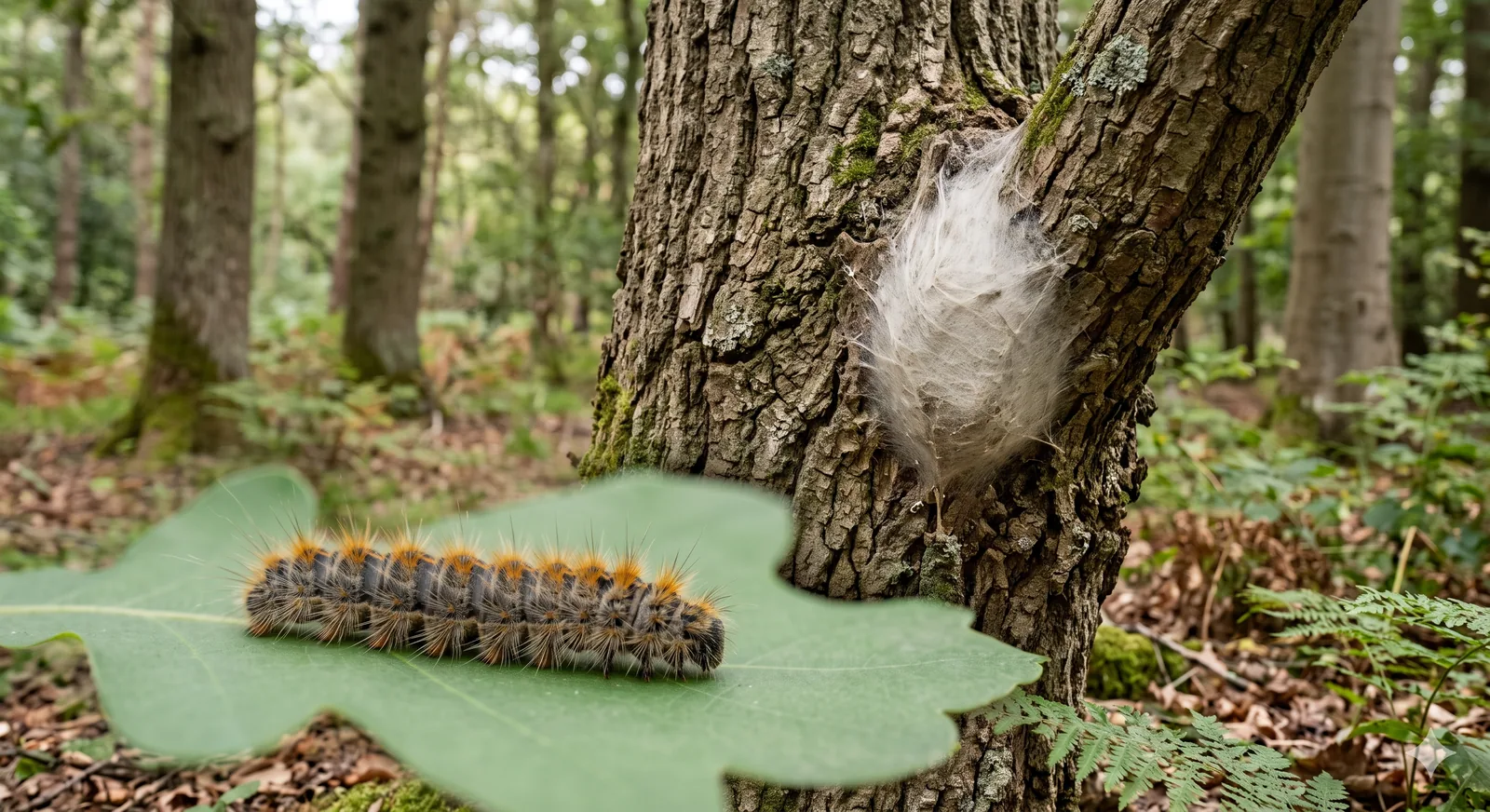
Oak processionary moth (OPM) – a notifiable quarantine pest whose larvae possess toxic hairs that trigger respiratory distress, skin rashes, and eye irritation in humans; each nest can contain up to 2,000 caterpillars that defoliate oak trees during spring feeding (UK Government Plant Health Guidance, 2026).
Key Takeaways
- Ash dieback has no cure. Management focuses on safety, removal of high-risk trees, and collection of fallen leaves to interrupt the fungal lifecycle (Harrow Council, 2026).
- Oak processionary moth is a quarantine pest in England. Moving large oak trees from established areas requires prior authorisation; contact records must be kept for 3 years (UK Government, 2026).
- OPM nests: report within 48 hours via TreeAlert or opm@forestrycommission.gov.uk (Forestry Commission, 2026).
- Professional OPM treatment requires registration under Official Control (plant protection products) Regulations. Keep treatment records for 3 years (UK Government, 2026).
- Ash dieback prevention means collecting and burning, burying, or deep composting fallen ash leaves each autumn (Harrow Council Tree Management, 2026).
What Exactly Is Ash Dieback and Why Should Woodland Owners Care?
Ash dieback is a lethal fungal disease that has devastated European ash populations since 2010. Infection rates exceed 90% in established outbreaks across southern England. The pathogen Hymenoscyphus fraxineus originated in Asia, where native ash species evolved resistance. European common ash (Fraxinus excelsior) and narrow-leafed ash lack this immunity. Summer heat triggers airborne spores from leaf litter; these infect new trees through leaf scars, causing progressive vascular blockage, crown dieback, and death.
Woodland owners face substantial liability risk. Infected ash trees lose structural integrity unpredictably—branches drop without warning, often years before the entire tree fails. Any infected ash adjacent to footpaths, roads, or buildings requires priority assessment by a qualified arborist. The Forestry Commission does not mandate immediate felling of all infected ash, but landowners must demonstrate due diligence in managing public safety under the Occupiers' Liability Act 1957. Miss this, and you're exposed to negligence claims if someone is injured by a falling branch.
Ash supports over 1,000 species in the UK, including 45 obligate species (entirely dependent on ash for survival). Its loss eliminates nesting sites for hole-nesting birds, removes critical food for ash-associated invertebrates, and disrupts soil structure and water retention in riparian zones—all of which affects flood mitigation.
Is ash dieback fatal to all ash trees?
Essentially yes. Infected ash trees are ultimately fatal in the vast majority of cases, though death takes 3 to 10 years depending on tree age, vigour, and site conditions. Young saplings often die within a single growing season; mature trees with established roots may survive several years with progressive crown dieback. Around 1–5% show natural tolerance, displaying limited symptoms despite exposure. The UK Ash Dieback Research Programme is identifying and propagating these tolerant genotypes. Commercially available resistant stock remains scarce in 2026.
Understanding Oak Processionary Moth: The Hairy Pest Ravaging Oak Forests
Oak processionary moth (Thaumetopoea processionea) was first detected in England in 2005. Now it is established across Greater London and the Home Counties, with isolated outbreaks as far north as Yorkshire. The pest is native to southern Europe but has expanded northward due to milder winters and accidental transport of egg-laden oak trees. Caterpillars hatch in April, feed voraciously through May and June, and pupate in communal silk nests by mid-July. A single nest can house up to 2,000 larvae; severe infestations strip entire oak canopies bare in weeks.
The real danger is not tree death but human and animal health. From late April onward, larvae develop thousands of microscopic barbed hairs (setae) containing the urticating protein thaumetopoein. These hairs break off easily, become airborne, and cause acute allergic reactions: itchy rashes, conjunctivitis, respiratory distress, and in rare cases anaphylaxis. Dogs are particularly vulnerable—ingestion of caterpillars or contact with hairs causes severe oral inflammation and systemic poisoning.
OPM is a quarantine pest under official control in England. No large oak tree (trunk diameter >8 cm at 1.2 m height) may be moved from the established area into the buffer zone or exclusion zone without prior written authorisation. Professional operators must maintain contact records for all large oak recipients for at least 3 years to ensure traceability if an outbreak occurs.
What are the health effects of oak processionary moth caterpillars?
Contact with OPM caterpillars or shed hairs causes dermatitis (itchy, raised welts), conjunctivitis (red, watering eyes), and pharyngitis (sore throat, difficulty swallowing). Inhaling airborne hairs triggers asthma-like symptoms: wheezing, chest tightness, persistent cough. Symptoms typically appear within hours and can persist for weeks if hairs remain embedded in skin or clothing. NHS guidance recommends showering immediately, washing clothes at 60°C, and seeking medical attention if respiratory symptoms develop. Children and people with pre-existing respiratory or atopic conditions face elevated risk.
How does oak processionary moth spread to new areas?
Adult females can fly up to 2 km to find suitable oaks for egg-laying, but the primary vector is human movement of infested trees. Nursery stock, landscape specimens, and large oaks transported for commercial planting have introduced OPM to previously unaffected regions. Egg masses are laid in late summer on twigs high in the crown—often invisible during winter inspections. A single infested tree can carry several hundred egg masses, each holding 100–300 eggs. The Forestry Commission requires professional suppliers to inspect all large oaks before movement, though cryptic egg placement means inspections are imperfect.
"Professional operators must retain contact records for large oak tree recipients for at least 3 years to ensure traceability of movements." — UK Government Guidance, Managing Oak Processionary Moth in England, 2026
How Do These Two Forest Threats Compare and Interact?
Ash dieback and oak processionary moth are ecologically distinct threats. Ash dieback spreads via wind- and water-dispersed fungal spores from fallen leaves; OPM spread is primarily human-driven (through traded trees) but also occurs via adult moth flight. Ash dieback acts slowly—individual trees decline over 3–10 years. OPM causes rapid seasonal damage, with peak defoliation in a 4–6 week window from mid-May to late June.
| Characteristic | Ash Dieback | Oak Processionary Moth |
|---|---|---|
| Pathogen/Pest Type | Fungus (Hymenoscyphus fraxineus) | Insect (Thaumetopoea processionea) |
| Primary Host | Common ash, narrow-leafed ash | Native and non-native oak species |
| Spread Mechanism | Airborne spores (wind), water splash | Adult moth flight (2 km), traded trees (long distance) |
| Mortality Timeline | 3–10 years post-infection | Rarely fatal; repeated severe defoliation weakens tree |
| Human Health Risk | None | High (toxic hairs cause dermatitis, respiratory distress) |
| Notifiable Status | Not notifiable (widespread, uncontainable) | Notifiable quarantine pest (England) |
| Treatment Available | None (no fungicide effective) | Yes (insecticide sprays, biological control, nest removal) |
| Record-Keeping Requirement | None (non-regulatory) | 3 years for large oak movements (UK regulations) |
Both diseases weaken tree immune systems, creating vulnerability to secondary pathogens and pests. Ash trees stressed by dieback succumb more readily to ash bark beetle and honey fungus (Armillaria spp.). Oaks repeatedly defoliated by OPM suffer reduced radial growth, compromised winter hardiness, and increased susceptibility to acute oak decline—a complex condition involving bacterial pathogens and native boring beetles. Mixed broadleaf woodlands with both ash and oak therefore face compounding stressors that potentially accelerate overall canopy decline.
Can a tree be infected by both ash dieback and oak processionary moth?
No. Ash dieback exclusively affects ash species; oak processionary moth feeds only on oak. That said, mixed woodlands containing both ash and oak can face both threats simultaneously—creating real headaches for land managers juggling parallel control strategies. A large estate woodland might require ash safety surveys and felling operations in one compartment while contracting OPM nest removal and pheromone trapping in adjacent oak stands. The result: arboricultural and biosecurity costs can double within a single management year, straining budgets and contractor availability.
What Are the Real-World Impacts on Forests, Biodiversity, and Local Economies?
Ash dieback has killed tens of millions of ash trees across the UK since 2012, fundamentally reshaping woodland composition. In East Anglia and the Midlands, ash was historically the dominant canopy tree in wet woodland and hedgerows. Wholesale mortality has opened canopies, allowing bramble and competitive shrubs to dominate understorey and reducing structural diversity. The loss of mature ash eliminates habitat for obligate species: the ash bark beetle, lesser stag beetle, and several rare lichens found nowhere else. Birds that nest in ash cavities—pied flycatcher, redstart, nuthatch—now face a shortage of suitable sites, particularly in regions where veteran ash provided their only refuge.
Forestry industries in affected regions face significant economic losses. Infected ash timber has limited commercial value. Discolouration and decay make it unsuitable for high-value applications (furniture, tool handles, sports equipment). Timber processors report a glut of low-grade ash firewood, depressing prices and leaving many landowners with net-negative returns after felling and extraction costs. The Forestry Commission estimates the total cost of managing ash dieback on publicly accessible land in England alone exceeds £2 billion over the next decade—surveys, felling, replanting combined.
Oak processionary moth infestations trigger public health alerts, school closures, and costly decontamination in severely affected areas. During 2024, three London boroughs closed parks and restricted access to tree-lined streets when larval activity peaked; decontamination (pressure washing pavements, removing nests, applying residual insecticide) cost councils over £600,000. Private landowners face similar expenses. A single mature oak with multiple nests can require £300–£800 for professional treatment, depending on tree size and access. Schools, care homes, and recreational facilities must budget for annual inspections and treatment to comply with the Health and Safety at Work Act 1974.
Which animals depend on ash trees and how does ash dieback affect them?
Over 1,000 species in the UK are associated with ash, including 45 obligate species that cannot survive without it. The ash bark beetle (Hylesinus fraxini) is entirely dependent on ash; its larvae develop under the bark of stressed or dying trees. Several rare lichens—Caloplaca lucifuga and Bacidia incompta among them—grow exclusively on ash bark in ancient woodland. Birds such as bullfinch and hawfinch consume ash seeds; loss of seed crops reduces winter food availability. Hole-nesting species (marsh tit, lesser spotted woodpecker) rely on dead ash heartwood cavities. Dead ash initially provides abundant nesting sites, but eventual collapse eliminates habitat faster than replacement trees can mature—potentially isolating breeding populations for 20+ years.
What is the economic impact of ash dieback on timber production?
The UK forestry sector has lost an estimated 95% of its commercial ash resource. Ash was historically valued for strength, flexibility, and shock resistance: tool handles, furniture frames, sports equipment (snooker cues, hockey sticks, cricket stumps). Infected timber is downgraded to firewood or left to decay in situ if extraction costs exceed salvage value. Sawmill volumes have collapsed from approximately 120,000 m³ annually (pre-2012) to fewer than 10,000 m³ in 2025. Landowners who planted ash in the 1990s anticipating 40–50 year rotations now face premature felling with minimal return. Some report net losses after contracting felling and haulage.
What Control and Management Strategies Actually Work?
Ash dieback has no cure. No fungicide effective against Hymenoscyphus fraxineus exists in field conditions. Management focuses on three priorities: public safety, slowing disease spread, and conserving genetic resistance. Landowners with ash trees adjacent to roads, footpaths, or buildings must conduct regular safety inspections by a qualified arborist. The Forestry Commission recommends annual surveys for high-risk trees, escalating to biannual inspections once significant crown dieback (>50% crown loss) becomes evident. Felling infected ash before structural failure is the only reliable method to eliminate liability risk.
Disrupting the fungal lifecycle requires collecting and destroying fallen ash leaves each autumn. The fungus overwinters on leaf litter, producing fruiting bodies (apothecia) that release airborne spores in June and July. Burning, burying (minimum 50 cm depth), or hot composting (sustained >60°C) kills the pathogen and reduces local spore load. This intervention is practical in small woodlands, gardens, and parks; large-scale forestry operations cannot feasibly manage leaf litter across extensive ash stands.
Oak processionary moth control integrates multiple strategies depending on infestation severity, site access, and proximity to public areas. Professional control methods include:
- Insecticide application – Contact or systemic insecticides applied mid-April (ideally during third instar, before toxic hairs develop) kill larvae before significant defoliation occurs. Products containing diflubenzuron or Bacillus thuringiensis var. kurstaki are approved for OPM control in the UK. Application requires registration under Official Control (plant protection products) Regulations; treatment records must be retained for 3 years.
- Manual nest removal – Most effective June–July when larvae form communal nests. Operators require full PPE (coveralls, gloves, respirator, eye protection); nests are cut from branches, double-bagged, and incinerated or deep-buried. Labour-intensive and suitable only for accessible trees with limited nest numbers (fewer than 10 nests per tree).
- Pheromone trapping – Synthetic female pheromone traps capture male moths July–September, reducing breeding population. Traps must be placed in high-canopy positions (>4 m height) and monitored weekly. Trapping alone does not eliminate OPM but reduces infestation pressure when combined with other methods.
- Biological control – Native parasitoid wasps (Coccygomimus turionellae, Eremochila sanguinea) attack OPM larvae and pupae. The Forestry Commission is researching augmentative releases to establish self-sustaining biocontrol. As of 2026, biological control remains experimental and is not yet available as a commercial service.
Early detection saves money and prevents spread. Property managers, groundskeepers, and arborists in established OPM areas should inspect oaks from late April onward. Look for silk webbing on trunks and branches, defoliated patches in the outer canopy, and processions of hairy caterpillars moving nose-to-tail along branches. Report all suspected sightings via TreeAlert (online portal) or opm@forestrycommission.gov.uk within 48 hours. The Forestry Commission may deploy rapid-response survey teams and issue local treatment orders under the Plant Health Act 1967.
Can ash dieback be cured or treated?
No. Ash dieback cannot be cured or treated once infection is established. No fungicide, pruning technique, or soil amendment halts disease progression in infected trees. Systemic fungicide injections (propiconazole, tebuconazole) have been tested in controlled trials; none provided consistent disease suppression in field conditions. The only intervention with demonstrated potential is genetic: breeding programmes are crossing naturally tolerant ash trees to develop resistant cultivars. The UK Ash Dieback Research Programme has identified candidate trees with <10% crown dieback despite heavy local infection. Commercial availability of resistant stock remains limited and expensive in 2026, however, and unlikely to meet reforestation demand before 2030.
What pesticides are used to control oak processionary moth?
Primary insecticides approved for OPM control in the UK are diflubenzuron (a chitin synthesis inhibitor) and products containing Bacillus thuringiensis var. kurstaki (Btk, a bacterial larvicide). Diflubenzuron disrupts larval moulting, causing mortality during the transition to later instars; it is applied as a foliar spray in mid-April when larvae are in second or third instar. Btk produces crystalline toxins that paralyse the larval gut; it is selective for Lepidoptera with minimal non-target effects. Both products require application by certified operators using boom sprayers or mistblowers to achieve canopy penetration. Spraying is most effective before larvae develop toxic hairs (typically by late April); post-hair development, dead larvae still pose health risks until hairs degrade—several months or longer.
What Are Governments and Conservation Organisations Doing to Fight These Threats?
The UK government enforces biosecurity measures under the Plant Health Act 1967 and subsequent regulations. The Forestry Commission operates the UK Plant Health Service, which monitors, surveys, and responds to outbreaks of notifiable pests including OPM. Regulations prohibit movement of large oak trees from OPM-established areas without prior authorisation; non-compliance carries penalties up to £5,000 or six months' imprisonment under Section 3 of the Plant Health Act 1967. Professional tree suppliers must maintain traceability records for 3 years, enabling rapid contact tracing if an introduced tree later carries OPM egg masses.
Ash dieback, by contrast, is no longer subject to movement restrictions; the disease is widespread and uncontainable. Government response has shifted from containment (abandoned in 2013) to long-term resilience planning. The UK Ash Dieback Research Programme, a £10 million initiative spanning 2013–2026, aims to identify and propagate ash trees with natural genetic tolerance. Early results indicate 1–5% of the UK ash population exhibits high tolerance; these trees show minimal symptoms despite heavy spore exposure. Seed orchards have been established in several regions to bulk-up resistant seed. Commercial availability of genetically superior planting stock remains limited, however, and is unlikely to meet reforestation demand before 2030.
Local authorities face a legal obligation under the Health and Safety at Work Act 1974 and the Occupiers' Liability Act 1957 to manage tree-related risks on publicly accessible land. Many councils now take this seriously, running annual surveys, contracting nest removal, and funding public education campaigns. In London boroughs with established Oak Processionary Moth programmes, annual spending ranges from £150,000–£400,000—money that comes from general council budgets and occasional Forestry Commission Tree Health Pilot grants. Ash dieback, though, presents a far steeper bill. The Local Government Association estimates that councils across England face a collective £1.5 billion cost over the next 15 years just to survey, fell, and replant ash trees on highways and parks. That's not a one-time expense; it's a rolling commitment that will reshape local authority spending priorities throughout the 2030s.
Are there ash trees resistant to ash dieback?
Yes. Between 1–5% of UK ash trees show natural tolerance to the disease. Field surveys in heavily infected woodlands have identified these "plus trees"—specimens that suffer less than 10% crown dieback after 5+ years of exposure, whilst their neighbours are collapsing at >70% dieback or dying outright. The encouraging part: this tolerance is genetic and heritable. Progeny trials confirm that seedlings from tolerant parents perform significantly better than unselected stock. The Forestry Commission has already established seed orchards and clonal archives to preserve these genotypes, but here's the catch. Commercialisation has stalled. As of 2026, resistant ash planting stock exists only in limited quantities from specialist nurseries, costs 3–5 times more than standard ash, and remains restricted to research plots and high-value restoration sites. Scaling up production would require years of investment and demand that simply isn't there yet.
What is the UK government doing about ash dieback?
Government strategy rests on three pillars: breeding for genetic resistance, enforcing biosecurity, and publishing safety guidance. The Forestry Commission runs the Living Ash Project (2020–2028), which screens thousands of candidate tolerant trees, tests their offspring in field trials, and develops assisted gene flow techniques to speed up resistance breeding. On biosecurity, import bans remain in place for ash from continental Europe—though ash dieback itself is already endemic and uncontainable, so the bans mainly prevent other high-risk pathogens from arriving. Landowners can access published guidance on safety management, felling best practice, and replanting strategies. That said, no statutory compensation or grant scheme exists for private landowners hit by ash dieback. Costs fall entirely on your shoulders unless the tree sits on publicly managed land.
This article is published by an independent tree care information resource for educational purposes only and does not represent or claim affiliation with any government body, regulatory authority, or official organisation.
Worried about a diseased or dangerous tree?
Find a qualified local tree surgeon
Ash dieback and OPM need expert handling. We connect UK homeowners and landowners with vetted, insured arborists in their area.
Frequently Asked Questions About Ash Dieback and Oak Processionary Moth
How long does it take for ash dieback to kill a tree?
Timeline varies dramatically: 3–10 years is the typical range, but context matters. Young saplings and coppice regrowth often die within one or two growing seasons. Mature trees (>20 cm diameter) usually last 5–10 years, their crowns declining progressively. Trees under stress—waterlogged soil, compacted roots, polluted air—decline faster. A small minority (1–5%) carry natural tolerance and may survive indefinitely with minimal symptoms. If you're watching a tree decline, this means the first season rarely shows catastrophic failure; you usually have time to plan removal or arrange risk management before structural integrity fails.
Can I walk through a forest with oak processionary moth caterpillars?
You can, but don't. Direct contact with caterpillars, nests, or silk webbing triggers the problem. Avoid touching tree trunks or branches where nests are visible. Wear long sleeves, trousers, and closed footwear. Shower and wash clothes immediately afterwards at 60°C. If a rash, respiratory symptoms, or eye irritation develops within hours, seek medical attention and tell your GP you may have contacted OPM hairs—the diagnosis isn't obvious and doctors need that context. Public access restrictions are typically posted where infestations are severe; councils and the Forestry Commission will close areas when risk warrants it. Respect those notices.
Will all ash trees disappear from Europe?
Extinction is unlikely, but wholesale devastation is not. Models predict 90–95% mortality in heavily infected regions over coming decades. The 1–5% carrying natural genetic tolerance will survive and form the seed stock for future ash populations—though recovery will take multiple tree generations, roughly 80–120 years. Active reforestation using resistant ash stock could speed recovery, but resistant planting material remains scarce in 2026. Ash will likely become a minor component of mixed broadleaf woodland instead of regaining its historical dominance in some regions.
Can oak processionary moth affect other tree species?
Oak processionary moth larvae feed almost exclusively on oak (Quercus spp.)—both native pedunculate and sessile oak, plus introduced species such as red oak and turkey oak. Under extreme starvation, when oak foliage is gone, larvae may nibble hazel, hornbeam, or birch, but these alternatives don't support complete larval development or breeding. OPM is a specialist oak pest with negligible impact on other species. Woodland managers can use this specificity strategically: mixed stands with fewer than 30% oak are far less suitable for OPM than oak-dominated monocultures.
Should I cut down my ash tree if it has ash dieback?
Not automatically. Felling is mandatory only if the tree creates imminent safety risk to people or property. Start with a qualified arborist—someone registered with the Arboricultural Association or equivalent—to assess structural integrity, decay extent, and target zones (areas where the tree could fall and cause harm). If your ash stands in open countryside, far from roads, buildings, and public access, you may leave it to decline naturally; dead trees provide valuable habitat for saproxylic invertebrates and fungi. If it overhangs a footpath, highway, or building, or shows advanced basal decay, felling becomes the only defensible risk-management strategy. The Forestry Commission offers no grants or compensation for ash felling. All costs are yours.