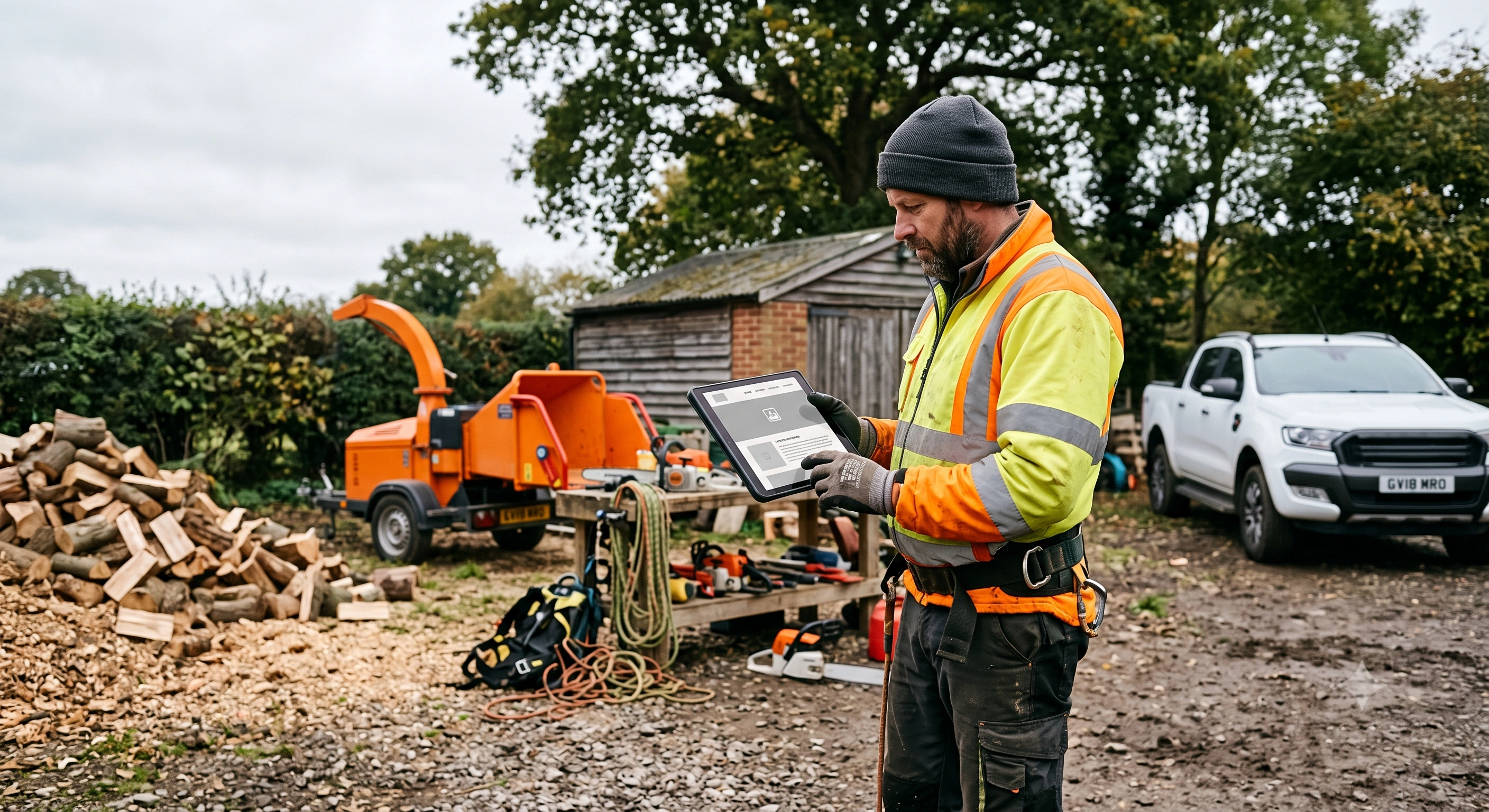
A qualified tree surgeon in Surrey turned away three enquiries in one week in January 2026 because potential clients couldn't verify his credentials online. Each caller had found his name through word-of-mouth but moved on to competitors who displayed their NPTC qualifications and public liability insurance on searchable websites. He lost an estimated £4,200 in work before reconsidering his digital presence.
No, tree surgeons do not need a website by law. No UK statute, EU regulation, or primary legal source mandates that tree surgeons maintain a website or any specific digital presence. The requirement is a commercial consideration, not a legal obligation—actual regulations focus on qualifications, insurance, and safety compliance, not online marketing channels.
Tree surgeon – a professional arboriculturist who specialises in the cultivation, management, and study of trees, shrubs, and other woody plants, typically holding recognised qualifications such as NPTC (National Proficiency Tests Council) certificates or Lantra Awards in arboriculture and tree work.
Key Takeaways
- No UK law requires tree surgeons to operate a website; legal obligations centre on qualifications (NPTC, Lantra Awards), public liability insurance, and Health and Safety Executive (HSE) compliance
- In 2025, 68% of UK consumers researched local services online before making contact, yet 31% of established tree surgeons still operated without a dedicated website
- Google Business Profile, trade directories (Checkatrade, TrustATrader), and social media can generate leads alone—but this approach leaves you competing on price rather than trust
- A professional website lets you display credentials (BS 3998 compliance, Arboricultural Association membership), handle quote requests 24/7, and show project portfolios that directories simply cannot match
- Basic tree surgeon websites cost £800 to £2,500 upfront, plus £100–£300 annually for hosting and domain—often recovered after two or three additional jobs
Is There a Legal Requirement for Tree Surgeons to Have a Website?
No legal requirement exists. Tree surgeons in the United Kingdom face no statutory obligation to maintain a website, digital storefront, or online presence of any kind. The Arboricultural Association, the professional body for tree care practitioners, does not mandate websites for members. The Health and Safety Executive (HSE), which governs workplace safety under the Health and Safety at Work Act 1974, requires documentation of risk assessments, insurance certificates, and competency records—but specifies no format or publication method for those documents. The Forestry Commission regulates tree felling through the Forestry Act 1967 and requires a felling licence for most trees above five cubic metres, yet imposes no requirement to disclose that licence digitally.
What Are the Actual Legal Requirements for Tree Surgeons?
Qualifications, insurance, and safety standards form the legal bedrock. The NPTC administers competency assessments in chainsaw operation, aerial tree work, and stump grinding; Lantra Awards offers equivalent certifications. Neither qualification is legally mandatory for all tree work. Here's the practical catch: insurance providers typically refuse public liability cover without recognised certificates, and local authorities frequently specify NPTC certification in contract tenders. Miss this, and you're locked out of commercial work even if no statute explicitly forbids it.
Public liability insurance occupies an odd legal position. Not technically required by statute, it functions as a de facto necessity—most clients (residential and commercial) will not proceed without proof of cover, typically £5 million minimum for tree surgery work. The moment you hire a single employee, even part-time or seasonal, Employer's Liability insurance becomes a legal requirement under the Employers' Liability (Compulsory Insurance) Act 1969. That's non-negotiable.
Safety enforcement falls to the HSE under the Work at Height Regulations 2005 and the Provision and Use of Work Equipment Regulations 1998 (PUWER). You must conduct risk assessments, maintain equipment inspection records, and provide personal protective equipment. The Control of Substances Hazardous to Health Regulations 2002 (COSHH) govern petrol, two-stroke oil, and wood preservatives. None of these specify how—or whether—you communicate compliance to potential clients. But the HSE does inspect records, and poor documentation can result in enforcement notices or prosecution.
Tree preservation orders (TPOs) and conservation area restrictions apply to specific trees, not to practitioners. A tree surgeon does not need a licence to work on TPO-protected trees, but the property owner must obtain consent from the local planning authority before work begins. Felling licences under Section 9 of the Forestry Act 1967 apply to property owners or those instructing the work, not to the tree surgeon executing it—though in practice, tree surgeons often manage the application process on a client's behalf.
Do Tree Surgeons Need Professional Memberships or Trade Body Registration?
Membership in the Arboricultural Association, the International Society of Arboriculture (ISA), or the Trust Mark scheme is entirely voluntary but commercially valuable. The Arboricultural Association maintains a directory of approved contractors who meet minimum standards: £5 million public liability insurance, relevant NPTC qualifications, and adherence to British Standard BS 3998:2010 (Tree Work – Recommendations). Directory listing raises visibility but does not replace a website—the association's search tool displays only basic contact details and a short description, with no space for portfolios, testimonials, or service explanations.
Trust Mark, a government-endorsed quality scheme, includes tree surgery under its "gardening and landscaping" category. Registration requires proof of insurance, qualifications, and compliance with consumer protection regulations, plus an annual inspection. Trust Mark members receive a profile on the scheme's website, but this is a directory entry, not a controlled digital presence.
British Standard BS 3998:2010 and BS 5837:2012 (Trees in Relation to Design, Demolition and Construction) set technical guidelines for tree work and construction near trees. Compliance is not legally required except where a contract or planning condition explicitly references the standards—but specifying adherence to BS 3998 in marketing materials signals professionalism and can justify premium pricing.
What Do Tree Surgeon Customers Actually Look For Before Hiring?
Credentials verification ranks first. A 2025 survey by the Arboricultural Association found that 74% of residential clients checked a tree surgeon's qualifications before requesting a quote. Clients want to see NPTC or Lantra certificates, public liability insurance (with an expiry date), and membership in a recognised trade body. A scanned certificate on a website provides instant reassurance; without one, clients must request documents by email or wait for a printed copy during a site visit. That delay alone costs jobs—impatient clients move to the competitor who can show credentials in 30 seconds.
Reviews and testimonials follow closely. Google reviews visible on a Business Profile carry significant weight—83% of respondents in the same survey said they would not contact a tree surgeon with fewer than ten reviews or a rating below 4.0 stars. Third-party reviews on Checkatrade, TrustATrader, or Bark provide additional social proof. A website allows you to curate testimonials with project details (tree species, work type, location) that generic review platforms cannot accommodate.
Response speed matters enormously. Enquiries submitted through a website contact form generate an automatic confirmation email, reassuring the client that their request was received. Tree surgeons who rely solely on telephone contact or unmonitored email accounts risk losing impatient clients to faster-responding competitors. A website with a quote request form, integrated calendar, or live chat function reduces response time and captures enquiries outside business hours—converting the 9 PM weekend browser into an actual lead.
How Do Customers Search for Tree Surgeons Online?
Local search dominates overwhelmingly. The phrase "tree surgeon near me" generates approximately 18,000 UK searches per month; "tree surgeon [town name]" accounts for thousands more. Google's local pack—the map and three business listings at the top of search results—captures the majority of clicks. A complete Google Business Profile (with verified address, service categories, photos, and reviews) appears in the local pack regardless of website ownership, though Google prioritises businesses with linked websites when ranking positions within the pack.
Directory sites capture significant traffic but fragment your audience. Checkatrade, Rated People, MyBuilder, TrustATrader, and Bark rank highly for generic tree surgery searches. These platforms operate on pay-per-lead or subscription models; you receive enquiries but compete with multiple other contractors responding to the same lead. Most clients submit the same enquiry to three or more tree surgeons simultaneously, reducing conversion rates and forcing price competition.
Social media, particularly Facebook, drives referrals and discovery. Local community groups and neighbourhood pages frequently feature requests for tree surgeon recommendations. A tree surgeon with an active Facebook Business Page can respond directly to these posts. Without a website, potential clients must navigate to your Facebook page and scroll through posts to find service descriptions, pricing guides, or credentials—friction that loses visitors.
Direct website visits remain a minority channel but carry the highest conversion value. A client who types your business name into a search engine or visits a bookmarked URL has already decided to investigate you specifically. These visitors convert at higher rates than directory leads because they are not simultaneously comparing multiple providers. A website optimises this high-intent traffic; a missing or poorly designed website squanders it.
Can Tree Surgeons Get Enough Business Without a Website?
Yes. Many do. Tree surgeons with strong local reputations, decades of established client relationships, and consistent word-of-mouth referrals often operate successfully without websites. A 2025 industry survey found that 31% of UK tree surgeons with turnover above £50,000 per year did not maintain a dedicated website. These businesses rely on Google Business Profile, directory listings, repeat clients, and referrals from landscapers, builders, and estate agents. Still, that means 69% of similarly established competitors have chosen to build one—often because they found that directories and social media alone left them competing against price-hungry strangers rather than attracting loyal, trust-based clients who value professionalism.
Geography shapes whether you actually need a website. Rural areas with two or three qualified tree surgeons in a 20-mile radius leave clients with limited choice—they'll rely on personal recommendation and whoever picks up the phone. A well-maintained Google Business Profile with strong reviews often handles the job. But move to suburban or urban terrain where a single postcode might hold ten or more competitors, and a website becomes harder to skip. Without one, you're fighting for differentiation on reputation alone.
Your client type matters just as much. A homeowner with a fallen oak after a storm will call the first tree surgeon who answers, website or not. Commercial clients—property management companies, councils, schools, hospitals—work differently. They issue formal tenders requiring written submissions. Here's the thing: procurement officers expect to find detailed service pages, case studies, equipment lists, health and safety policies, and proof of insurance. A website doesn't guarantee you'll win the contract, but its absence slows the vetting process and signals you're not set up for larger work.
Pricing power correlates with digital presence. Without a website, you compete almost entirely on price, because clients have no way to evaluate your expertise, equipment investment, or qualifications. A website lets you justify premium rates by explaining advanced rigging techniques, investment in low-impact equipment (tracked access platforms, noise-reduced chippers), compliance with BS 3998, and post-work habitat surveys for protected species.
What Are the Alternatives to Having a Website?
A fully optimised Google Business Profile is the single strongest alternative. Include your business name, verified address, phone number, service categories (tree surgeon, stump grinding, hedge trimming), hours, high-quality photos of completed work, and regular project posts. Google rewards complete profiles with higher visibility in local pack results and Google Maps. The Q&A feature lets potential clients ask questions directly. Reviews provide social proof. None of this requires a website—but it does require consistent upkeep.
Third-party directories trade flexibility for credibility. Checkatrade charges roughly £1,200 annually, plus a percentage of lead value. TrustATrader and Rated People operate on pay-per-lead models (£5 to £30 per enquiry depending on job value and location). You gain instant credibility through verified reviews and trade body checks. The downside: standardised listings with minimal space for detailed service explanations, no blog content or educational material, and zero control over branding or user experience. You're renting visibility, not building it.
Social media—particularly Facebook and Instagram—substitutes for a website if you're willing to post regularly. Before-and-after photos, short videos of rigging techniques or large tree dismantling, client testimonials. Facebook allows direct messaging and quote requests. Instagram's visual format suits dramatic imagery: crane-assisted removals, ancient oak pruning, habitat restoration. But algorithms shift unpredictably, limiting organic reach. Posts vanish into archives. A Facebook page never becomes the permanent reference library a website can be.
Word-of-mouth and vehicle signage remain foundational, especially in tight-knit communities. A liveried van displaying contact details, service list, and trust marks (Arboricultural Association logo, NPTC badge) generates enquiries wherever it parks. Local newspaper advertising, community noticeboards, leaflet drops—these still work in pockets, though their reach has declined sharply as younger homeowners (the 30–50 age group most likely to own property with mature trees) search almost exclusively online.
You can combine these channels to avoid website costs entirely. Google Business Profile plus one paid directory plus a weekly Facebook post plus professional van signage costs roughly £2,000 annually—substantially less than a custom website. Except this multi-platform approach demands consistent management across separate systems. You lose a centralised hub for detailed information. And you sacrifice the authority signal that a professional website projects, which matters when competing for premium contracts.
What Are the Real Benefits of Having a Website as a Tree Surgeon?
Credibility separates you from unqualified operators and casual "man-with-a-chainsaw" traders. A professional website lets you display scanned NPTC certificates, insurance documents, risk assessment templates, and Arboricultural Association membership. In a sector where unlicensed work is common, this transparency moves the needle. Clients comparing three quotes gravitate toward whoever documents qualifications and safety procedures openly.
Lead generation runs 24/7. A website captures enquiries at 10pm on Sunday or 6am on a bank holiday when your phone is silent. A contact form with service checkboxes (tree felling, crown reduction, stump grinding, hedge trimming) and a free-text job description field pre-qualifies leads and eliminates time wasted on unsuitable work. Add a calendar booking tool (Calendly, SimplyBook.me) and you eliminate phone tag entirely—clients schedule site visits directly.
Service explanation depth is impossible in directory listings. Dedicate a page to tree felling (covering TPO obligations and felling licences). Another to crown reduction and thinning (BS 3998 recommendations, seasonal timing). Stump grinding gets its own page—removal vs grinding vs chemical treatment, with trade-offs. Emergency tree work demands a detailed page explaining response times, dangerous tree assessment, and storm damage protocols. Each page can include FAQs, photo galleries, and diagrams that educate clients and eliminate repetitive phone questions.
Portfolio pages build tangible confidence. Categorise projects—large oak removals, veteran tree surgery, TPO-protected work, construction site tree protection. Caption each before-and-after photo with species, work performed, equipment used, duration. Embed videos showing rigging techniques, chipper operation, or site restoration. This kind of documentation reassures clients about your professionalism and care in ways that a five-star review cannot.
"A professional website transforms a tree surgeon from a casual tradesperson into a specialist contractor. Clients instinctively trust a business that invests in transparent credibility and clear communication."
Does a Website Help Tree Surgeons Charge Higher Prices?
Indirectly, yes. A website doesn't inflate market rates for a standard crown reduction, but it enables premium positioning. Clients willing to pay above-market rates want reassurance that the cost reflects superior expertise, not just higher markup. A website provides space to justify that premium: detailed safety procedures (risk assessments, aerial rescue training, first aid certification), environmental considerations (habitat surveys, deadwood retention, bat and bird nesting checks), and British Standards compliance.
Service justification pages convert price objections into value recognition. A "Why We Cost More" page explains investment in tracked access platforms that protect lawns (versus manual handling across turf), low-emission chippers that reduce noise disturbance, full site restoration (turf repair, mulch removal, debris clearance). Clients who understand these distinctions shop on value, not price alone.
Detailed project case studies anchor client expectations. A project page titled "Oak Tree Removal in Conservation Area: £3,200" with photographs, timeline (two days including permit wait), equipment list (35-tonne crane, 12-inch chipper, stump grinder), and obstacles overcome (TPO application, neighbour access negotiation) educates potential clients about realistic pricing. Transparency filters out budget-conscious enquiries early and prevents sticker shock later.
Trust signals elevate perceived professionalism. Memberships (Arboricultural Association, ISA), certifications (NPTC CS30, CS38, CS39), and generous insurance coverage (£10 million public liability instead of the standard £5 million) position you as a specialist, not a generalist. Premium pricing becomes defensible when credentials are immediately visible.
Can a Website Replace Traditional Advertising for Tree Surgeons?
Partially. A website combined with search engine optimisation can replace declining channels like local newspapers, yellow pages, and parish magazines. SEO-optimised service pages targeting "[town name] tree surgeon", "tree removal [county]", and "emergency tree work [area]" generate organic search traffic without recurring advertising costs. The catch: new websites typically need three to six months to gain traction, whereas paid advertising delivers visibility immediately.
Cost structure favours websites over time. A quarter-page newspaper advert costs £200–£600 per insertion; twelve monthly insertions reach £2,400–£7,200 annually. A professionally designed tree surgeon website costs £1,200–£2,500 upfront, then £100–£300 yearly for hosting and domain renewal. After year one, your cost-per-lead drops substantially while print advertising costs remain flat.
Longevity matters. Print adverts exist for one edition. Radio spots air for 30 seconds. A website page ranking on Google's first page for "tree surgeon [town]" generates leads continuously, day and night, for months or years. Blog posts ("When Should You Prune an Oak Tree?", "How to Identify Ash Dieback"), guides ("Tree Preservation Orders Explained"), and seasonal advice ("Storm Damage: What to Do Before Calling a Tree Surgeon") attract search traffic long after publication—something no print campaign can match.
Data transforms marketing from guesswork into strategy. Google Analytics tracks visitor numbers, pages viewed, enquiry form submissions, and referral sources. You identify which services generate the most enquiries, which blog posts drive traffic, and whether visitors arrive from Google, Facebook, or directories. Print and radio advertising offer no equivalent insight—clients rarely volunteer how they found you.
Van signage and local sponsorships keep their value. A liveried van parked in a village during a visible job becomes a moving billboard, generating neighbourhood enquiries. Sponsoring a local football team, village fete, or community woodland project builds goodwill that no website replicates. The strongest approach combines a website as your central information hub with selective offline touchpoints.
What Should a Tree Surgeon Website Include to Be Effective?
Put your credentials front and centre on the homepage. Visitors land on your site with one question in mind: are you qualified and insured? They shouldn't have to dig for the answer.
- Scanned NPTC certificates—CS30 (chainsaw maintenance), CS31 (felling small trees), CS38 (aerial tree rescue), CS39 (aerial cutting using free-fall techniques). Include whichever apply to your scope.
- Insurance certificates showing public liability (minimum £5 million) and employer's liability where applicable, with expiry dates clearly visible. Expired certificates kill credibility instantly.
- Trade body memberships with clickable logos linking to verification—Arboricultural Association, ISA, Trust Mark. Clients often verify these.
- Health and Safety compliance: statement confirming adherence to Work at Height Regulations 2005 and PUWER 1998
Service pages require depth, not a catchall list. Generic "Services" pages convert nobody; separate pages for each core offering let you speak directly to what each client needs.
- Tree felling and removal — cover the legal terrain (TPOs, conservation areas, felling licences), your methods (sectional dismantling, crane-assisted removal), and what happens after (site restoration). Clients often don't realise they'll need a felling licence; explaining this upfront positions you as professional, not just another contractor.
- Crown reduction and thinning — reference BS 3998 standards, mention seasonal constraints (avoid pruning oaks March–October due to oak wilt risk), and distinguish aesthetic from structural work. Homeowners sometimes expect year-round pruning; knowing your limitations builds trust.
- Stump grinding — compare depths (surface-level vs below-ground), note replanting implications, and mention chemical alternatives.
- Emergency tree services — storm damage response, dangerous tree assessment, 24-hour availability, insurance claim support. People in crisis need reassurance you'll actually answer the phone.
- Hedge trimming and maintenance — domestic vs commercial scope, frequency guidance, and wildlife calendar (nesting bird season March–August). Many homeowners don't realise they're breaking the law cutting during nesting season.
Local search visibility depends on specificity. Rather than vague language, write naturally into your service pages: "We provide tree felling services across Surrey, including Guildford, Woking, Farnham, and surrounding villages." A dedicated service area page with an embedded Google Map signals legitimacy and improves Map Pack visibility.
Your portfolio is your proof. Organise a gallery by project type—residential tree removal, commercial site clearance, TPO-protected work, veteran tree surgery—and let the images speak. Each project entry should include:
- Tree species and size (e.g., "80-year-old oak, 18 metres height")
- Work carried out—crown reduction, sectional dismantle, stump grind
- Location (town or neighbourhood, never full address)
- What made it tricky—tight access, neighbour considerations, TPO complexities
- Duration and approximate cost range
Testimonials matter most when they're specific. Compare these two: "John removed a dangerous ash tree and left the site immaculate—highly recommend" versus "John dismantled a 15-metre ash tree with suspected dieback in our Godalming garden. He applied for the felling licence, protected our flower beds with ground mats, and ground the stump 30cm below surface for replanting. £1,400, completed in one day." The second tells a story; the first is noise.
No website, or a weak one?
Get a site that wins tree work
We build fast, mobile-first websites for UK tree surgeons that turn visitors into enquiries. Book a free, no-obligation call.
Your About page should introduce the principal tree surgeon by name, outline qualifications and years in business, and explain what drives your practice. Skip empty phrases like "passionate about trees"—instead state facts: "trading since 2018, completed over 450 residential and commercial projects across Surrey." Contact page needs phone, email, contact form, business address (helps local SEO and reassures clients you're established), and business hours. People want to know they can reach you.
A blog or advice section pulls search traffic and demonstrates you know your field. Short, practical articles answering the questions people actually type into Google rank well:
- "When Can You Legally Fell a Tree in Your Garden?" — covers felling licences, TPOs, conservation areas
- "How Much Does Tree Surgery Cost? Price Guide 2026" — typical costs for common jobs and pricing variables
- "Identifying Ash Dieback: What to Look For and What to Do" — symptoms, reporting, treatment options
- "Do I Need Planning Permission to Prune a Tree?" — TPO process, conservation rules, neighbour disputes
Target one specific question per article, use relevant keywords naturally, and link back to related service pages. Two to four articles yearly suffices—quality and relevance beat frequency.
How Much Does a Tree Surgeon Website Cost and How Long Does It Take?
Website costs depend on design complexity, functionality, and whether you choose a template, builder, or custom developer. Here's realistic UK pricing for 2026:
| Website Type | Cost Range | Timeline | Suitable For |
|---|---|---|---|
| DIY website builder (Wix, Squarespace) | £150–£400 (annual subscription) | 1–2 weeks | Solo operators comfortable with technology; limited time to learn platform |
| Template-based WordPress (freelancer) | £800–£1,500 | 2–4 weeks | Established tree surgeons needing professional design without custom features |
| Custom WordPress (agency) | £2,000–£4,500 | 4–8 weeks | Growing businesses wanting tailored design, SEO optimisation, lead generation tools |
| Ongoing costs (hosting, domain, maintenance) | £100–£300/year | Annual | All website types; higher for managed hosting or monthly updates |
The reality: DIY builders work for budget-conscious operators willing to invest time; template freelancer sites offer best value for most tree surgeons; custom agency builds justify cost only if you need advanced features like booking systems or CRM integration.
DIY builders (Wix, Squarespace, GoDaddy) charge annual subscriptions starting around £150 for a basic plan with custom domain and no platform branding. Drag-and-drop editors and mobile-responsive templates come built in, plus basic SEO tools. The cost is your time—expect 10–20 hours learning the platform, writing copy, sourcing photos, and configuring settings. Updates and content changes stay your responsibility indefinitely.
Freelancer-built template sites use WordPress with pre-designed themes customised for your business. A freelance designer typically charges £800–£1,500 for a five- to seven-page site (homepage, service pages, about, contact, gallery). They handle domain, hosting, SSL certificate setup; install and customise the theme; add your content and photos; and configure basic SEO. You can edit text and add photos through the WordPress dashboard afterward, though major design changes require developer help.
Custom-built sites involve bespoke design and advanced functionality. A digital agency charges £2,000–£4,500 for a fully unique tree surgeon website—not a template—with local SEO optimisation (service area pages, Google Business Profile integration, citation building), lead generation tools (quote calculator, booking system, automated responses), and content strategy (initial blog posts, keyword research). Build time extends to six to eight weeks because of design revisions, content creation, and technical integrations. Choose this route if you're treating your website as a core marketing asset, not just an online brochure.
Ongoing expenses include domain (£10–£15/year), hosting (£50–£200/year depending on performance), SSL certificate (often included), and maintenance (plugin updates, security patches, new content). DIY builders bundle these into subscription fees; self-managed WordPress sites require separate payments. Some tree surgeons pay £30–£100/month for managed updates and backups, ensuring security and functionality without technical headaches.
Break-even happens when your website generates one or two extra jobs monthly. If average job value is £800 and you land two additional clients monthly, annual revenue rises by £19,200—easily covering a £2,000 build and £200 running costs. Most tree surgeons hit break-even within three to six months of launching an optimised site.
Published by Tree Surgeon Leads UK, a specialist marketing and lead generation agency working with UK tree surgeons.
Frequently Asked Questions
Do tree surgeons legally need a website in the UK?
No. UK law requires qualifications (NPTC or Lantra certificates), public liability insurance, employer's liability insurance (where applicable), and HSE compliance—but not a website. A website is a business decision, not a legal mandate. That said, it significantly aids credential verification and client acquisition, especially in competitive urban markets.
Can a tree surgeon succeed without a website?
Yes. Many tree surgeons build steady work through Google Business Profile, word-of-mouth referrals, directory listings (Checkatrade, TrustATrader), and social media. Rural areas with lower competition make this easier. Except—established businesses with decades of reputation have an advantage that most new or mid-sized operators lack. If you're competing for commercial contracts or operating in an urban area, a website moves you ahead of competitors still relying on word-of-mouth alone.
How much should a tree surgeon spend on a website?
A freelance designer can build you a template-based website for £800–£1,500, then charge £100–£300 annually to keep it running. Custom agency work costs more—£2,000–£4,500—but throws in SEO and lead generation tools that often pay for themselves. DIY builders (Wix, Squarespace) stay cheap at £150–£400 per year, though you'll lose hours learning the software.
Most tree surgeons get the best return with a freelancer-built template. You avoid the DIY time sink. You skip the agency markup. And you still get a site that ranks and converts.
What must be included on a tree surgeon website?
Clients need proof before they hire you. Scan your NPTC and Lantra certificates directly into the site. Display your public liability insurance with the expiry date visible—missing this kills deals. List memberships (Arboricultural Association, Trust Mark) because these filter out the one-man crews in a customer's mind.
Then build separate pages for what you actually do: tree felling. Crown reduction. Stump grinding. Emergency callouts. Each service gets its own section because Google ranks them differently, and your customer might search for just one.
Before-and-after photos matter more than you'd think. Include them. Add testimonials that name the project and the outcome, not just "Great job!" Mention your service area by postcode so local searches find you. And make your phone number clickable.
Does a website help tree surgeons charge more?
Yes, but only if you explain *why* your quote is higher than the next guy's.
A website gives you that space. Write about BS 3998 compliance—most customers have never heard of it, which means they don't know they should care. Show your tracked access platforms and noise-reduced chippers. Explain that you run habitat surveys and check for nesting birds before you touch a branch. Describe how you restore the site afterward.
Once a customer understands these details, they stop shopping by price. They shop by value. That's when your rates stick.