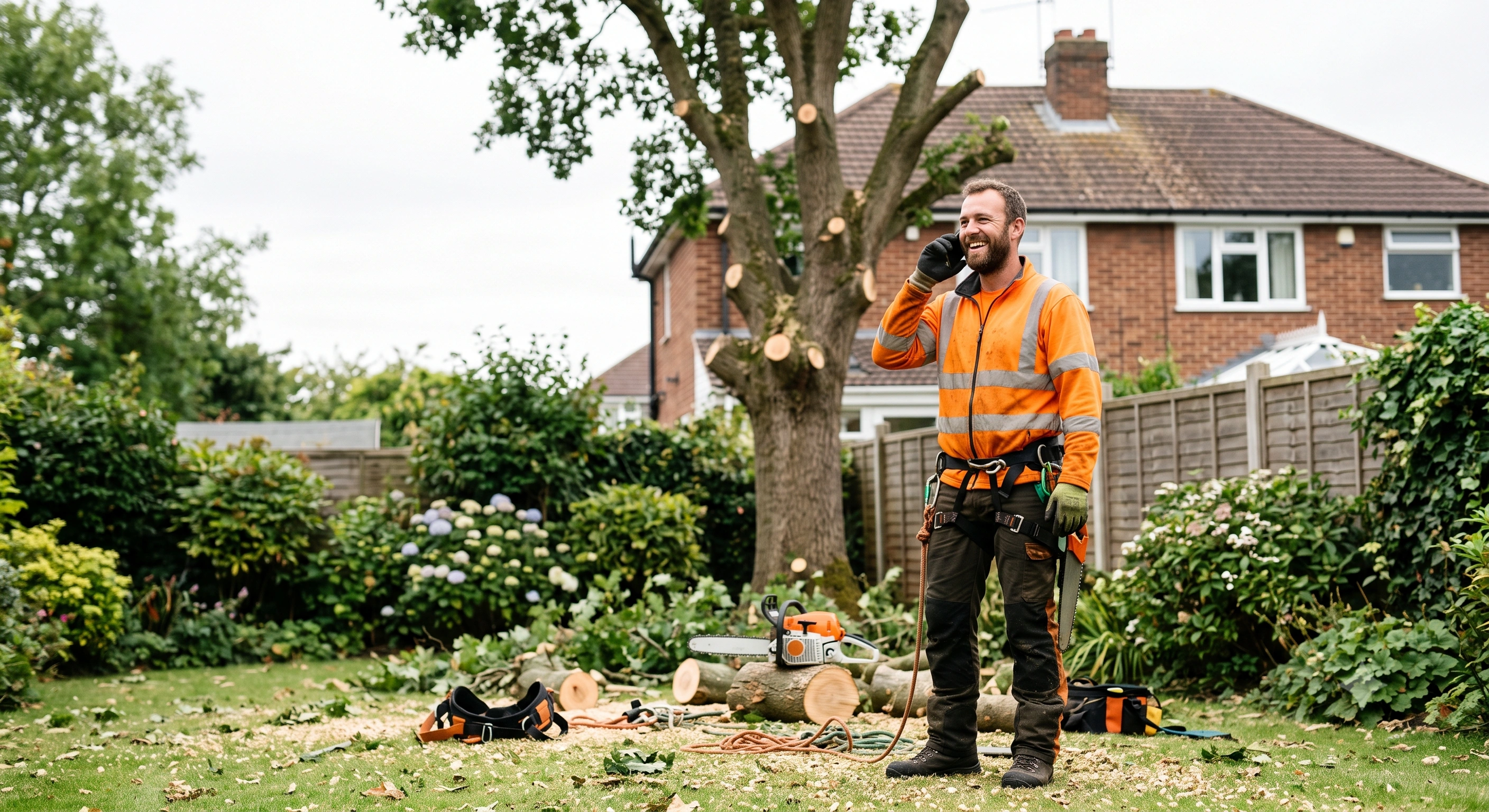
A Lancashire tree surgeon spent £840 on shared leads in January 2026 and closed three jobs. His competitor, working the same postcodes, invested £600 in exclusive enquiries and closed five. Both served identical job types—crown reductions and section felling—yet one model returned nearly double the revenue per pound spent.
Exclusive leads typically convert at 20–33%, cost £75–200 each, and deliver three to four times the close rate of shared leads, which convert at 8–12% and cost £15–45 per enquiry. For established tree surgery businesses with proven closing skills, exclusive leads generate higher ROI despite the upfront premium. Newer operators building pipeline volume often find shared leads offer lower entry cost and faster learning cycles—though the time spent quoting non-converting leads can offset those savings.
Exclusive leads are homeowner or commercial property enquiries sold to a single tree surgery contractor, with no competing bids from other arborists. Shared leads are the same enquiry distributed simultaneously to three to eight tree service providers, creating a price-driven competitive environment from first contact.
Key Takeaways
- Exclusive tree surgeon leads convert at 20–33%, shared leads at 8–12%, according to non-official home services industry platforms.
- Exclusive leads cost £75–200; shared leads £15–45. Cost-per-job—not cost-per-lead—determines which actually saves money.
- No government body tracks or regulates lead distribution quality in the UK tree surgery sector. The Forestry Commission, HSE, and Arboricultural Association publish nothing on this.
- Shared leads suit new businesses building volume. Exclusive leads favour established firms with higher close rates and predictable cash flow.
- Strategic switching works seasonally: shared leads during high-demand storm-damage periods when volume matters; exclusive during quieter pruning months when consultative selling wins contracts.
What Are Exclusive and Shared Tree Surgeon Leads?
An exclusive lead is straightforward: one homeowner or commercial property enquiry, one tree surgery business. When a property owner submits a request through a lead-generation platform—via organic search, pay-per-click advertising, or directory listing—the platform routes that enquiry to a single contractor who paid for exclusivity. No competing tree surgeons receive the contact details, job description, or customer phone number. You own the opportunity outright and face no immediate price competition from other arborists bidding the same work.
Shared leads work differently. The identical enquiry reaches multiple contractors simultaneously. Most platforms send the same job request to three, five, or eight tree surgery companies at once—all within seconds of one another. Each contractor receives the homeowner's name, postcode, preferred contact method, and job description. Crown reduction, tree removal, stump grinding, hedge work. The result is a race: whoever calls first, quotes fastest, or undercuts on price typically wins.
Lead distribution mechanics follow a tiered subscription model. Platforms capture enquiries through search engine optimisation, Google Local Services Ads, and comparison directories, then allocate them based on what the contractor pays. Higher-paying subscribers get exclusive access; budget-tier members share the same pipeline with competitors. Real-time matters enormously: leads delivered within minutes of submission convert at nearly double the rate of aged leads circulating for hours or days.
How does lead distribution work in the tree care industry?
Lead-generation companies rank prominently for high-intent keywords—"tree surgeon near me," "emergency tree removal [town]"—and intercept the enquiry at the moment a property owner searches. They monetise it by selling access to contractors. The homeowner often does not realise their request will reach multiple businesses unless the platform discloses this in its terms, which many do not.
Subscription level and per-lead pricing determine exclusivity. An exclusive lead typically costs four to six times more than a shared lead because you eliminate competition and increase conversion probability. Shared-lead buyers accept lower per-lead cost in exchange for higher rejection rates, slower response times from overloaded homeowners, and price negotiation starting from the first conversation.
Timing is critical. A lead delivered within five minutes converts at nearly double the rate of one delivered an hour later—the homeowner remains engaged, hasn't yet fielded three competing phone calls, and hasn't formed price expectations from rival quotes. Aged leads recycled days after submission convert poorly, yet some platforms bundle them into budget packages without disclosure. That's a trap worth avoiding.
How Do Conversion Rates Compare Between Exclusive and Shared Tree Surgeon Leads?
Exclusive leads convert at approximately one in three to one in five (20–33% close rate), whilst shared leads convert at one in eight to one in twelve (8–12%). These figures come from non-official data published by home services marketing platforms operating in the UK and US markets, not from government agencies, the Arboricultural Association, or any regulatory body.
Exclusive tree surgeon leads convert at 20–33%, nearly triple the 8–12% close rate of shared leads, because the contractor controls the sales conversation without immediate price competition.
Conversion rate means the percentage of purchased leads that result in a signed contract and completed job. A 20% conversion rate means that for every ten exclusive leads purchased at £100 each (£1,000 total spend), two jobs close. If those jobs average £800 in revenue, you generate £1,600 from £1,000 in lead cost—a 60% gross margin before labour and materials.
The same £1,000 spent on shared leads at £25 each buys 40 enquiries. At 10% conversion, four jobs close, generating £3,200 revenue. But here's the catch: you've spent vastly more time quoting those non-converting leads. Forty site visits instead of ten. Forty quote documents instead of two. Forty follow-up calls instead of two.
What drives conversion? Response time (calling within five minutes increases close rate by 40–50% compared to one-hour delays). Geographical proximity (contractors within three miles of the job site win more often than those ten miles away). Pricing that matches local market rates. Service specialisation—certified arborists with BS3998 qualifications close complex dismantles more reliably than general tree cutters.
What is the typical conversion rate for shared leads?
The 8–12% benchmark reflects price-shopping behaviour. A property owner who receives five phone calls within ten minutes of submitting an enquiry frames the decision as a price comparison, not a service quality assessment. The first contractor to call may spend fifteen minutes explaining BS5837 constraints and tree preservation order implications, only for the homeowner to thank them politely and ring off to hear four cheaper quotes.
Lead fatigue makes it worse. By the third or fourth phone call, homeowners grow irritated, stop answering unknown numbers, or default to the lowest price without considering insurance cover, HSE compliance, or waste carrier licensing. Contractors report that homeowners often forget which company they spoke with, confuse quotes, and fail to return calls—behaviours rare with exclusive leads, where the property owner expects and welcomes a single follow-up conversation.
Cost-per-acquisition tells the real story. Ten shared leads at £30 each (£300 total) converting at 10% yield one job. Four exclusive leads at £120 converting at 25% also yield one job but cost £480 total. Shared leads appear cheaper. Except they demand ten site visits, ten estimates, and ten follow-up calls. Four exclusive leads require four site visits, typically involving longer consultative conversations that allow you to upsell additional work and justify the premium you charged upfront.
Do exclusive leads really convert better than shared leads?
Yes. The 20–33% conversion advantage aligns with contractor experience in the UK tree surgery sector. Exclusive-lead buyers report longer phone conversations (eight to twelve minutes versus three to five for shared leads), higher willingness from homeowners to schedule site surveys rather than request instant phone quotes, and greater receptivity to premium services such as BS3998-compliant pruning, root protection area surveys, and ongoing tree management contracts.
Reduced competition enables consultative selling. When a homeowner knows they are speaking with one vetted contractor rather than entering a bidding war, the conversation shifts. "What's your cheapest price?" becomes "What do you recommend for this oak tree near the house?" You can educate them on structural pruning, target pruning to British Standards, and long-term tree health without fear that a competitor will undercut you five minutes later with a price-only quote that ignores standards.
Time investment per lead remains higher—site visits average forty-five minutes compared to twenty minutes for rushed shared-lead quotes—but the close rate justifies it. Working exclusive leads means allocating calendar time for thorough assessments, written quotes with photographs and species-specific recommendations, and follow-up emails explaining insurance cover and HSE compliance. One in three will convert. One in ten won't justify the effort.
What Are the Real Cost Differences Between Exclusive and Shared Tree Leads?
Shared lead pricing in the UK ranges from £15 to £45 per enquiry. Small pruning jobs cluster at £15–25; large conifer removals and oak dismantles reach £35–45. London and South East postcodes command premiums over rural Scotland or Wales. Exclusive lead pricing spans £75 to £200+, with emergency storm-damage work and commercial site clearance at the upper end, routine hedge trimming or small crown lifts at the lower bound.
Break-even analysis determines which model generates profit. A contractor paying £30 per shared lead and converting at 10% spends £300 to win one job. If that job invoices at £600, gross margin before labour and materials is £300 (50%). The same contractor buying exclusive leads at £120 and converting at 25% spends £480 per closed job (four leads purchased, one converted). If the job invoices at £800—because the homeowner agreed to additional stump grinding and chipping services during the consultative site visit—gross margin is £320 (40%). Revenue per job is higher; margin percentage is slightly lower. The tradeoff depends on your overhead costs and whether you have spare capacity.
Hidden costs hide in plain sight. A tree surgeon spending three hours daily driving to shared-lead site visits—measuring trees, photographing decay, writing estimates—might handle ten enquiries weekly and close just one job. That's a 10% conversion rate for work that doesn't generate revenue until the estimate becomes a signed contract. Take those same three hours and apply them to four exclusive leads instead: longer consultations, detailed written proposals, one job closed with time left over for actual billable tree work. The gap between these two scenarios is the opportunity cost of chasing shared leads—the work you could have done instead.
How much should I pay for an exclusive tree surgeon lead?
Regional variation is real. Greater London, Birmingham, Manchester, and Bristol postcodes see exclusive leads priced at £120–180 for standard residential work like crown reduction, pollarding, or section felling. Move to rural areas—Cumbria, Northumberland, Devon, Cornwall—and the same jobs cost £75–120. Lower local competition means platforms have less pricing power. Emergency work is different: a storm-damaged tree blocking a road or crushing a conservatory roof may cost £200–250 as an exclusive lead because homeowners convert immediately and rarely negotiate price.
Job value should drive your spending decision. A crown reduction on a mature oak—worth £800–1,200 in invoice terms—justifies a £150 exclusive lead. Hedge trimming valued at £200–300 does not. Calculate your maximum acceptable lead cost as 10–15% of expected job value for exclusive leads (a £100 lead cost on an £800 job = 12.5%) and 5–8% for shared leads. Pay beyond these thresholds and you erode margin unless your conversion rates exceed industry averages.
Exclusive leads unlock upsell opportunities that shared leads rarely deliver. A homeowner requesting crown reduction on one oak may agree to reducing a second tree, grinding three stumps, and scheduling an annual inspection—turning a £600 base job into a £1,400 package. That conversation happens because you consulted rather than competed on price. Shared-lead buyers quoting on price alone rarely upsell; the homeowner has already framed the purchase as a commodity transaction.
Which Lead Type Makes Sense for Different Business Stages?
New tree surgery businesses should start with shared leads. Sole traders and partnerships in their first two years lack the cashflow to afford £150 per exclusive lead when working capital is tight and the operator is still refining estimating skills. Shared leads provide twenty to thirty opportunities monthly at manageable cost. Volume matters here: you'll practice site assessments, test pricing strategies against competitors, and discover which job types convert best—learning that costs money in real time.
Established companies—five or more employees, dedicated crews, predictable monthly revenue—gain more from exclusive leads. When you close at 30–40% (typical for experienced estimators), investing £600–800 weekly in premium leads makes sense. Three to four jobs weekly from exclusive leads, plus time freed from unproductive quoting, allows you to focus on crew management and strategic growth instead of chasing price shoppers.
Seasonality changes the equation. Autumn and winter storm seasons create urgency: homeowner demand for emergency removal surges, and shared leads convert at 15–18% because the homeowner needs it done, not cheap. Platforms flood with enquiries; even shared-lead buyers close multiple jobs daily. Spring and summer quieter periods shift toward planned crown reductions and TPO applications—work where homeowners research thoroughly and value expertise over lowest price. Exclusive leads win in these months.
Commercial and residential work are different animals. Commercial leads—local authority contracts, housing developer clearance, utilities vegetation management—almost always justify exclusive purchase. Contract values range from £5,000 to £50,000+. Procurement favours detailed written tenders, and price is one factor among many: insurance, methodology, programme. Residential work for small jobs (£200–400 hedge trims, ivy removal, minor pruning) rarely justifies exclusive pricing.
Are shared leads worth it for new tree surgery businesses?
Yes. A newly qualified arborist or NPTC-certified climber launching their own business needs volume and learning simultaneously. Shared leads deliver both. At £20–35 per lead, you can purchase ten enquiries weekly (£200–350 spend) and close one job monthly even at 8% conversion. Four jobs per month at £600 average generates £2,400 revenue against £1,000 in lead cost—sustainable while you build reputation and your repeat-customer base.
The learning curve alone justifies the cost. Shared leads force you to estimate complex scenarios: trees near buildings, overhead cables, TPO constraints. You practice client communication under competitive pressure. You discover which job types your business can profitably serve. Losing shared-lead quotes teaches faster than winning them: you quickly learn you cannot compete on price with established firms for large oak removals requiring cranes and road closures—but may find a profitable niche in garden tree pruning or small conifer removals where lower overheads allow competitive pricing.
Watch for the graduation signal. Once you consistently convert shared leads at 12–15% (above industry average), maintain steady monthly revenue, and notice that quoting time exceeds billable time, test exclusive leads in limited volume: two to four weekly. Track close rates, revenue per lead, and total hours. If exclusive leads convert at 25%+ and generate higher per-job revenue, shift budget incrementally. Aim to reach 70–80% of lead spend on exclusivity once the numbers prove it works.
When should I switch to exclusive leads only?
Business maturity shows specific markers. Established local reputation (Google reviews, steady word-of-mouth referrals), five or more employees allowing you to delegate fieldwork, and predictable monthly cashflow of £15,000+ covering wages, equipment, insurance, and overheads. At this point, you no longer need high-volume low-conversion enquiries; you need high-probability opportunities that justify dedicated estimator time.
Closing percentage acts as your trigger. A contractor consistently closing 20–25% of shared leads should test exclusive leads immediately—your sales skill already exceeds average. If exclusive-lead conversion hits 30–40%, the business model shifts fundamentally: fewer leads purchased, higher investment per lead, more time per quote, but significantly higher revenue per closed job and far less wasted effort.
Market saturation sends clear signals. You receive the same shared lead from two different platforms (the enquiry was resold without disclosure). You encounter the same competitor names repeatedly on shared-lead quote lists. Homeowners tell you "fifteen tree surgeons have already called." These conditions mean your local market is over-served with shared-lead buyers. Standing out requires exclusive access to enquiries or abandoning platform leads entirely for organic marketing: website SEO, Google Business Profile optimisation, direct advertising to homeowners.
What Do the Numbers Really Tell Us About Lead Quality?
The figures you read—8–12% shared-lead conversion, 20–33% exclusive-lead conversion, £15–45 and £75–200 pricing brackets—come from private marketing platforms and industry blogs, not government agencies or peer-reviewed research. The Forestry Commission, Health and Safety Executive, Arboricultural Association, and Companies House do not collect or publish data on lead-generation practices in tree care. No official statistics exist, which means any claim about "industry averages" is someone's marketing assertion.
No legal framework governs lead quality or platform obligations. Unlike financial services (FCA-regulated) or claims management (FCA-regulated), tree surgery lead generation operates as a purely commercial transaction between private parties. Platforms set their own terms, define "exclusive" and "shared" however they choose, and face no statutory duty to verify homeowner intent, disclose resale practices, or guarantee lead accuracy. They operate under contract law, not sector regulation.
Verify leads yourself. Ask the homeowner directly during the first phone call: "How many tree surgeons are you speaking with?" or "Did you submit this enquiry through a comparison website?" Most homeowners answer honestly and appreciate the transparency. If they say "You're the fifth person to call today," you know the lead was shared despite platform claims. Track these outcomes in a spreadsheet over thirty days to audit platform honesty against their stated definitions.
Are there industry standards for lead quality?
No trade body, certification scheme, or standards organisation publishes quality benchmarks for tree surgeon leads. The Arboricultural Association accredits tree care businesses for technical competence—BS3998 compliance, HSE safety standards, insurance adequacy—but does not certify or regulate lead-generation platforms. No external body has jurisdiction here.
Private contractual terms between platforms and contractors define quality. These terms vary widely. One platform may promise "homeowner verified by phone before lead distribution"; another may send any enquiry containing a postcode and the word "tree." Refund policies are contractual, not statutory: platforms typically offer credits for demonstrably fake leads (disconnected phone numbers, commercial spam) but reject refund requests for "homeowner not ready to proceed" or "homeowner chose another contractor"—both classified as legitimate leads despite not converting.
Third-party verification rests with the contractor. Document every lead outcome: contacted and quoted, contacted but not interested, phone disconnected, wrong number, duplicate of previous lead, commercial solicitation. After thirty days, calculate your personal conversion rate and compare it to platform claims. If your conversion rate for exclusive leads sits at 12% whilst the platform advertises 25–30%, request data transparency or switch providers. This gap matters: it means you're overpaying by 50–150% per job closed.
How to Evaluate Tree Surgeon Lead Providers Before Committing
Request lead distribution transparency before purchasing. Ask explicitly: "If I buy an exclusive lead, will you sell this same enquiry to any other contractor, in any postcode, at any time?" and "How many contractors receive each shared lead?" Reputable platforms answer directly; evasive responses ("We optimise distribution to maximise your success") signal opaque practices. Request sample contract terms and refund policy in writing before paying any deposit or monthly subscription.
Examine refund and credit policies for specific exclusions. Most platforms refuse refunds for "non-responsive homeowners" or "homeowner changed their mind"—a reasonable boundary, since platforms cannot control whether a customer decides to hire you. Credits should be automatic, though, for disconnected numbers, duplicate leads sold twice to the same contractor, or enquiries with no contact information. Platforms that deny credits for objectively invalid leads are hiding their quality problems.
Verify geographical targeting actually works. A tree surgeon serving Berkshire and North Hampshire should not receive leads in Oxfordshire, Surrey, or Wiltshire unless explicitly requested. Some platforms define service areas broadly ("South East England") and distribute leads across a fifty-mile radius—which wastes your time on enquiries too distant to serve profitably. Specify maximum travel distance (e.g., "within fifteen miles of Reading") and test whether the platform honours this before committing.
Test both lead types in small batches before signing monthly contracts. Purchase ten shared leads and four exclusive leads over two weeks; track call answer rates, homeowner engagement, quote requests, close rates, and revenue per closed job. Calculate cost-per-acquisition for each type and compare against your average job value. If exclusive leads convert at 30% and generate £900 average jobs whilst shared leads convert at 10% and generate £550 average jobs, the ROI case for exclusivity becomes obvious despite higher per-lead cost.
Major platforms include Checkatrade, Bark, MyBuilder, Rated People, TrustATrader, and niche directories like ArborGold or TreeWork. Checkatrade operates a subscription model with homeowner-initiated enquiries; Bark uses a bidding system where contractors compete for shared leads. MyBuilder and Rated People sit between the two models. Request trial periods (many platforms offer first-month discounts) and evaluate lead quality, homeowner responsiveness, and platform support before scaling investment.
What should I ask a lead provider before buying?
Lead age determines whether you'll actually reach the homeowner. Real-time leads—delivered within five minutes of homeowner submission—convert at double the rate of leads delivered an hour later. Platforms that batch leads and distribute once daily, or worse, sell aged leads from previous weeks, waste contractor money because homeowners have already called competitors. Request confirmation: "Will I receive this lead within five minutes of the homeowner submitting the enquiry?" If the platform cannot guarantee real-time delivery, factor substantially lower conversion rates into your cost-per-job model.
Homeowner verification processes separate quality platforms from volume mills. Platforms that verify phone numbers, require postal address (not just postcode), and ask qualifying questions ("Do you own this property?" "When do you need the work completed?" "Have you received other quotes?") deliver higher-intent leads. Those accepting any submitted form without verification generate high volumes of spam, commercial solicitations, and non-serious enquiries. Ask: "What steps do you take to verify the homeowner is genuine and ready to hire?"
Exclusivity zone definitions require extreme clarity. Some platforms promise exclusive leads but define exclusivity as "one contractor per postcode sector" (e.g., RG1 5)—a geographic area that may contain 5,000 households. Others sell to one contractor per town or one per county. Ask: "If I buy an exclusive lead in Reading, will you sell the same lead to a contractor based in Wokingham?" and "Do you resell exclusive leads if the first buyer doesn't close the job?" Platforms that resell after 48 hours without disclosure undermine the exclusivity you paid for.
Tired of competing for the same lead?
Get exclusive tree work leads
We run Google and Meta campaigns for UK tree surgeons only. Every lead is yours alone — never shared, never resold. Book a free strategy call.
Published by Tree Surgeon Leads UK, a specialist marketing and lead generation agency working with UK tree surgeons.
Frequently Asked Questions
Can I negotiate for semi-exclusive leads with better conversion rates than shared leads?
Some platforms offer tiered exclusivity: limiting distribution to two or three contractors rather than eight. Semi-exclusive leads typically cost £45–75—midway between shared and fully exclusive pricing—and convert at 12–18%, better than standard shared leads but below full exclusivity. Availability varies: Bark and Rated People occasionally offer this tier, whilst Checkatrade operates subscription-only models with no per-lead exclusivity options. Negotiation becomes possible for high-volume buyers. Contractors purchasing fifty-plus leads monthly may secure reduced pricing or upgraded exclusivity as a retention incentive.
How do I calculate the break-even point for switching from shared to exclusive tree leads?
Break-even occurs when cost-per-job remains constant or decreases despite higher per-lead cost. Calculate current cost-per-job: (shared lead price × number purchased) ÷ jobs closed. If you buy twenty shared leads at £30 each (£600 total) and close two jobs, cost-per-job is £300. Model exclusive leads: if each costs £120 and you expect 25% conversion, you need five leads (£600 total) to close 1.25 jobs, yielding £480 cost-per-job—worse than shared. But if exclusive leads generate higher average job value (£900 vs. £600) due to upselling, revenue per closed job increases enough to justify the switch. Track both cost-per-job and revenue-per-job over thirty days to find your true break-even.
What refund rights do I have if a tree surgeon lead is fake or already closed?
Refund rights are contractual, not statutory. Most platforms issue credits (not cash refunds) for leads with disconnected phone numbers, invalid contact details, or duplicate distribution to the same contractor. Platforms rarely refund for "homeowner not interested," "homeowner hired another contractor," or "homeowner unresponsive," because these reflect market outcomes, not platform failure. Read the terms of service carefully before purchasing; some platforms impose 24-hour claim windows (you must report the problem within one day) or require written evidence (screenshots, call logs). If a platform consistently refuses legitimate credit requests, stop purchasing and post factual reviews on Google and Trustpilot to warn other contractors.
Do exclusive leads perform better in rural areas or urban postcodes?
Urban postcodes (London, Manchester, Birmingham) see higher shared-lead competition, making exclusive leads more valuable because homeowners receive six to ten calls within minutes of submitting enquiries. Rural areas (Devon, Cumbria, Northumberland) have fewer active tree surgeons, so shared leads convert at slightly higher rates (10–14% vs. 8–10% urban) because homeowners receive only two or three competing calls. Exclusive leads outperform shared leads universally—but the margin is wider in cities. Contractors in rural areas can succeed with shared leads longer into their business lifecycle than urban operators, who benefit from switching to exclusive leads earlier.
Should I buy leads year-round or only during peak tree-work seasons?
Lead purchasing should match capacity, not seasons. Buying leads when your diary is full wastes money; homeowners hiring urgently will book the first available contractor, and delayed responses tank conversion rates. Purchase leads during quieter periods (late spring, summer) to fill gaps between repeat-customer bookings and word-of-mouth referrals. Avoid pausing lead purchasing in winter storms, despite high demand, because platform costs surge (exclusive leads may hit £250 during named storms) and your crews are already fully scheduled with emergency work. Maintain consistent low-volume exclusive-lead purchasing (two to four weekly) year-round to smooth revenue fluctuations, and scale up shared-lead volume during shoulder seasons when you have spare crew capacity.
How can I track whether a platform is secretly reselling my exclusive leads?
Ask the homeowner directly during your first phone conversation: "Just to confirm, did you submit an enquiry online, and have other tree surgeons contacted you today?" Most homeowners answer honestly. If they report receiving multiple calls for an enquiry you purchased as exclusive, document the date, lead details, and homeowner statement, then challenge the platform immediately via email (creating a written record). Test ten consecutive exclusive leads; if more than two were distributed to competitors, the platform is breaching its terms. Contractors with VoIP systems can assign separate phone numbers per provider and monitor whether homeowners call numbers you did not distribute—a definitive sign of resale.