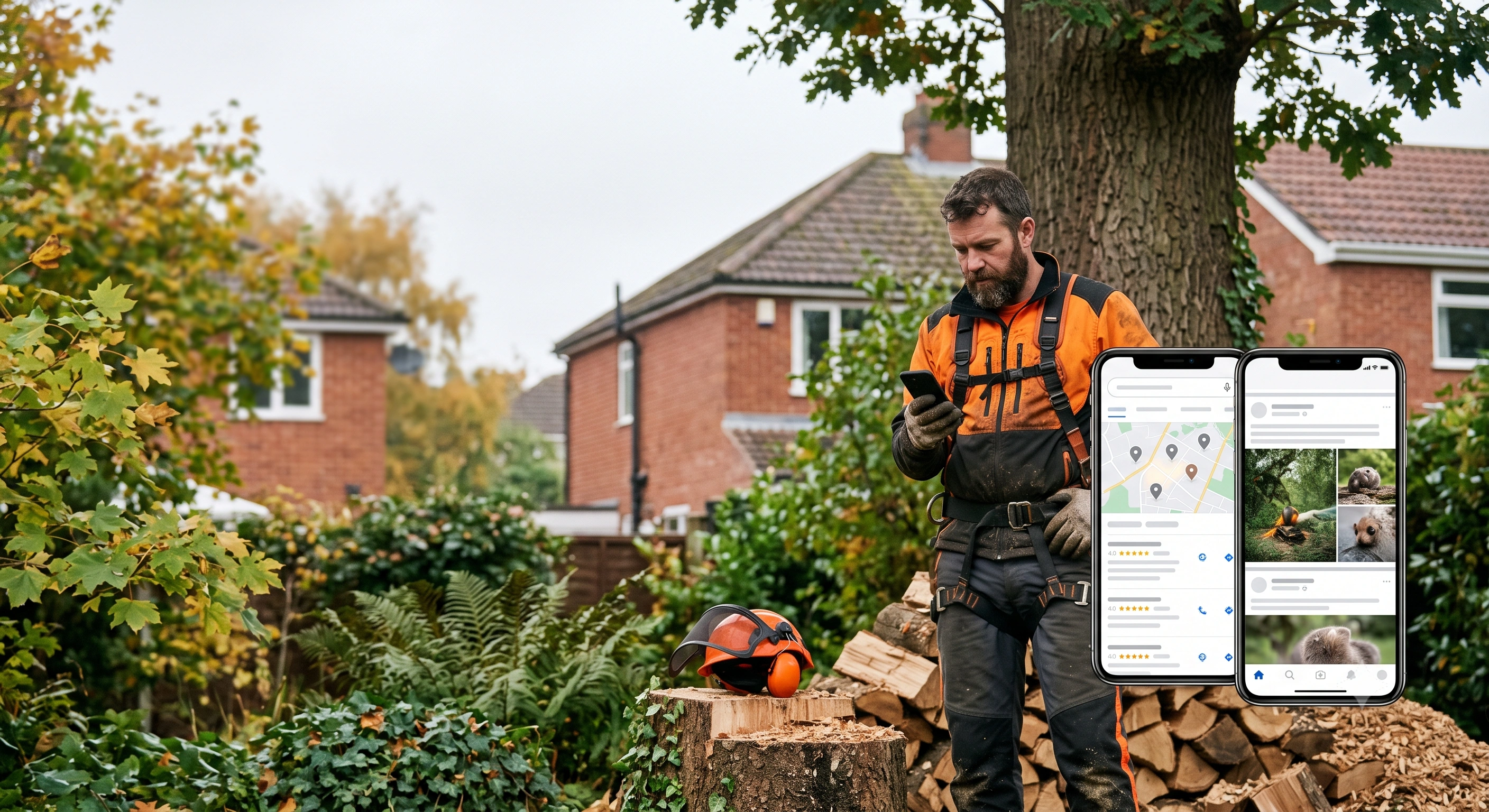
A Surrey-based tree surgeon launched his first paid campaigns in March 2025 with £1,500 split evenly between Google and Facebook. Within four weeks, Google Ads had delivered 18 qualified enquiries at £42 each with a 68% booking rate; Facebook generated 31 form fills at £24 each but only 7 converted to paid work. His crew schedule filled from Google leads whilst Facebook contacts mostly disappeared after initial contact.
Google Ads consistently outperforms Facebook Ads for tree surgeons seeking immediate job bookings. The gap is stark: Google generates leads at £30–£100 per enquiry with conversion rates of 60–75%, versus Facebook's £20–£35 cost per lead but only 25–30% booking rates. Why? Intent. Google captures homeowners actively searching for tree services right now. Facebook reaches property owners who may need work eventually but haven't started looking.
Lead generation advertising for tree surgeons refers to paid digital campaigns on search engines (Google Ads) or social platforms (Facebook/Meta Ads) designed to capture contact details from property owners seeking arboricultural services, typically through search results, display banners, or social feed placements targeting specific demographics and geographic areas.
Key Takeaways
- Google Ads reaches the 8% of homeowners actively searching "tree surgeon [town]" right now; Facebook targets the remaining 92% not currently looking
- Booking rates tell the real story. Google leads close at 60–75%; Facebook at 25–30%, because search intent signals immediate need
- Smart budget split: most UK tree surgery firms allocate 70% to Google Ads and 30% to Facebook for ongoing brand visibility
- Crew size matters. Small teams of 2–5 climbers operate effectively on £800–£1,800 monthly across both platforms
- Storm damage work converts almost exclusively through Google search—emergency keywords spike 300–500% when severe weather hits
Do Google Ads or Facebook Ads Generate Better Leads for Tree Surgeons?
Google Ads delivers superior return on investment for tree surgeons who need immediate bookings. Industry data from 2025 shows Google generates leads at £30–£100 per qualified enquiry, with booking conversion rates between 60% and 75%. Facebook costs less upfront—£20–£35 per raw lead—but only 25–30% progress to paid work.
Here's what actually happens: someone types "tree surgeon near me" or "emergency tree removal Berkshire" into Google. They face an immediate problem. A fallen branch blocks their drive. A diseased oak threatens the neighbour's conservatory. Planning permission requires an arborist report within weeks. They want quotes today, not next month.
Facebook is different. Users scroll their feed looking at holiday photos and news articles. Even perfectly targeted ads—homeowners aged 40–65 in £400,000+ properties—reach people with no current tree work planned. A minority bookmark the page or submit an enquiry form. Most lack urgency entirely. When you call back, they're "just browsing" or "thinking ahead to spring." The conversion happens much later, if at all.
Total monthly advertising spend for most established UK tree surgery firms sits between £1,000 and £2,500. During peak trading months (March–November), firms typically split this 70% Google and 30% Facebook. Winter months see a shift to 50/50 or even pausing Google entirely, since search volume drops and Facebook brand-building becomes more cost-effective when immediate leads dry up.
What Is the Average Cost Per Lead for Tree Services on Each Platform?
Google Ads cost per lead for tree surgeons in the UK ranges from £30 to £100. Five main factors explain the variation:
- Geographic competition drives massive differences. Greater London, Home Counties, and affluent market towns (Guildford, Tunbridge Wells, Oxford) push costs toward £80–£100 per lead. Rural Wales, East Anglia, and northern England sit closer to £30–£50
- Service type matters too. Emergency call-outs and dangerous tree work command premium bids (£5–£12 per click); routine pruning and hedge trimming attract lower costs (£2–£6 per click)
- Seasonality swings costs dramatically. Storm seasons (October–February) and spring growth (April–June) increase competition and costs by 40–60% versus quieter July–August periods
- Keyword specificity affects both cost and quality. Exact-match "tree surgeon [town name]" converts better and costs more than broad "tree services" or "tree cutting"
- Ad quality and landing page can slash costs by 30–50%. Fast-loading mobile sites with clear calls-to-action achieve better Quality Scores, reducing cost per click substantially
Facebook Ads seem cheaper upfront—£20–£35 per raw lead—but that's misleading. Once you factor in the low conversion rate, the effective cost per booking rises to £70–£120. Spend £1,000 on Facebook and you might collect 35 form submissions but book only 9 jobs (£111 per actual customer). Spend the same £1,000 on Google and you'll get 15 enquiries converting to 11 bookings (£91 per customer). Google wins on actual cost per customer.
Budget minimums differ sharply. Google Ads requires at least £600–£800 monthly to gather enough data for optimisation and maintain consistent lead flow. Below that threshold, campaigns run intermittently and fail to build momentum. Facebook tolerates smaller tests—£300–£500 monthly—because cost per impression is lower, though results remain unpredictable until the algorithm learns your audience over 4–6 weeks.
How Does Customer Intent Differ Between Google Ads and Facebook Ads?
Google Ads captures high-intent homeowners at the moment they decide to hire. Search queries like "tree surgeon Cheltenham," "crown reduction quote," or "emergency tree removal near me" signal immediate need. The homeowner has identified a problem, decided professional help is required, and begun comparing local firms. They'll contact three to five tree surgeons within the next 24 hours and book one within three days.
Facebook interrupts passive browsing. A homeowner scrolling through photos of their niece's graduation sees your ad featuring a climber dismantling a large oak. The targeting is precise—age 50, owns a £500,000 detached house in Warwickshire, interested in gardening and home improvement—but they weren't thinking about tree work until that moment. A small percentage click out of curiosity. Most scroll past without a second thought.
Urgency levels diverge sharply. Google leads often describe time-sensitive situations: a tree split in last night's storm resting on the garage roof, a neighbour's complaint about overhanging branches, or a mortgage survey flagging subsidence risk from a nearby poplar. They need a site visit this week and work completed within a fortnight. Facebook leads frequently ask for rough figures, express interest in "maybe next year," or request quotes for hypothetical projects that may never happen.
According to analysis of 2,400 UK tree surgery enquiries in 2025, Google-sourced leads booked site visits at 73% rates whilst Facebook leads converted to visits at just 28%.
The 8% versus 92% split describes the market at any given moment. Only 8% of property owners are actively seeking tree surgery services today; Google Ads reaches this narrow slice efficiently. The remaining 92% may need tree work someday—perhaps in six months or three years. Facebook allows you to stay visible across that longer timeline, building name recognition so your brand comes to mind when the need eventually arises.
When Should Tree Surgeons Prioritise Google Ads Over Facebook Ads?
Five specific scenarios demand Google Ads prioritisation:
Emergency and storm damage response. When severe weather hits—named storms, summer gales, heavy snow—search volume for "emergency tree removal" and "fallen tree" spikes by 300–500% within 48 hours. Google Ads capture this surge immediately; Facebook cannot react quickly enough. Firms offering 24-hour callout services should maintain always-on Google campaigns with premium bids on emergency keywords during October–March storm season.
Peak trading months requiring immediate bookings. March through June and September through November represent peak demand for planned tree work (pruning, reductions, removals coordinated with bird nesting windows and planning regulations). Small crews need calendars booked three to four weeks ahead. Google Ads fill schedules predictably; Facebook's slower conversion cycle leaves gaps.
New businesses establishing their initial customer base. A newly qualified tree surgeon with fresh insurance and kit needs paying work within weeks, not months. Google Ads deliver faster results than Facebook's brand-awareness approach. Even a modest £600 monthly Google budget generates 8–12 qualified leads, converting to 5–8 bookings—enough to sustain a sole trader through the first season whilst building a reputation and referral network.
Limited marketing bandwidth. A two-person operation cannot afford time managing multiple campaigns, nurturing cold Facebook leads, and following up unresponsive enquiries. Google Ads produce ready-to-buy leads requiring minimal nurture—usually one phone call and a site visit—maximising billable hours versus admin time.
High-value commercial and local authority contracts. Facilities managers, estates departments, and commercial property owners searching "tree surgery contractor [region]" or "BS3998 qualified arborist" represent high-value multi-site contracts worth thousands per job. These searches occur on Google, not Facebook. Campaigns targeting commercial keywords often cost less than residential terms due to lower competition, giving you efficient access to this B2B segment.
What Targeting Strategies Work Best for Tree Surgery Businesses?
Google Ads campaigns for tree surgeons perform best using exact-match keywords within tightly defined local service areas. Pair high-intent search terms with geographic precision and time-based scheduling aligned to when homeowners actually search and make buying decisions.
Should Tree Surgeons Use Exact-Match or Broad-Match Keywords?
Exact-match keywords deliver superior return on investment for tree surgery campaigns. An exact-match keyword like [tree surgeon Maidstone] triggers your ad only when someone types that precise phrase or a close variant. Broad-match keywords cast a wider net—tree surgeon Maidstone on broad match might show ads for "tree surgeon salary Maidstone," "tree surgeon courses Kent," or "tree surgeon jobs"—wasting budget on irrelevant clicks from job-seekers, students, or competitors researching the market.
Build campaigns around 15–25 exact-match keywords structured into tight ad groups:
| Keyword Type | Example | Monthly Search Volume (UK average) | Typical CPC |
|---|---|---|---|
| Town + service | [tree surgeon Guildford] | 40–120 | £3.50–£8.00 |
| Town + specific work | [crown reduction Oxford] | 10–30 | £2.80–£6.50 |
| Emergency intent | [emergency tree removal near me] | 5–15 (spikes to 200+ in storms) | £6.00–£12.00 |
| Service + qualification | [BS3998 tree surgeon Berkshire] | 5–20 | £2.20–£5.50 |
Why this matters: Exact-match keywords cost 30–40% more per click than broad match, but they convert at 3–4 times the rate. That cuts your cost per actual booking roughly in half—which means your ad spend turns into work faster.
Negative keywords filter out the noise. Add these to every campaign from day one: "-jobs," "-salary," "-courses," "-apprenticeship," "-equipment," "-supplies," "-training." People searching these terms are job hunters and DIYers, not homeowners calling for quotes. Check your search term report every week and add new negatives whenever your ads appeared for irrelevant queries. Doing this monthly alone can drop your cost per lead by 10–15%.
Local radius targeting should match where you can actually work profitably. Sole traders typically reach 15–25 miles from base; larger crews with multiple teams can stretch to 30–50 miles. Here's the problem: a tree surgeon in Dorchester bidding on "tree surgeon Dorset" pays for clicks from Bournemouth, 40 miles away. Tighter targeting cuts that wasted spend.
Ad scheduling reveals your real window. Data from 2025 shows Tuesday through Saturday, 7am to 8pm pulls in 85% of bookings while using only 60% of your budget. Homeowners search during commute times (7–9am, 5–7pm), lunch breaks (12–2pm), and Saturday mornings (9am–1pm). Pause overnight and Sunday ads unless you genuinely offer 24-hour emergency response—most late-night clicks come from people gathering quotes on Sunday, then multiple competitors reach them Monday morning anyway.
What Demographics Should Tree Surgeons Target on Facebook?
Facebook works best when you're targeting homeowners aged 35–65 with household incomes in the top 25–50% and properties worth above £400,000. That's not snobbery—it's data. People in this bracket own detached or substantial semi-detached houses with mature gardens. Mature gardens need professional arboricultural work. Younger homeowners focus on interiors and small spaces; older owners have established landscapes that require ongoing management.
Effective Facebook targeting layers several filters together:
- Age bracket: 35–65 years old (the sweet spot for property ownership and established outdoor spaces)
- Geography: Radius targeting within your service area, then separate ad sets for affluent postcodes—use CheckMyPostcode or Zoopla price data to identify neighbourhoods where median values exceed £400,000
- Home status: Facebook's "Likely homeowners" and "New homeowners" categories, which it infers from financial behaviour, life events, and how long someone's lived at an address
- Property value: Custom audiences built from postcode sectors with median house prices above £400,000
- Outdoor interests: "Gardening," "Home improvement," "Landscaping," "National Trust," "RHS"—these indicate someone actively invested in their property and outdoor space
- Spending behaviour: "Engaged shoppers – Home & Garden," "Frequent travellers" (disposable income signal), "Charitable donors" (proxy for established, professional households)
Exclude renters and flat-dwellers by narrowing to "Homeowners only" and blocking interest categories like "Apartment living," "House sharing," "Rental properties." Each excluded segment drops cost per lead by 15–25% because you're filtering out people who can't commission tree work anyway.
Lookalike audiences pull from your own customer data—email lists, phone numbers from past jobs, website visitors. Facebook's algorithm builds a "3% lookalike audience" by finding the 3% of UK users who most resemble your best customers. After you feed it 50+ seed customers, this typically outperforms manual demographic targeting.
Seasonal creative rotation prevents fatigue. Spring campaigns (March–May) emphasise crown reduction and deadwood removal before summer growth kicks in; autumn (September–November) highlights storm prep and leaf clearance; winter (December–February) showcases emergency response and quiet-season discounts. Rotate images and ad copy every 4–6 weeks—identical ads shown repeatedly to the same people cause click-through rates to plummet 40–60%.
How Should Tree Surgeons Split Their Advertising Budget Between Platforms?
If you want jobs now, allocate 70% of budget to Google Ads and 30% to Facebook during peak months (March–November). Google brings ready-to-book leads today. Facebook builds brand recognition that matters six months from now, when someone remembers your name and calls.
Take a £1,500 monthly budget: £1,050 goes to Google exact-match campaigns in your service area; £450 stays on Facebook, keeping your name visible to homeowners who aren't searching yet but will need you eventually. Google funds the urgent demand. Facebook plants seeds.
| Business Stage | Google Ads % | Facebook Ads % | Total Monthly Budget (GBP) | Primary Goal |
|---|---|---|---|---|
| New startup (0–12 months) | 85% | 15% | £800–£1,200 | Fill calendar quickly |
| Established sole trader | 70% | 30% | £1,000–£1,800 | Sustain bookings + some brand |
| Growing crew (2–5 staff) | 70% | 30% | £1,500–£2,500 | Maintain pipeline + awareness |
| Mature business (5+ staff) | 60% | 40% | £2,000–£4,000 | Balance immediate + long-term |
The breakdown: Google gets the bulk because it converts fast. Facebook's payoff takes 6–18 months as brand recognition builds.
Seasons shift spending. During storm season (October–February), move to 80% Google and 20% Facebook to capture emergency spikes. In summer lulls (July–August) when search volume drops and homeowners are on holiday, cut total spend by 30–40% or flip to 50/50, using quiet months for brand-building while competitors pause.
Starting out? Run Google-only for 60–90 days. Establish your baseline cost per lead, fill the calendar with paying work, then add Facebook once cash flow allows. Splitting a thin budget across both platforms from day one means neither campaign gathers enough data to optimise—you'll have erratic results on both fronts.
If you have strong referral pipelines, you can afford more Facebook investment—40–50% of total spend. You don't need paid leads for survival, so Facebook becomes a long-term asset keeping your name in front of past customers (repeat work) and neighbours (word-of-mouth reduction). Over time, this reduces paid search dependency.
Budgets under £800 monthly? Don't split. Run Google-only until you hit £1,200–£1,500. Below that threshold, both platforms receive too little spend to optimise, and low-volume data makes performance unpredictable.
Not sure which channel to run?
Get the right mix for your business
We run both Google and Meta for UK tree surgeons and pick the mix that fits your area and budget. Book a free strategy call.
What Campaign Settings Generate the Most Tree Service Leads?
Google Ads campaigns perform best with location-specific exact-match keywords, tight geographic targeting, and weekday scheduling that aligns to when homeowners actually search. Campaign structure isn't fancy—it's foundational. Messy campaigns waste 40–60% of budget on irrelevant clicks and miss the high-intent searchers entirely.
Split campaigns by major service area (towns or postcode sectors) so you can adjust bids by location performance. A Berkshire-wide campaign hides crucial detail. Separate Reading, Newbury, and Bracknell campaigns will show you that Reading leads cost £45 and convert at 70%, while Bracknell costs £60 and converts at 50%. That insight lets you reallocate budget smartly instead of dumping money into underperforming areas.
Negative keyword lists are your filter. Add these from launch:
- Job searches: -jobs, -vacancies, -salary, -careers, -apprentice, -training, -courses
- DIY/equipment: -hire, -rental, -buy, -equipment, -chainsaw, -tools, -supplies
- Information-only traffic: -how to, -DIY, -yourself, -free, -course
- Unrelated services: -stump grinder hire, -wood chippings free (unless you offer these)
Location settings matter more than you'd think. Choose "Presence: people in your targeted location" instead of the default "Presence or interest." That default shows your ads to anyone searching your town name, even if they're in Manchester researching a holiday cottage. A Manchester homeowner will never call your Surrey crew.
Scheduling by performance cuts waste. 2025 data shows Tuesday–Saturday, 7am–8pm captures 82% of conversions on just 58% of budget. Apply bid adjustments: +20% during peak hours (7–9am, 12–2pm, 5–8pm weekdays; 9am–1pm Saturday), -50% overnight and Sundays unless you genuinely operate 24-hour emergency response.
Meta campaigns follow different logic. Set conversion objective to "Leads," not "Traffic" or "Engagement"—this tells Facebook to optimise for form submissions, not just clicks. Two lead methods exist:
Instant Forms: Pop-up forms within Facebook/Instagram that users complete without leaving the app. Generate 60–80% more submissions than landing-page forms because friction is zero, but quality drops. Many users submit impulsively and don't remember calling when you ring two hours later. Use these for prospect list-building and nurture sequences, not direct conversion.
Landing Page Forms: Sending users to your website contact form cuts submissions by 40–60% compared to instant forms, but something crucial happens in that friction—casual browsers get filtered out, leaving only people genuinely ready to hire. If you're a small outfit that needs bookings now rather than a prospect list for later, instant forms beat landing pages. Landing pages suit crews with capacity to nurture leads or those hunting for higher-quality enquiries.
Run both methods side-by-side across separate ad sets for four weeks. Track cost per actual booking, not just lead cost. You might see instant forms deliver 40 leads at £22 each with a 20% booking rate (£110 cost per customer booked), while landing pages generate 12 leads at £38 but convert 45% of them (£84 per customer). The landing page wins despite costing more upfront.
Creative matters as much as targeting. Your ad copy should lead with what separates you—qualified arborist, £5 million public liability insurance, 15 years in business. Build urgency: "booking for April–May now." Show social proof: Google reviews, before-and-after photos. Video ads of climbing work, crane lifts, or dramatic tree removals pull 40% higher engagement than static images. Factor in production costs and time before committing.
Retargeting campaigns recover people who visited your site or engaged with an ad but didn't enquire. These audiences run small—typically 50–200 users monthly for a local tree surgeon—but convert at 2–3 times the rate of cold traffic. Budget 10–15% of your Facebook spend here. Small audiences, outsized returns.
What Time of Day Should Tree Surgeons Run Google Ads?
The best window for cost-effective bookings runs 7am to 8pm, Tuesday through Saturday. Search data from 2025 maps when homeowners actually hunt for tree work:
- Morning commute (7–9am): Smartphone searches from the car or after school drop-off. Often triggered by spotting a problem tree en route or discovering storm damage overnight
- Lunch (12–2pm): Desktop and mobile searches from offices and homes, when people carve out 15–30 minutes to gather quotes
- Evening (5–8pm): Peak search volume. Homeowners are home, can discuss projects with partners, and actually make decisions
- Saturday morning (9am–1pm): Weekend window where people have time to call, book site visits, and meet contractors that same day
Pause ads from 10pm to 6am, and skip most of Sunday unless you genuinely operate 24-hour emergency callout. Late-night and Sunday searches come from people planning to phone around Monday morning; competitors will reach them fresh at 9am Monday while you've already burned money on a click from 36 hours prior.
Bid adjustments sharpen efficiency. Raise bids by +20% during those four high-converting windows to own the top spots when intent peaks. Cut bids by -30% to -50% during slack periods (Monday mornings, Sunday afternoons) or skip those windows entirely.
Storm season flips the script. When the Met Office issues yellow, amber, or red wind warnings—roughly October through February—people search "fallen tree removal" and "dangerous tree" at all hours, weekends included. Spike emergency campaigns with premium bids (£8–£15 per click) across the clock, pausing only when your crews are genuinely swamped.
Geographic time zones rarely matter in the UK. That said, crews covering both Scottish Highlands and southern England should note sunrise and sunset times shift by about 90 minutes seasonally, nudging search patterns earlier in Scotland and later in the south during summer.
How Do You Set Up Lead Generation Campaigns on Facebook for Tree Services?
Start by choosing the right campaign objective. Select "Leads"—not Traffic, Engagement, or Conversions—so Facebook's algorithm hunts for users most likely to fill out your form.
The three-tier setup:
- Campaign level: Pick "Leads" objective, set a daily or lifetime budget (minimum £15 daily for steady delivery), keep Campaign Budget Optimisation on
- Ad set level: Build your audience (demographics, location radius, interests), choose placements (Facebook Feed and Instagram Feed work best; disable Audience Network and Messenger initially to guard quality), set your schedule
- Ad level: Upload creative (images or video), write primary text and headline, connect to your lead form or landing page
Instant forms need careful setup. Create a template asking for name, phone, email—optionally postcode, property type, and work description. Keep it short; each extra field kills completion by 15–20%. Add a privacy policy link (required by UK GDPR) and a welcome screen explaining what happens: "We'll call within 24 hours to arrange your free quote."
Pre-fill form fields from Facebook profile data whenever possible. Name, email, and phone load automatically if the user shared them with Facebook, cutting friction. Custom questions like "What tree work do you need?" require typing and lower completion but improve lead quality by separating vague interest from actual projects.
Landing page campaigns demand Facebook Pixel installed across your website. Paste the Pixel code on every page, then set up Custom Conversion tracking for the "Thank You" page users reach after submitting your contact form. Without proper tracking, Facebook can't optimise delivery, and you're flying blind.
Start with £15–£25 daily (£450–£750 monthly) to give Facebook's learning algorithm enough volume. Split across 2–3 ad sets testing different audiences—maybe 35–50 age range, 50–65 age range, and a lookalike audience. Wait 14 days before deciding; earlier judgements don't hold statistical weight.
Watch cost per lead and lead quality, not just lead count. If instant forms bring 40 leads at £18 each but only 6 actually book, while a landing page generates 12 leads at £35 with 7 bookings, the landing page delivers better return despite higher surface spend. Track each lead through to booking in a spreadsheet or CRM to see true cost per customer.
Which Platform Delivers Better ROI for Different Tree Service Scenarios?
Emergency tree removal and storm damage work lives almost entirely on Google Ads. A homeowner wakes to find a split oak on their garage roof after overnight gales and searches "emergency tree removal [town]" immediately—often at 6am. They need a crew on-site today. They'll book whoever qualified answers the phone first. Facebook can't capture that zero-hour panic; by the time they see your Facebook ad, a competitor has already answered their call.
Google wins emergency work for three hard reasons: timing (ads show within seconds of the crisis), intent (the searcher has decided to hire and is shopping now, not browsing), and immediacy (call extensions and click-to-call buttons connect them to your phone in one tap). Put 100% of emergency advertising into Google, with premium bids (£8–£15 per click) on keywords like "emergency tree removal," "fallen tree," "dangerous tree," and "storm damage tree" during October–February.
Routine maintenance and trimming play differently. A homeowner planning annual crown reduction or hedge work has breathing room—they're booking 2–4 weeks ahead, pulling multiple quotes, weighing factors beyond price (insurance, qualifications, reviews, professionalism). Google Ads catch them mid-research, but Facebook Ads plant your name months earlier. When they eventually search Google, you're already familiar.
Split routine work 70% Google and 30% Facebook. Facebook builds brand over 6–12 months while Google converts the immediate searches. Homeowners who've seen your Facebook ads multiple times are likelier to click your Google ad, likelier to call, likelier to book without shopping competitors—multi-channel presence compounds.
New service areas justify heavy Facebook spending. Expanding from Oxfordshire into Buckinghamshire means zero local reputation, no referrals, van drivers unknown. Google Ads still work but cost 40–60% more per click in unfamiliar territory because Quality Score depends partly on historical performance per location. Spend 3–6 months on Facebook building familiarity across Buckinghamshire postcodes, then lean hard into Google once brand recognition exists.
New-territory budget split: 50% Facebook and 50% Google for the first 90 days, then shift to 30% Facebook and 70% Google once brand recognition solidifies and Google data accumulates. Check branded search volume—people searching your company name—monthly; rising brand searches mean Facebook is working.
Storm season reshapes allocation. October–February, push Google to 80–85% to grab emergency demand spikes; July–August, dial Google back to 50% and bump Facebook to 50%, using the quiet months to build autumn awareness. Adjust budgets monthly based on Google Keyword Planner trends.
| Scenario | Google Ads % | Facebook Ads % | Typical Budget (GBP/month) | Expected Leads (Google) | Expected Leads (Facebook) | Conversion Rate to Booking |
|---|---|---|---|---|---|---|
| Emergency tree removal | 100% | 0% | £1,500 | 20–30 | 0 | 75–85% (Google) |
| Routine pruning/maintenance | 70% | 30% | £1,400 | 12–18 | 18–25 | 65% (Google), 25% (Facebook) |
| New service area launch | 50% | 50% | £1,200 | 8–12 | 20–30 | 45% (Google), 20% (Facebook) |
| Storm season peak | 85% | 15% | £2,000 | 25–35 | 8–12 | 70% (Google), 25% (Facebook) |
| Summer maintenance lull | 50% | 50% | £1,000 | 10–15 | 15–22 | 60% (Google), 30% (Facebook) |
Bottom line: Google Ads own urgency and immediate need. Facebook Ads build long-term positioning that lifts every channel's performance over months.
Consider a Hampshire tree surgeon spending £1,000 monthly on Google alone. That typically yields 13–17 leads and 9–12 actual bookings—roughly £5,850–£7,800 in monthly revenue at £650 per job. Add £400 for Facebook, and the picture shifts: you'll see 16–20 new leads from Facebook, but only 4–6 will convert initially, pushing revenue to £8,450–£11,700. Wait six months, though. Facebook retargeting kicks in. Brand recognition builds. The same £1,400 now generates 18 Google leads plus 20 Facebook leads—and here's the payoff—18 total bookings, hitting £11,700 monthly. The platforms don't just coexist; they amplify each other.
Published by Tree Surgeon Leads UK, a specialist marketing and lead generation agency working with UK tree surgeons.
Frequently Asked Questions About Google Ads vs Facebook Ads for Tree Surgeons
Can Tree Surgeons Use Both Google Ads and Facebook Ads Together?
Running both simultaneously works best. Allocate 60–70% to Google Ads—that's where homeowners land when they search "tree surgeon near me" or "emergency branch removal." Dedicate 30–40% to Facebook for brand awareness and longer-term pipeline building. Google captures the urgent need. Facebook captures the future client who hasn't yet had a problem but will in twelve months. If your monthly budget sits below £1,200, start with Google only. Facebook becomes worthwhile once cash flow supports splitting your investment without spreading yourself too thin.
How Long Does It Take to See Results From Each Platform?
Google moves fast. First leads arrive within 48–72 hours; real optimisation happens over 3–4 weeks once the system has enough click and conversion data to sharpen your bids and keywords. You'll typically see 8–15 qualified enquiries monthly from £1,000 spent. Facebook plays a longer game. The algorithm needs 4–6 weeks just to learn who your ideal customers are, and your initial cost per lead will run 60–80% higher than it will after optimisation. Many tree surgeons quit Facebook too early. Give it 3–4 months before deciding if it works for you. The real win—better repeat exposure, higher name recall—compounds over 6–18 months.
Do Facebook Ads Work for Emergency Tree Services?
Not well. Facebook reaches passive browsers scrolling their feed. Emergency tree work needs active urgency—a homeowner whose tree just split in a storm doesn't wait for a Facebook ad to appear. They search Google immediately for "emergency tree removal" or "fallen tree removal." That's when they hire. During storm season, Facebook can't compete with that zero-hour demand spike. Put 100% of emergency-service budget into Google with premium bids on crisis keywords. Facebook may build general awareness that you offer emergency response, but it won't capture the moment it matters most.
What's the Minimum Budget Needed to Test Each Platform?
Google needs £600–£800 monthly to work properly. Below that, campaigns run sporadically, keywords don't get enough impressions to measure, and results feel random. Facebook tolerates smaller budgets—£300–£500 works—because impressions cost less. Still, you need 30–45 days for the system to learn what it's doing. If your total marketing budget is under £1,000 monthly, go all-in on Google first. Move to Facebook only once you can invest £1,200–£1,500 total without spreading resources so thin that neither channel gets what it needs.
Should Tree Surgeons Hire an Agency or Run Ads Themselves?
New to advertising and working with under £1,500 monthly? Start solo. Google's guided setup and Smart campaigns let you learn fundamentals while establishing baseline performance. Agencies charge 15–25% of ad spend—often £200–£600+ monthly—which might eat your entire margin at that scale. Once you hit £2,000+ monthly or manage both Google and Facebook simultaneously, an agency becomes worth the cost. They optimise faster, sidestep expensive mistakes (weak keywords, wrong geography, broken conversion tracking), and typically deliver 30–50% better cost per lead through refinement that most business owners lack time to handle.