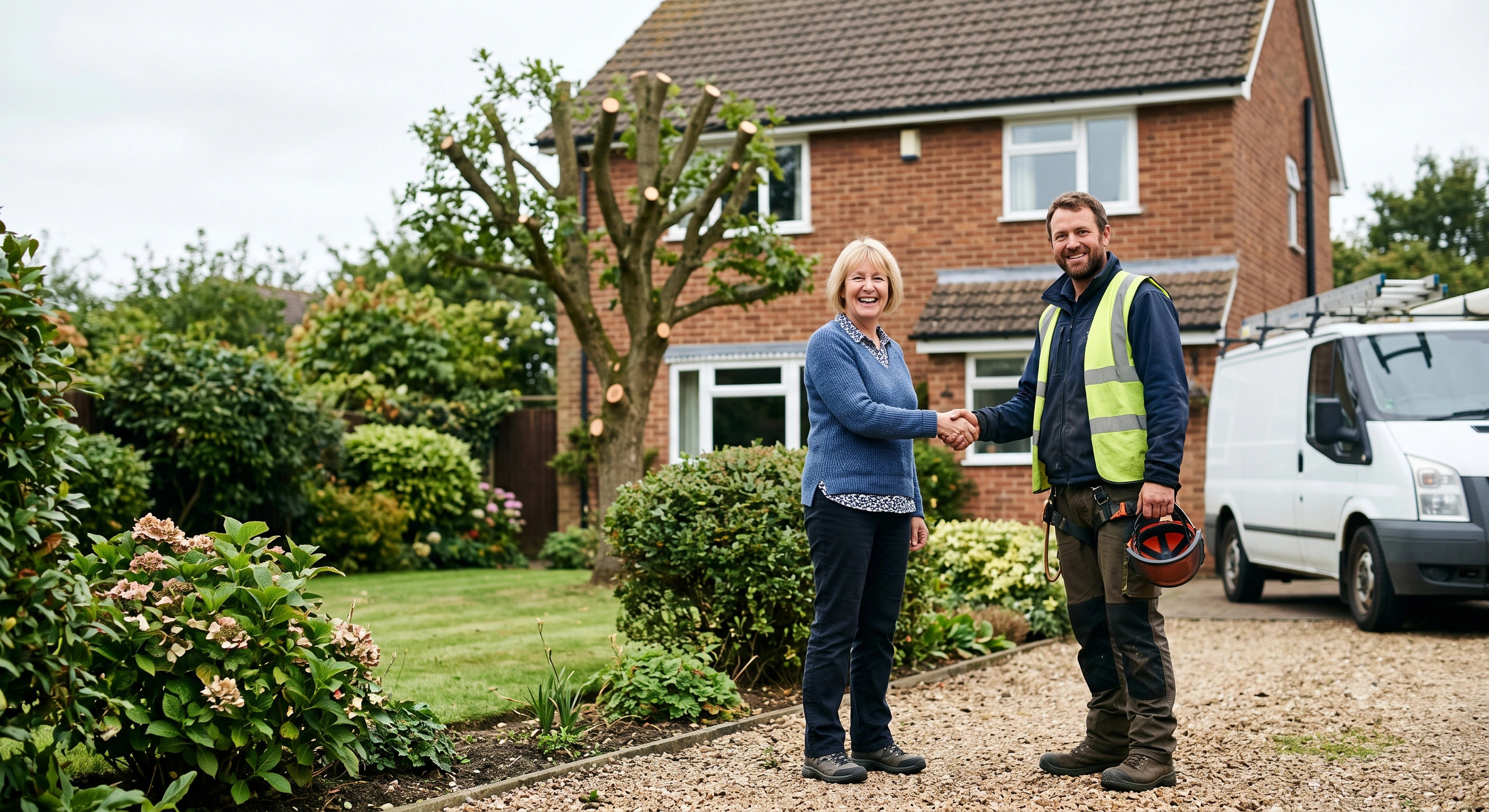
A Berkshire tree surgeon completed a £1,800 crown reduction in April 2025. The client was delighted. Three months later? Still no review. The customer had promised to leave one but never followed through. Without a process, even perfect work vanishes online.
Getting customer reviews is the single biggest challenge facing UK tree surgeons today. Physical work, high job values, long completion timelines — these create barriers that plumbers and electricians simply don't face. This guide shows exactly how to build a consistent review pipeline without violating platform policies, damaging your reputation, or wasting time on methods that don't work.
Customer review acquisition is the systematic process of requesting, collecting, and managing client feedback on public platforms such as Google Business Profile, Trustpilot, and the Arboricultural Association directory, using methods that comply with each platform's terms of service and UK consumer law.
Key Takeaways
- Google Business Profile drives 87% of local search visibility for "tree surgeon near me" queries — ignore it and you're invisible to homeowners actively searching for help
- The optimal review request window is 24–72 hours post-completion, when job quality is memorable but before daily life crowds in
- Google's review policies explicitly prohibit incentivising specific ratings or selectively asking only satisfied customers; violating this can suspend your Business Profile
- QR codes on invoices increase completion rates by 30–40% compared to verbal requests alone — friction kills good intentions
- Commercial clients (property managers, councils) rarely leave public reviews due to procurement policies; request testimonials instead
Why Do Tree Surgeons Struggle to Get Reviews Compared to Other Service Businesses?
Tree surgery faces three structural barriers that plumbers, electricians, and other trades don't encounter. First: timing. Much tree work is emergency-driven (storm damage, dangerous limbs) or seasonal (winter pruning), creating narrow windows when customers are thinking about the service. By the time a client realises they should leave a review, weeks have passed and the job has faded from memory.
Second is price. Tree work in the UK averages £800–£2,500 per job. High-value services make clients cautious about public endorsements — they worry about liability if their recommendation leads to a problem for someone else. A satisfied bathroom fitter's client will cheerfully recommend them; a satisfied tree surgeon's client often hesitates, fearing they could be held responsible if something goes wrong later.
Third, credibility gaps make reviews essential yet hard to obtain. The UK market includes highly qualified arborists holding NPTC CS38/39 certificates alongside operators with no formal training. Customers know this disparity exists. They need reviews to distinguish legitimate professionals from cowboys, but new or small businesses lack the established reputation that encourages clients to go on record.
What makes tree surgery different from other home services when collecting feedback?
Outcome lag is brutal. A newly fitted boiler either works or it doesn't — feedback is immediate. A crown reduction's success takes weeks or months to become apparent: Did the tree recover? Did the wound seal properly? Is the canopy balanced? Customers hesitate to endorse work when they can't yet see the final outcome, meaning your feedback window closes just as it's opening.
Safety concerns weigh heavily. Tree surgery is one of the most dangerous occupations in the UK, with HSE figures showing an average of three fatalities per year in arboriculture. Clients who recommend a tree surgeon feel a moral responsibility if that contractor later injures someone. This unspoken liability fear suppresses review rates, especially for high-risk jobs like felling or working near power lines — work that's perfectly safe and professionally executed can still feel risky to endorse publicly.
Which Review Platforms Should Tree Surgeons Prioritise for Maximum Visibility?
Google Business Profile dominates local search. When a UK homeowner searches "tree surgeon near me" or "tree removal Oxfordshire," Google's map pack appears above organic results. That ranking depends on three factors: review quantity, review recency, and review response rate. A business with 40 reviews updated within the past three months will outrank a competitor with 60 older reviews, even if the competitor has a higher average rating.
Platform-specific policies shape where you should focus effort. Google prohibits review gating — asking only satisfied customers to leave reviews whilst steering dissatisfied ones to private feedback channels. Violate this and Google can remove reviews or suspend your profile entirely. Yelp actively filters solicited reviews, meaning any review that appears to result from a direct request may be hidden from your public profile. Trustpilot allows verified review invitations but requires proof of a genuine transaction.
The Arboricultural Association's Find a Contractor directory offers a niche advantage for professional arborists. Membership demonstrates commitment to industry standards, and the directory allows clients to leave feedback alongside your credentials. Search volume is lower than Google, but the audience is highly targeted: people using the AA directory are specifically seeking qualified professionals, not just the cheapest quote.
Facebook and Nextdoor operate differently. Facebook's recommendation algorithms mean a five-star review may appear in the newsfeeds of your client's friends and neighbours — hyperlocal word-of-mouth at scale. Nextdoor reviews carry particular weight because the platform verifies users' addresses, so a positive review comes from a verified resident of the area you serve.
Does Google Business Profile really matter more than other review sites for tree surgeons?
Yes, measurably so. Google Local Services Ads — the "Google Guaranteed" badge at the very top of search results — requires a minimum of five reviews and a 3.0+ rating to maintain eligibility. Businesses with this badge receive an average of 40% more enquiries than those without it, according to Google's own 2025 SMB data. Without that badge, you're competing for attention below paid ads and trusted competitor listings.
Map pack visibility correlates directly with review velocity (how recently you received reviews) rather than total count. A business that received ten reviews in the past month typically outranks one that received fifty reviews over five years. Google's algorithm interprets recent reviews as a signal of current activity and relevance.
Response rate matters as much as rating itself. Google's 2024 local search quality guidelines confirm that businesses which respond to reviews — particularly negative ones — receive a ranking boost. The algorithm treats public responses as evidence of active management and customer service commitment. Ignore a negative review and you signal that you don't care what clients think.
Should qualified arborists focus on industry-specific directories?
Professional credentials deserve professional platforms. The Arboricultural Association Find a Contractor directory allows you to display NPTC certificates, ISA certification, and Approved Contractor status alongside client feedback. Google and Trustpilot can't offer this combination — credentials appear only as text in your business description, easily buried among dozens of other businesses.
Cross-posting creates leverage. When a client leaves a positive review on the AA directory, you can (with their permission) request they also leave a Google review. Frame it as helping other homeowners find qualified professionals: "Your feedback on our AA profile has been really helpful — would you mind copying it to our Google listing so more people can find qualified arborists?" Most clients willing to leave one review will leave two when the ask is framed as a public service.
What Are the Exact Steps to Ask for Reviews Without Violating Platform Policies?
Timing determines success. Request reviews 24–72 hours after job completion, when the work is fresh in the customer's mind but cleanup is done and disruption has settled. Asking during active work feels presumptuous; asking weeks later competes with dozens of other priorities and gets lost.
Language matters more than you'd think. Google's review policies explicitly prohibit asking for specific ratings. "We'd appreciate your feedback on Google" complies. "Please leave us a five-star review" violates it and can result in review removal or temporary suspension of your Business Profile. Yelp's policies go further, discouraging any direct solicitation — frame it as "If you use Yelp, we'd welcome your honest thoughts there" if you must ask at all.
The multi-channel sequence maximises response rates whilst respecting customer attention. Immediately after completing work, leave a physical card on-site thanking them for their business, with a QR code linking to your Google review page. Within 24 hours, send a text message: "Hi [Name], just checking you're happy with the oak tree work we completed yesterday. If you have a moment, we'd really value your feedback: [link]." If no response within three days, send a single follow-up email with different framing: "We're always looking to improve our service. Your thoughts on the recent work would be genuinely helpful."
QR codes eliminate the biggest barrier: navigation friction. Most people struggle to find a business's Google review page manually. A QR code on your invoice takes them directly there with one scan. UK data from 2025 shows that QR-code-enabled review requests achieve 30–40% completion rates, compared to 8–12% for verbal requests alone. The difference isn't quality — it's effort required from the customer.
Document every request. Save screenshots showing the neutral language you used and the date you sent it. If a customer later leaves a negative review and claims you only ask satisfied clients, you have evidence proving you solicit feedback from everyone. Google rarely removes negative reviews, but documented proof of policy compliance protects your Business Profile from suspension if a complaint is filed.
How soon after completing tree work should you ask for a review?
The 24–72 hour window balances memorability against completion. Within 24 hours, the job quality is vivid — the customer walked outside this morning and saw the transformed tree. After 72 hours, daily life reasserts itself: work stress, family commitments, the next household project. Your tree job becomes just another completed task, not an experience worth documenting.
Stump grinding is the exception. Stumps don't vanish immediately. If you've ground a stump to 15cm below ground level, the sawdust and chips remain visible for a week. Customers sometimes worry the job is incomplete until grass starts growing over the area. Wait 7–10 days before requesting a review for stump work — this allows the site to naturalise and concerns to resolve, at which point the customer can leave an honest review rather than a tentative one.
Can you legally offer incentives for tree surgery reviews?
Platform policies universally prohibit incentivising positive reviews. UK law, however, permits incentivising feedback generally. The distinction matters legally and practically.
You cannot offer "£20 off your next job for a five-star Google review" — this violates Google's terms and potentially breaches the Consumer Protection from Unfair Trading Regulations 2008 by creating misleading endorsements. You can offer "£20 off your next job when you leave us any honest feedback on Google, whether positive or negative." The critical difference: the incentive must not be conditional on rating. If you miss this distinction, you'll face platform penalties (removal of reviews, account suspension) and potential regulatory action from Trading Standards.
Charity donations sidestep policy concerns entirely. "For every review we receive this month, we'll plant a tree through the Woodland Trust" incentivises the act of reviewing, not the content. No platform prohibits this approach, and it reinforces your environmental credentials without legal risk.
Prize draws occupy a grey area. Google's policies don't explicitly address them, but the US Federal Trade Commission's 2023 guidance on endorsements (widely adopted as international best practice) states that prize-draw entries conditional on reviews must be disclosed within the review itself. The practical result: your reviews would need to say "I entered a prize draw for leaving this review," which undermines their credibility. Avoid this method.
Want more reviews and more work?
Turn your reputation into leads
Reviews win local ranking and trust — we help UK tree surgeons get found and get booked. Book a free, no-obligation strategy call.
How Do You Generate Reviews from Commercial Clients and Property Managers?
Business-to-business tree work rarely produces public reviews. Property management companies, local councils, housing associations, and estate managers operate under procurement policies that prohibit public endorsement of suppliers. A facilities manager for a 200-unit block of flats cannot leave a Google review saying "Excellent tree surgeons" without potentially violating their employer's vendor neutrality rules.
Request testimonials instead. After completing a commercial contract, ask: "Would you be willing to provide a brief written testimonial we can feature on our website? We'd send you the draft for approval before publishing anything." Most procurement officers can provide a factual statement like "We engaged [Company] for emergency tree removal following Storm Henk. Work was completed on schedule and within budget." Whilst this doesn't help your Google ranking, it provides credibility for your website and tender submissions — which often matters more to B2B decision-makers than star ratings.
LinkedIn recommendations work for contract managers and estate directors. Build a professional relationship with the decision-maker, then ask them to endorse your company on LinkedIn. These endorsements don't affect local search rankings but appear when potential clients research your business name, and they carry weight because the recommender's own professional reputation is attached to the statement.
Municipal contracts require alternative documentation. When you complete tree work for a council's parks department or highways team, public review is effectively impossible. Instead, request permission to use the project as a case study: "May we feature this project on our website, including before/after photos and a description of the scope? We'd anonymise any sensitive details and send you final copy for approval." Case studies demonstrate capability to future commercial clients even though they don't generate review platform metrics.
Why don't commercial tree surgery clients leave Google reviews?
Corporate governance policies treat public supplier endorsements as potential conflicts of interest. If a property manager leaves a glowing Google review for your company, then later accepts a hospitality event from you, internal auditors may question whether the relationship compromised procurement objectivity. Even innocent public endorsements can create appearance-of-impropriety issues, so most organisations simply prohibit them.
Individual facility managers can sometimes review in a personal capacity — but only if they make clear they're not speaking for their employer. A review saying "I manage a retail park and we've used this tree surgery company three times — always reliable" walks a fine line. If the reviewer's employer discovers it, they may ask them to remove it. For this reason, even well-intentioned commercial clients often decline to leave public feedback.
| Client Type | Likelihood of Public Review | Alternative Documentation | Best Platform |
|---|---|---|---|
| Residential homeowner | High (40–50% if asked) | Standard Google/Facebook review | Google Business Profile |
| Small landlord (1–3 properties) | Moderate (25–35%) | Testimonial + Google review | Google Business Profile |
| Property management company | Very low (5–10%) | Written testimonial for website | LinkedIn (personal connection) |
| Local authority / council | None (policy prohibited) | Case study with redacted details | Your website + tender docs |
| Housing association | Very low (5%) | Testimonial quote from named officer | Your website |
| Commercial estate (retail, office) | Low (10–15%) | LinkedIn recommendation | LinkedIn company page |
Residential homeowners remain the primary source of public reviews for tree surgeons. Commercial work provides revenue and credibility, but not review platform metrics. Successful businesses maintain separate documentation strategies for B2C (public reviews) and B2B (case studies, testimonials, LinkedIn) clients.
What Should You Do When Customers Leave Reviews on the Wrong Platform or Don't Follow Through?
Review link confusion causes 67% of committed customers to abandon the process. A client says "Yes, I'll leave you a review" but then opens Google, searches for your business name, clicks your website instead of your Business Profile, and can't find a review button. After two minutes of hunting, they give up. This silent failure is the biggest leak in most tree surgeons' review pipelines.
QR codes eliminate navigation entirely. Print platform-specific QR codes on the bottom of your invoice: one for Google, one for Facebook, one for Trustpilot. Label each clearly. When you ask for a review, point to the specific code: "If you scan this one, it takes you straight to our Google page." Test the QR codes yourself on both iOS and Android devices before printing them — broken links destroy completion rates.
Platform migration happens when customers default to their preferred review site. Someone might leave a Facebook review because that's the app they use daily, even though you specifically need Google visibility. Wait two weeks after the Facebook review appears, then send a personalised message: "Thank you so much for the lovely Facebook review — it really made our day. I hate to ask, but would you be willing to leave a similar note on our Google page? It helps local homeowners find us when they search for tree surgeons. I've attached a direct link: [URL]. If you're too busy, no worries — we really appreciate the Facebook review." Most clients willing to write one review will copy-paste a second when you've made it frictionless.
The Arboricultural Association directory creates a strategic first-ask opportunity for members. If you're an AA Approved Contractor, request the AA review first. The process is simpler (no Google login required), and the audience is self-selecting (people browsing the AA directory are quality-focused). Once the client has invested time leaving one review, asking them to duplicate it on Google feels like a small incremental request rather than starting from scratch.
How do you redirect customers who review you on Facebook to Google?
Timing and gratitude come first. Respond publicly to the Facebook review within 24 hours: "Thank you so much for taking the time to share this, [Name]. We're really glad the oak tree work met your expectations." Wait 10–14 days to avoid appearing pushy. Then send a private message: "Hi [Name], I wanted to thank you again for the Facebook review. I have a small favour to ask: would you be willing to leave a similar review on our Google page? Most homeowners search there first, so it helps local people find qualified arborists. I've attached a direct link that should take 60 seconds: [URL]. Totally understand if you're too busy — we're grateful for the Facebook review either way."
The 60-second estimate matters. Customers often assume leaving a second review means rewriting everything from scratch. Explicitly tell them "You can copy-paste your Facebook review" or "It should take about 60 seconds." Include screenshots showing exactly what they'll see: "Click the link, choose a star rating, paste your text, click Post. Done."
How Can Tree Surgeons Respond to Negative Reviews Without Damaging Their Reputation?
Public responses to negative reviews are one of the most powerful but underused tools in online reputation management. Google's algorithm interprets responses as evidence of active customer service, and potential clients reading your reviews judge your professionalism based on how you handle criticism. A well-crafted response can convert a negative review into a demonstration of competence and care.
Acknowledge the specific concern first. Never open with "We're sorry you feel that way" — it sounds dismissive. Instead: "We're sorry the cleanup didn't meet your expectations. We aim to leave every site spotless, and it's clear we fell short in your case." Naming the specific issue (cleanup, timing, communication) shows you've read and understood the complaint rather than offering boilerplate apologies.
Offer offline resolution second. Public reviews are not the place to debate facts or defend your actions at length. "We'd like to understand what happened and make it right. Could you call our office at [number] or email [address] so we can discuss this properly?" This signals to future readers that you take complaints seriously whilst moving the conversation away from a public forum where emotions escalate and misunderstandings multiply.
Demonstrate competence third. If the complaint relates to safety, quality, or standards, briefly cite your credentials: "All our arborists hold NPTC CS38 and CS39 certification, and we're members of the Arboricultural Association. Tree safety is our absolute priority, which is why we take your concerns seriously and want to investigate what happened." This reassures potential clients reading the review thread that the negative experience was an anomaly, not a pattern.
Never argue. Never make excuses. Never blame the client — even if the review is factually inaccurate or their complaint unfair. A defensive public response destroys your credibility because future customers reading the exchange will side with the reviewer; businesses hold more power than individuals do. Acknowledge the feedback, offer to resolve the issue offline, and demonstrate competence through your response. That's the only approach that works.
Should you ask Google to remove a negative review?
Google removes reviews only in specific cases: fake reviews, spam, off-topic content (reviewing the product rather than your service), conflicts of interest (a competitor posting negative feedback), illegal content, or sexually explicit material. A review simply because it's harsh or you disagree with the facts? Google won't remove it.
The flagging process is straightforward. Open your Google Business Profile, find the review, click the three-dot menu, select "Flag as inappropriate," and choose the policy violation. Google's system reviews flags within 48 hours. If denied, request human review through the support channel. Approval rates are low — typically 10–15% of flagged reviews actually disappear.
Here's what matters: a negative review from a genuine customer describing a real (if disputed) experience will never be removed, even if factually inaccurate. Your recourse is a strong public response and building enough positive reviews that the negative one becomes statistically insignificant. Fifteen five-star reviews and one one-star review gives you a 4.7 average. Most potential clients will read the one-star review, see your professional response, and judge that the weight of evidence favours your business.
How Do You Systematise Review Collection So It Happens Consistently?
Manual processes fail the moment you get busy. You complete a job, intend to ask for a review later, take three emergency calls, and forget. A week passes. The moment is gone. Only review strategies that require zero memory or willpower work long-term.
Automate the ask through your invoicing system. Software like Powered Now, YourTradebase, or Fergus can send an automated email or SMS 48 hours after you mark a job complete. The message should come from you — use your name in the "from" field, not a generic "info@" address — and include direct links to your review pages. Automation removes human error.
Print review cards as standard job completion materials. Design a business-card-sized card with a thank-you message on one side and a QR code on the other. Hand one to every client as you're packing up. Stick one under a magnet on their fridge. Leave one on the kitchen counter with your invoice. Physical cards have a 10–15% scan rate within the first week, and many customers photograph the QR code to use later rather than scanning immediately.
Train your team to ask verbally if you employ other climbers or groundworkers. The most effective ask comes at the emotional high point: when the client walks outside and sees the finished work. Use this script: "Looks great, doesn't it? If you're happy with how it turned out, we'd really appreciate a quick review on Google. I've left a card with a QR code that takes you straight there." The combination of verbal ask and physical card increases completion rates by 15–20 percentage points compared to card alone.
Track completion in a simple spreadsheet. Column A: client name. Column B: job completion date. Column C: review request sent (yes/no). Column D: review received (yes/no). Column E: follow-up sent (yes/no). Every Monday, filter for jobs completed 3–10 days ago where review request = yes but review received = no. Send a single follow-up to those clients. This ensures no one falls through the cracks while respecting customers who've chosen not to leave feedback.
What percentage of customers should you expect to leave reviews?
UK tree surgery industry benchmarks sit at 12–18% unprompted conversion (customers who leave reviews without being asked) and 35–45% prompted conversion (customers who leave reviews after a single ask). Best-in-class operations achieve 50–60% prompted conversion.
Completion rates climb when: job value exceeds £1,500, work is visible from the street (neighbours comment on the transformation), work matches the quote exactly with no surprises, and you're an owner-operator business (customers feel more connection to a sole trader than a corporate brand). Completion rates drop when: the work is emergency-based (customers are stressed), it's on rental properties (tenants don't feel ownership), or it happens during winter (customers spend less time in gardens).
A realistic target for a tree surgery business with a systematic process: 40 reviews per 100 jobs completed. This assumes you're asking every customer, using multi-channel methods (card + text + email), and following up once with non-responders.
| Review Acquisition Method | Completion Rate | Time Investment | Platform Compliance Risk |
|---|---|---|---|
| Verbal ask only (no link) | 8–12% | Low (30 seconds) | None |
| Printed card with QR code | 15–22% | Low (print once, hand out) | None |
| Text message with direct link | 30–40% | Medium (manual or automated) | None if neutrally worded |
| Email with direct link | 18–25% | Medium (manual or automated) | None if neutrally worded |
| Combination (card + text + email) | 45–55% | Medium (initial setup, then low) | None if neutrally worded |
| Incentive (discount conditional on positive review) | 60–70% | Medium | High (violates Google policy) |
| Incentive (discount for any feedback) | 50–60% | Medium | Low (check current policies) |
Combining multiple low-friction methods (card, text, email) achieves the best balance: high completion rate, low time investment, zero policy risk. High-completion methods that violate platform policies create long-term risk that outweighs short-term gains.
Which Mistakes Do Most Tree Surgeons Make When Trying to Get Reviews?
Asking too late is the single most common failure. Wait a week, two weeks, a month — and your job becomes one of a dozen things the customer has dealt with. The work was good. They genuinely intended to leave a review. But when they finally open Google, they can't quite remember your company name and give up after one search.
Asking too early creates the opposite problem. A customer standing in their garden surrounded by sawdust and wood chips, while your chipper screams in the background, isn't in the headspace to write a review. They're thinking about lunch, their next meeting, whether the noise annoyed the neighbours. Ask when the chaos has settled but memory is fresh — typically 48–72 hours after job completion.
Review gating — asking only happy customers — violates Google's terms and creates statistically suspicious patterns. Thirty five-star reviews and zero one- or two-star reviews triggers Google's manipulation detection. Ironically, businesses that ask everyone (including dissatisfied customers) and receive a few critical reviews often rank higher, because the mixed feedback appears authentic.
Complicated processes kill completion. "Go to Google, search for our business name, scroll past the ads, click the business listing, find the reviews tab, click Write a review..." Most customers give up halfway. A direct link or QR code that lands them on the review-writing interface with a single tap is the difference between 15% completion and 45%.
Silence on reviews — particularly negative ones — signals to both Google's algorithm and potential customers that you don't monitor feedback or care about service. Businesses that respond to 90%+ of reviews (even just a "Thank you" to positive ones) typically rank two to three positions higher in local map pack results than businesses with identical ratings but zero response activity.
Neglecting to follow up means relying entirely on customer memory and goodwill. People are busy. A gentle reminder three days after your initial ask ("Just following up in case you didn't get a chance...") typically captures another 10–15% of customers who genuinely intended to leave a review but forgot.
How Do Different Types of Tree Work Affect Review Likelihood?
Crown reductions and aesthetic pruning generate the highest review rates. A customer looks at their oak tree — previously overwhelming the garden — and sees light, shape, and balance. The emotional impact drives them to share the experience. Expect 50–60% review completion for jobs where the before/after difference is striking.
Emergency work produces fewer reviews despite high customer satisfaction. When you remove a storm-damaged tree that threatened a conservatory, the customer is relieved, not delighted. Relief doesn't generate the enthusiastic public endorsement that delight does. Expect 25–35% review completion for emergency callouts, even when the customer is extremely grateful.
Stump grinding creates a particular challenge: the job looks incomplete until grass grows back. Customers see sawdust and wood chips for a fortnight and worry you haven't finished properly. This is why the 7–10 day delay before requesting reviews matters for stump work. Once the area has naturalised, review rates for grinding match other services.
Commercial hedge cutting and routine maintenance rarely generate reviews — there's no memorable moment. Cutting a 50-metre beech hedge competently and on schedule is exactly what the customer expected. Meeting expectations doesn't typically prompt someone to write a public endorsement. Reserve your review-request energy for one-off projects with residential clients; don't waste time asking commercial maintenance customers who'll never respond.
Tree planting and soft landscaping drive enthusiastic reviews if you provide aftercare guidance. Customers who successfully establish a new tree feel proud and want to share it. Include a simple aftercare card (watering schedule, staking check, mulch top-up) with every planting job. Six weeks later, when the tree is thriving, send your review request. The combination of visible success and your professional guidance creates strong motivation to endorse your service.
Published by Tree Surgeon Leads UK, a specialist marketing and lead generation agency working with UK tree surgeons.
Frequently Asked Questions
How many reviews does a tree surgery business need to rank well on Google?
Google's map pack algorithm weighs review quantity alongside recency, rating, and response rate. In moderately competitive areas, 15–20 recent reviews (posted within the past six months) typically lands you on page one. London, Birmingham, or Manchester? You're looking at 40–60 reviews to crack the top three positions. But here's what matters most: at least one review per month. That consistency signals to Google that you're actively working, not dormant.
Can you get reviews from customers you worked for years ago?
Technically yes. Practically, it's a long shot. A customer from 2021 may not remember the job details well enough to write something specific—and vague reviews don't move the needle. Start with work from the past 12–18 months. For anyone older than that, a personalised message helps: "We completed tree work for you back in 2023 — if you were happy with the results and have a moment, we'd really appreciate your feedback on Google." Below 18 months, your success rate drops below 10%, so don't chase ghosts. Focus on recent work first.
Should tree surgeons ask for reviews on multiple platforms or focus on Google only?
Put 80% of your effort into Google Business Profile. That's where local search traffic lives. For the remaining 20%, pick one secondary platform based on who actually hires you: Nextdoor for suburban residential work, Trustpilist if property managers are your clients, Facebook if most customers are over 50. Asking someone to leave reviews on three or four sites kills your completion rate everywhere. Ten reviews on Google plus ten on Facebook beats ten reviews scattered across five platforms.
What should you do if a competitor is leaving fake negative reviews?
Document it first. Screenshots matter. Look for the tell-tale signs: multiple one-star reviews posted within 48 hours, accounts with no profile pictures, complaints about problems you don't even offer. Report each one through Google Business Profile using "Conflict of interest" as your violation type. If Google refuses removal, escalate through their business support line—established accounts get human review. Then respond publicly to the fake reviews. Keep it factual: "We have no record of working for a customer by this name, and the issues described don't match any service we provide. We've reported this to Google as a suspected policy violation." That public response alone signals to readers that something's off.
How long does it take to build a strong review profile from scratch?
Assume a 40–50% conversion rate on review requests. Complete 30–40 jobs in your first six months, and you'll accumulate 15–25 reviews. That's enough for visibility in less competitive areas. To reach 50 reviews—the threshold for serious competitive positioning in larger towns and cities—expect 12–18 months of consistent work and systematic requests. The real variable is job volume. A sole trader at 40 jobs per year needs three years to hit 50 reviews. A three-person team completing 150 jobs per year gets there in ten months.