A tree surgeon in Surrey spent £800 on Facebook ads in January 2025 and received just two enquiries—both for jobs under £200. Meanwhile, a competitor in the same town filled his diary for three months using a free Google Business Profile and a £50-a-week Local Service Ads budget. The difference wasn't the quality of work; it was the lead generation strategy.
Tree surgeons generate consistent, high-quality leads through local SEO, Google Ads, social media showcasing, and strategic B2B partnerships. The secret: prioritise exclusive leads from homeowners actively searching for tree services, not shared marketplace enquiries where you compete against five rivals for one job. In 2026, success means combining immediate paid channels with longer-term organic strategies that compound over time.
Exclusive leads – enquiries directed solely to your business, not shared with multiple competitors on marketplace platforms. Exclusive leads convert at 25-40% compared to shared leads at 5-15% because the customer isn't juggling five simultaneous quotes.
Key Takeaways
- Google Local Service Ads deliver exclusive leads for £20-50 per contact and appear above organic search results
- A fully optimised Google Business Profile generates 15-30 enquiries monthly in moderately competitive areas without paid spend
- Referral programmes offering £50-100 per successful booking turn past clients into consistent lead sources
- B2B partnerships with property management firms and estate agents provide recurring, higher-value contracts versus one-off residential jobs
- Social media content featuring dramatic tree removal footage increases engagement by 300% compared to static before-and-after photos

Why Do Tree Surgeons Struggle to Find Consistent Quality Leads?
Most tree surgery businesses rely on word-of-mouth referrals, which create unpredictable revenue cycles and leave gaps during off-peak months. According to Arboricultural Association data from 2025, 68% of UK tree surgeons report uneven cashflow tied directly to seasonal demand fluctuations. Word-of-mouth is valuable but uncontrollable—you cannot scale it when you need work urgently, and it often dries up entirely in winter.
High competition from larger tree care companies with dedicated marketing budgets makes visibility critical. National firms spend £3,000-8,000 monthly on Google Ads alone, pushing sole traders and small operators further down search results. Without a deliberate lead generation system, smaller businesses compete on price rather than expertise, eroding margins and attracting customers who delay payment or dispute invoices.
Seasonal demand peaks matter more than most contractors realise. Autumn leaf clearance, winter storm damage, and spring pruning create predictable booms followed by quiet summers. Without year-round lead flow, you either turn away work during busy periods or face idle weeks when you're covering fixed costs (insurance, vehicle payments, equipment maintenance) with no revenue coming in. A structured approach smooths revenue and lets you plan labour and pricing strategically rather than reactively.
What Is the Best Way to Get Tree Surgeon Leads?
Google Local Service Ads combined with a well-optimised Google Business Profile delivers the fastest, most cost-effective result. Local Service Ads appear above standard search results with a green "Google Screened" badge, and you pay only when someone contacts you—not per click. Cost per lead ranges from £20-50, and because leads come exclusively to you, conversion rates sit between 30-45% depending on response speed and quote competitiveness.
Local SEO through your Google Business Profile costs nothing beyond time investment and can generate 15-30 enquiries monthly in towns over 50,000 population. The profile must include high-resolution photos of completed jobs, accurate service areas (list every town and postcode you cover), and at least 20 customer reviews averaging 4.5+ stars. Profiles with 50+ reviews and weekly photo uploads receive 70% more enquiry volume than basic listings, according to Google's 2025 small business performance data.
Build a Local SEO Foundation That Attracts Homeowners Searching for Tree Services
Local SEO delivers the highest return on effort because homeowners search using location-specific terms: "tree surgeon near me," "emergency tree removal [town name]," "stump grinding [postcode]." Your Google Business Profile acts as a free landing page appearing in Google Maps, local pack results (the top three map listings), and standard search results when properly configured.
Upload at least 30 photos showing different service types: crown reduction, felling, stump grinding, hedge trimming, site clearance. Include images of your team, equipment (chipper, climbers, rigging gear), and branded van. Profiles with regular photo uploads (3-5 new images weekly) rank higher in local search because Google interprets fresh content as an active, reliable business.
Create location-specific landing pages targeting individual towns and neighbourhoods where you operate. Each page should include the town name in the H1 heading, meta title, and first paragraph, alongside unique content describing local tree species, common problems (ash dieback in Kent, oak processionary moth in Greater London), and council tree preservation order (TPO) rules. A tree surgeon covering 10 towns with dedicated pages will outrank a competitor with one generic "services" page, even if they have more backlinks.
Website speed matters more than most realise. Ensure your site loads in under 2.5 seconds on mobile devices—slow sites get penalised in local search rankings. Use WebPageTest or Google PageSpeed Insights to identify bottlenecks (usually oversized images or render-blocking scripts). Mobile responsiveness is non-negotiable; 73% of tree surgery searches occur on mobile devices, often from homeowners standing in their garden looking at a dangerous tree.
How Do Tree Surgeons Get Customers Online?
Three primary channels work: local search (Google Business Profile and SEO), paid search ads (Google Ads and Local Service Ads), and social media (Facebook, Instagram). Local search captures high-intent customers actively looking right now, typically for emergency work or projects with a decision timeline under seven days. These leads convert fastest but require your profile and website in the top three local results.
Paid search delivers immediate visibility at £1.50-6.00 per click depending on keyword competition. Emergency-related keywords ("emergency tree removal," "dangerous tree," "storm damage tree service") cost more but convert at 40-60% because the customer needs help urgently and books the first responsive, credible option. Non-urgent keywords ("tree pruning cost," "when to trim oak trees") cost less but convert at 10-20% because the searcher is still researching.
Social media works differently. Homeowners don't browse Instagram hunting for a tree surgeon, but they do share impressive content with neighbours and friends. A 20-second video of a 60-foot oak felled in tight residential space reaches 5,000-15,000 local viewers organically, creating future enquiries when those viewers eventually need tree work.
What Keywords Do Homeowners Search for Tree Surgeon Services?
Highest-volume, highest-intent keywords combine service type with location: "tree surgeon [town]," "tree removal [town]," "stump grinding near me," "emergency tree service [county]." Search volume varies by population density; "tree surgeon London" receives approximately 2,400 searches per month, while "tree surgeon Chelmsford" receives around 320, according to Google Keyword Planner data from January 2025.
Emergency and problem-focused keywords convert fastest: "dangerous tree removal," "tree fallen on house," "tree blocking road," "leaning tree emergency." These searches signal urgent need, and customers typically contact the first three businesses they find. Targeting these keywords with Google Ads or optimised landing pages captures customers willing to pay premium rates for same-day or next-day service.
Seasonal keywords spike predictably. "Autumn leaf clearance" peaks October-November, "storm damage tree" surges after named storms (February-March historically), and "tree pruning" climbs late winter (January-February) as homeowners prepare for spring growth. Building dedicated landing pages for seasonal services and pausing/resuming Google Ads campaigns aligns spend with actual demand, reducing wasted budget during low-intent periods.
Leverage Google Ads and Local Service Ads for Immediate Lead Flow
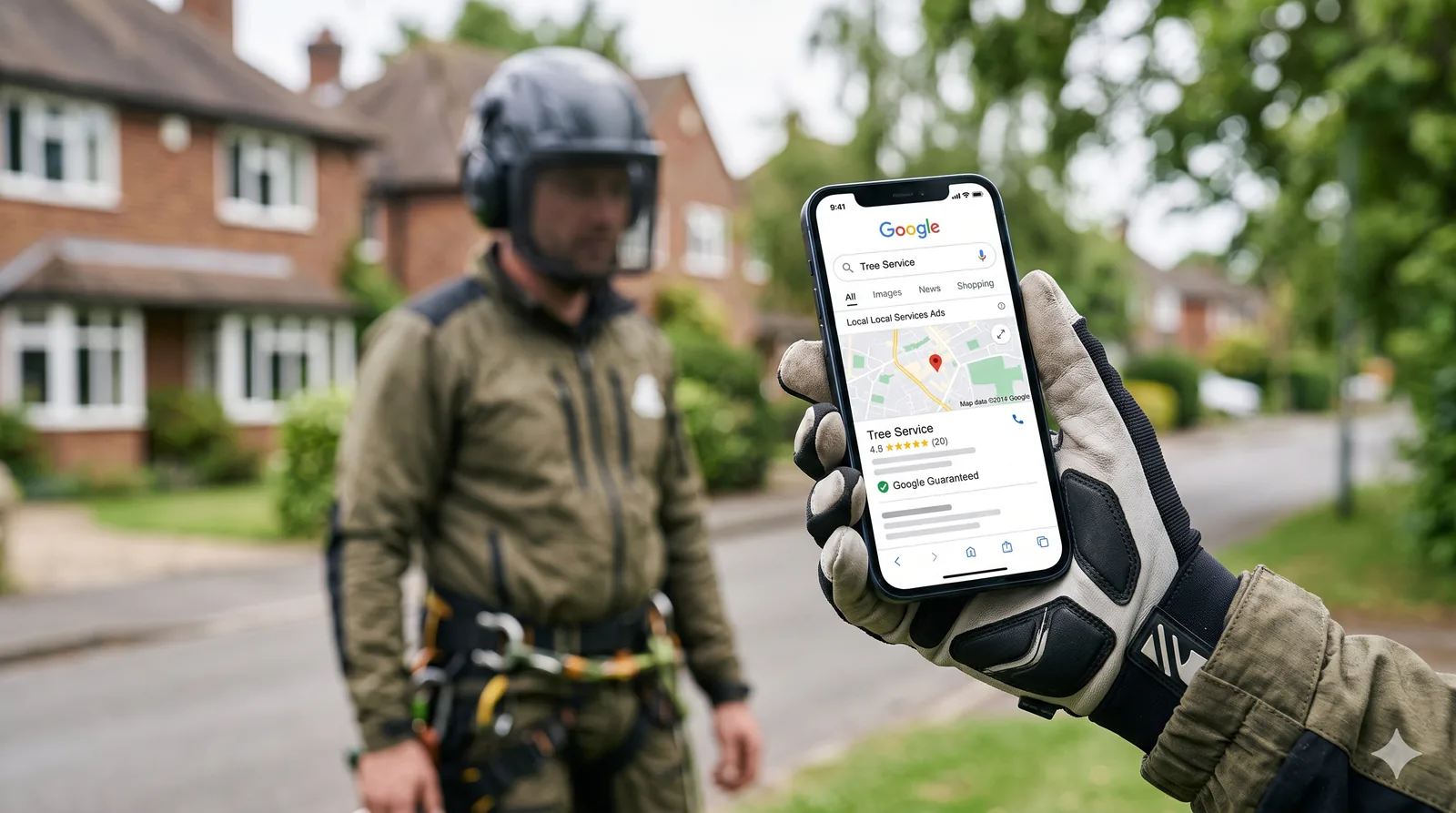
Google Local Service Ads appear above traditional pay-per-click ads and organic results, displaying your business name, star rating, phone number, operating hours, and a green "Google Screened" badge. Unlike standard Google Ads, you pay per valid lead (a phone call over 30 seconds or a message inquiry), not per click. This eliminates wasted spend on accidental clicks, competitor clicks, and users who land on your site but never engage.
To qualify for Local Service Ads in the UK, you must pass Google's screening: business registration verification, proof of insurance (minimum £1 million public liability for tree surgery), and background checks for business owners. Once approved, set a weekly budget (£50-300 is typical for sole traders; £500+ for firms with multiple crews) and define your service area by postcode. Google charges £20-50 per lead depending on service type and geographic competition; emergency tree removal leads cost more than routine pruning because of higher customer lifetime value.
Monitor lead quality weekly and dispute invalid leads through the LSA dashboard. Invalid leads include wrong-number calls, spam, customers outside your service area, and enquiries for services you don't offer. Google refunds disputed leads within 5-7 days if you provide evidence (call recording, message screenshot). Businesses that actively dispute 10-15% of leads (the industry average) reduce effective cost per lead by 8-12%.
Set up geographically targeted Google Search Ads with keywords like "tree surgeon [your town]," "emergency tree removal [county]," "stump grinding [postcode area]." Use location insertion in ad headlines so the ad dynamically displays the searcher's town: "Tree Surgeon in {LOCATION} – Same-Day Service." This personalisation increases click-through rates by 20-30% compared to generic ads, according to Google's 2025 advertising benchmarks.
Your Quality Score—Google's 1-10 rating of ad relevance, landing page experience, and expected click-through rate—directly determines whether you're profitable or bleeding money on clicks. Ads scoring 7+ cost 30-50% less per click than competitors stuck at 4-6. The fix: tighten your keyword match types (phrase and exact match only, never broad), write ad copy that mirrors the searched keyword word-for-word, and send clicks to a dedicated landing page featuring that specific service and location—not your homepage.
Are Google Local Service Ads Worth It for Tree Surgeons?
Yes—but only if you can respond within 60 minutes and convert at 30% or higher. The math: £35 per lead × 35% conversion = £100 cost per booked job. For residential tree surgery averaging £600-800, you're looking at 6-8× return on ad spend, leaving healthy room for labour, equipment, and disposal after costs. Miss either threshold (slow responses or weak conversion) and the numbers collapse fast.
Urban and suburban areas (populations over 30,000) make sense. Rural operators face a harder choice—the cost per lead stays the same, but lead volume can be unpredictable. Some weeks you'll see zero inquiries despite budget sitting there. Combine LSA with organic local SEO and Facebook community groups instead. You'll often get better results from the mix than LSA alone.
That "Google Screened" badge matters more than most tree surgeons realise. It signals background checks and verified insurance—which separates you from uninsured sole traders and cash-in-hand operators in homeowners' minds. For higher-value jobs (£1,500+) where credibility outweighs lowest price, this trust advantage converts noticeably better.
Use Social Media to Showcase Your Work and Generate Referrals
Social media isn't a direct lead channel—it's a portfolio and word-of-mouth amplifier. Homeowners don't browse Instagram planning to hire you next week. They share dramatic content with neighbours and family. Weeks later, when those viewers actually need tree work, they remember your videos.
Post before-and-after photos and short video walkthroughs (15-60 seconds) of difficult jobs: large trees in tight spaces, dangerous leaners, complex rigging, dramatic fellings. Real-time or sped-up videos (4-8×) generate 5-10× more engagement than static photos, according to Meta's 2025 small business data. More engagement means your content reaches friends-of-followers and local community members who don't follow your page.
Short-form clips work best. Capture the moment a tree starts falling, wood chips exploding from the chipper, a climber rigging a limb, or a stump grinder reducing a 3-foot stump to mulch. These "satisfying" moments perform exceptionally well in Reels and feed algorithms. Even with under 500 followers, expect 2,000-8,000 organic views locally.
Encourage satisfied customers to tag your business in their own posts and leave Facebook reviews. User-generated content (a customer posting their cleared garden and tagging you) carries far more weight than self-promotion—it reads as authentic testimony. Reshare those tagged posts (ask permission first) to your story or feed. Steady social proof reassures potential customers.
What Social Media Platforms Work Best for Tree Surgeons?
Facebook wins for UK tree surgeons. Join local community groups (residents' forums, neighbourhood watch pages, home improvement groups) and answer tree questions helpfully—include your business name in your profile so interested members find you easily. When someone posts "Can anyone recommend a tree surgeon?" in a 5,000-member local group and existing customers tag you, expect 3-8 direct inquiries.
Instagram builds brand recognition with younger homeowners (ages 28-45) who value visual proof of skill. Use Stories to document jobs, tag locations (this surfaces your content to location-browsers), and add polls or questions to boost engagement and algorithmic reach. It rarely generates direct leads, but it makes homeowners remember you when they eventually need help.
LinkedIn targets B2B buyers: property managers, facilities managers, estate agents, commercial property owners. Post professional case studies of commercial projects, explanations of legal requirements (TPO applications, conservation area rules), and credentials (NPTC qualifications, Arboricultural Association membership). Direct conversions are rare, but positioning yourself as credible pays off when commercial clients research you after initial contact.
Partner with Property Management Companies and Real Estate Agents for B2B Lead Sources
B2B partnerships deliver higher-value, recurring work. Property management firms overseeing residential developments, housing associations, or estates need regular tree maintenance (inspections, seasonal pruning, storm response) and value reliable contractors they can call repeatedly instead of sourcing quotes for every job.
Search "property management [your town]," check Companies House for firms managing 50+ properties, and ask existing customers if they know estate managers nearby. Approach with a one-page capability statement: insurance coverage, qualifications (NPTC, Arboricultural Association membership), equipment list, emergency response times. Offer a free site visit to assess their portfolio and provide a budgetary quote for annual contract work.
Estate agents recommend tree surgeons to sellers needing garden clearance, overgrown hedge trimming, or tree removal before listing. Sellers move fast (they want on market within 2-4 weeks), care less about price (offset by higher sale value or quicker sale), and often need additional services you can upsell. Offer referral fees (£50-100 per booking) or reciprocal arrangements.
Build referral programmes with contractors, landscapers, and home service coordinators. A landscaper who regularly encounters overgrown trees during garden redesigns becomes consistent lead source if you offer £75 per successful booking or reciprocal recommendations. Track referrals in a simple spreadsheet or shared Google Sheet so partners see accumulated referrals and claim commissions quarterly.
How Do You Partner with Other Businesses to Get Tree Surgeon Leads?
Formal referral agreements prevent confusion. Typical structure: £50-100 per booked job (not per inquiry) or reciprocal referrals. Payment happens after job completion and invoice settlement—not at booking—so your partner has incentive to send serious, ready-to-commit leads, not casual inquiries.
Target businesses that encounter tree issues: landscapers (overgrown trees blocking light or views), groundwork contractors (roots damaging drains or foundations), roofers (branches damaging tiles), builders (trees blocking extensions or conversions). These partners work directly with homeowners actively spending on property—the exact profile most likely to approve tree quotes without endless negotiation.
Maintain relationships through quarterly check-ins, priority scheduling for their referrals, and prompt commission payment (within 7 days of invoice settlement). Partners stop referring if they feel ignored, receive slow service, or chase delayed payments. Treat referral sources as carefully as your best retail customers—they represent recurring, predictable revenue that smooths seasonal cashflow.
Develop a Referral and Customer Retention Programme That Turns Past Clients Into Lead Generators
Existing customers convert highest and cost least. They've already experienced your quality, reliability, and pricing. A structured programme incentivises active recommendation instead of passive mention. Offer £50-100 per successful referral (paid as account credit, bank transfer, or gift voucher within 14 days of job completion).
Remove friction from referral. Send an email or text after job completion with a unique referral link they forward to friends, or provide business cards printed "Referred by [customer name]." Track referrals with a basic CRM, spreadsheet, or dedicated email address (referrals@yourbusiness.co.uk). Easier process = higher volume.
Send seasonal reminders to past customers: storm cleanup (after named storms), winter trimming (January-February before nesting season), spring maintenance (crown reduction, deadwood removal before growth peak). Include a time-limited offer (10% off before month-end). Most past customers won't think about tree maintenance until a problem forces the issue—but they'll hire you again when reminded at the right moment.
Start with a simple customer database: name, address, job type, job date, tree species. Why? Because targeted follow-up works. A customer who had crown reduction 18 months ago needs an inspection. Someone who removed a diseased ash tree should know about checking other ash trees on their property. Emergency storm work customers? They're prime candidates for preventative maintenance contracts. A database of 200 customers contacted twice yearly generates 15-25 repeat bookings annually—no advertising spend required.
Why Are Referrals Important for Tree Surgeons?
Referred customers convert at 40-60%. Cold leads? 10-25%. The difference is trust. When someone calls because a friend recommended you, they've already decided to hire a professional—they just need confirmation you're reasonable. Price objections disappear. They accept premium pricing without flinching. And they become repeat customers themselves, eventually referring 3-5 others over 2-3 years. One satisfied customer becomes five.
Price competition vanishes with referrals. When customers choose based on a recommendation, they're not automatically shopping for the cheapest option on comparison sites. You can price 10-20% above competitors because trust has already replaced price as the deciding factor.
Revenue also smooths out. Those slow months—June and July—when reactive demand drops? Referrals fill the gaps. Two to four bookings per month from past customers covers your fixed costs: insurance, equipment finance, van running. You're not scrambling through quiet weeks.
Consider Paid Platforms and Marketplaces That Connect You With Ready-to-Hire Customers
Checkatrade, Rated People, MyBuilder—these platforms connect you with homeowners actively requesting quotes. Cost: £8-25 per lead. The catch: each lead goes to 3-5 local tree surgeons simultaneously. Conversion drops to 10-18% because customers automatically pick the cheapest quote when comparing five nearly identical options.
Run a 60-90 day trial on any platform. Track three metrics: cost per lead, conversion rate, and average job value from platform customers. If cost per booked job exceeds £150 or conversion falls below 12%, the platform won't deliver profitable returns compared to Google Ads or Local Service Ads. Some platforms deliver genuinely interested homeowners; others are full of bargain-hunters and tire-kickers.
Speed matters on marketplaces. Respond within 30 minutes—platforms rank you higher and send better leads to fast responders with high ratings. An automated text acknowledgement sent within 60 seconds increases conversion by 15-20%, even if the message is generic. You're just confirming you received their inquiry and will call shortly.
Use these platforms tactically. During slow months (June-August), spend aggressively to fill gaps. When October-March brings organic leads and referrals, reduce or pause entirely. Watch your weekly spend and pause immediately if cost per booked job creeps above your target—typically 10-15% of average job value. Dynamic spending prevents over-reliance on expensive shared leads while maintaining baseline flow during quiet periods.
Tired of feast or famine?
Get exclusive tree surgery leads — yours alone
We build and run Google and Meta campaigns for UK tree surgeons only. No shared leads, no resold enquiries. Just local homeowners ringing you for tree work.
Published by Tree Surgeon Leads UK, a specialist marketing and lead generation agency working with UK tree surgeons. For general guidance only.
Frequently Asked Questions About Getting Tree Surgeon Leads
How much should tree surgeons spend on lead generation?
Most businesses allocate 5-10% of monthly revenue to marketing. For sole traders, that's £300-800 per month. Larger firms with multiple crews invest £1,500-3,000. During slow periods, bump it to 12-15% of revenue to maintain baseline lead flow and prevent the cashflow damage that comes from extended gaps between jobs.
How long does it take to see results from SEO for tree surgeons?
Local SEO—Google Business Profile optimisation, location-specific landing pages, customer reviews—typically shows results in 6-12 weeks for low-competition areas, 3-6 months for competitive urban markets. Paid advertising is faster: Google Ads and Local Service Ads generate leads within 24-72 hours. Run both. Paid ads fill your diary immediately while organic SEO builds in the background.
What's the average cost per lead for tree surgeons?
It varies by channel. Google Local Service Ads: £20-50 per exclusive lead. Google Search Ads: £15-80 depending on keyword competition and Quality Score. Marketplace platforms like Checkatrade: £8-25 per shared lead. Referral programmes: £50-100 per booked job. Organic leads from Google Business Profile and SEO cost nothing per lead—just ongoing time to maintain rankings and collect reviews.
Should tree surgeons focus on residential or commercial leads?
Residential closes faster: 3-10 days. Quick decisions, quick cashflow. Commercial takes longer—4-12 weeks—but offers larger contract values and recurring revenue. Successful tree surgery businesses typically run 70:30 or 60:40 residential-to-commercial splits. You get immediate income from residential while building stable, recurring work from commercial contracts.
How do tree surgeons follow up with leads to close more jobs?
Response speed is critical. Conversion rates drop 40% after 2-hour delays. Respond within 60 minutes. Send detailed written estimates within 24 hours. Then make 2-3 additional touchpoints over 7-10 days if they haven't committed. Use a CRM system or simple spreadsheet to track inquiry dates, quote dates, and follow-up schedules. Set reminders to call or text at day 3, day 7, and day 14 after the initial quote.