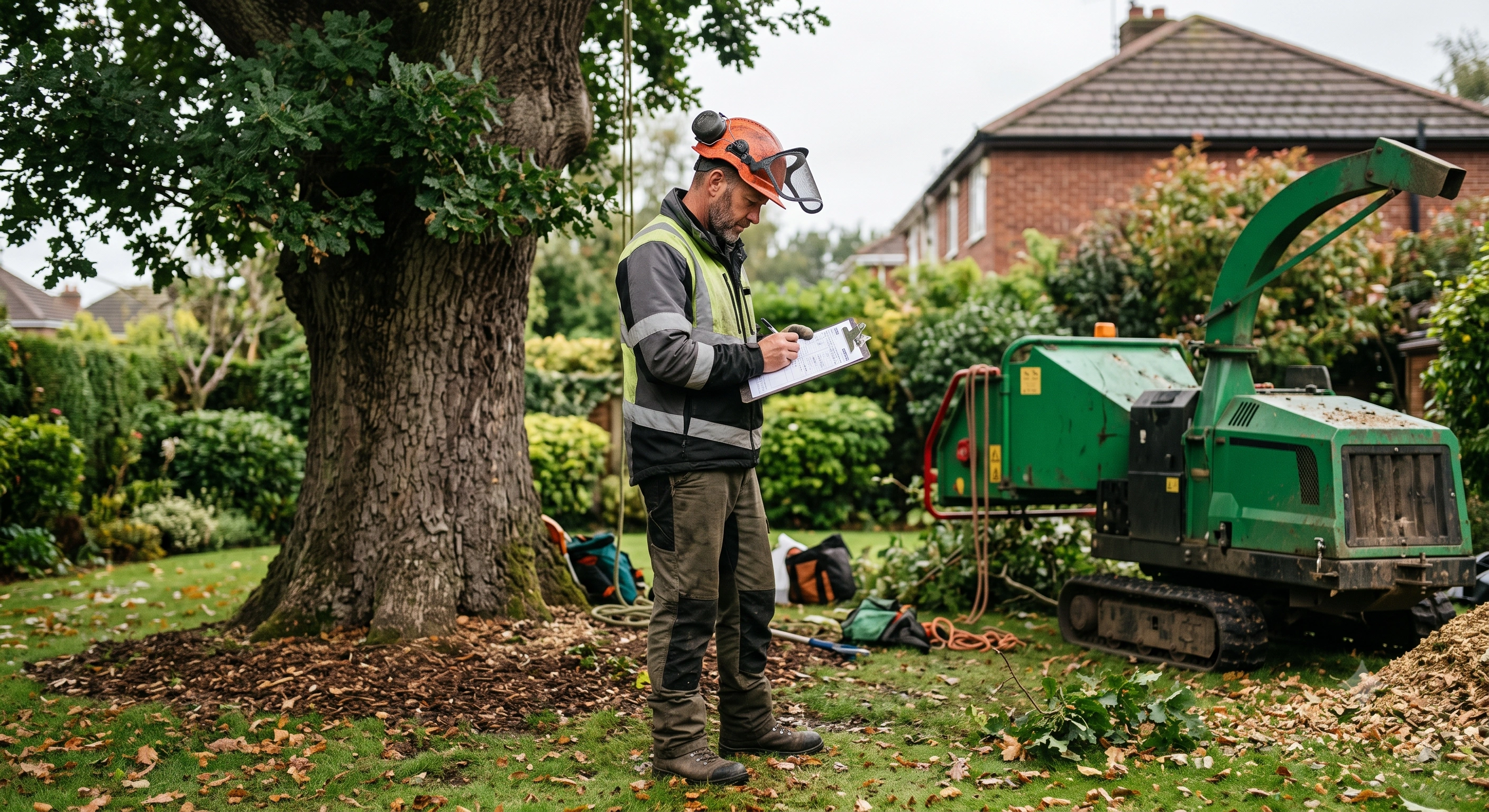
A Gloucestershire tree surgeon won a £3,200 oak-removal tender in February 2025, only to discover halfway through the job that his estimate covered barely half his actual costs. He'd forgotten to price the crane hire, underestimated debris volume by forty percent, and made nothing after three days of work.
Tree surgery pricing combines cost calculation, risk assessment, and market positioning. A profitable quote covers equipment, labour, disposal, insurance, and leaves a 10–20% margin after all expenses. Most UK tree surgeons use either day rates (£400–£700), per-tree pricing (£300–£900 for medium specimens), or itemised quotes that break down each cost component. Miss a single cost category – crane hire, disposal volume, or stump grinding depth – and your margin disappears. So does your profit on the next three jobs.
Tree surgery pricing – the structured calculation of costs and profit margin for arboricultural services, factoring equipment depreciation, labour, disposal fees, risk premiums, and market rates to produce a competitive yet profitable quotation.
Key Takeaways
- Day rates for qualified tree surgeons in the UK average £400 to £700, varying by region, experience, and certification. You're selling your time and expertise, not a fixed job scope.
- Per-tree trimming typically runs £300 to £700 for medium trees (30–60 feet). Pricing must land in that customer-acceptable range while still protecting your margin.
- Minimum fees of £100 to £250 cover mobilisation costs on small jobs. Skip this and a 30-minute drive to prune one branch becomes a loss.
- Emergency premiums of 50–100% above standard rates are justified for storm damage and out-of-hours work. Customers calling at midnight expect to pay for it.
- Target profit margins of 10–20% after all direct costs to sustain a viable business and cover the jobs that underrun.
What Are the Standard Pricing Models for Tree Surgery Work?
Three dominant pricing structures exist in UK tree surgery: day rates, per-tree pricing, and itemised quotations. Each suits different job types and customer expectations.
Day rates bundle labour, basic equipment, and expertise into a single daily charge. A qualified tree surgeon with Level 3 Diploma or CS38/39 chainsaw tickets commands £400 to £700 per day across the UK. Southern England and urban centres push the upper bound; rural Wales, Scotland, and northern regions sit closer to £400. This model works well for maintenance contracts, estate management, and jobs where scope might expand once on site. You're paid for your time and skill regardless of the specific volume of work completed. The risk is yours: if a job runs longer than expected, you've already quoted the day rate. If it finishes early, the customer sees that and may question the value.
Per-tree pricing attaches a figure to each specimen based on size, species, condition, and work type. Medium trees (30 to 60 feet tall) average £300 to £700 for trimming; larger removals can exceed £1,500. Homeowners prefer this approach – they want a fixed price before signing anything. The catch: you must assess the site accurately. A 40-foot ash with decay near a conservatory is not the same job as a 40-foot healthy birch in open ground, even if both fit the "medium tree" bracket. Under-assess and you're working for peanuts. Over-assess and you lose the tender.
Itemised quotations break the job into line items: felling (£X), rigging and dismantling (£Y), stump grinding (£Z), disposal (£W), permits (if applicable). This transparency builds trust with commercial clients, local authorities, and insurance companies. It also protects you when a customer asks to remove one element – "we'll keep the logs" – so you adjust the quote by deleting that line rather than re-pricing the entire job from scratch.
Should I Charge by the Hour or by the Job?
Hourly rates expose you to scope creep and make customers anxious about watching the clock. Most UK tree surgeons avoid advertising hourly charges. If a local authority term contract demands them, expect £50 to £90 per hour for a qualified climber, less for groundsmen. A three-person team at £60 average yields £180 per hour crew rate. Watch your hours closely.
Job-based pricing (fixed-price quotations) wins more domestic work. Homeowners crave certainty. You estimate the hours required, multiply by your internal hourly cost (including overheads), add materials and disposal, then add margin. The customer sees one number. If the job runs faster than expected, you keep the efficiency gain; if slower, you absorb the loss. This approach rewards experience and accurate site assessment – and punishes careless estimates.
Minimum fees of £100 to £250 protect profitability on small jobs. Driving thirty minutes to prune a single branch for £60 loses money once you account for fuel, insurance, and the opportunity cost of a larger job. State your minimum clearly in initial contact so there's no surprise later.
What Is a Typical Tree Surgeon Day Rate?
A qualified tree surgeon (NPTC/City & Guilds certified, minimum three years' experience, public liability insurance) charges £400 to £700 per day in the UK. London and the South East sit at £600 to £700; the Midlands, South West, and East Anglia range £450 to £600; Wales, the North, and Scotland average £400 to £550.
Trainee or groundsman rates run £150 to £250 per day. Crew rates (two climbers plus groundsman) average £900 to £1,400 per day depending on region and whether you supply the chipper and other heavy equipment.
Certification moves the needle. An Arboricultural Association Registered Consultant or someone holding the RFS (Register of Professional Foresters) commands a premium. Specialist skills – large crane operations, confined-space rigging, veteran-tree surgery – justify £700+ day rates even in less affluent regions.
How Do I Calculate My Base Costs Before Adding Profit?
Profitable pricing begins with knowing every cost. Miss one category and your margin evaporates. Break costs into equipment, labour and overheads, and disposal.
Equipment costs divide into fixed and variable. Fixed costs: insurance (public liability, employers' liability, tool cover), vehicle finance or depreciation, chainsaw and climbing-gear replacement cycles, and chipper depreciation. A mid-range 6-inch chipper depreciates roughly £3,000 per year over five years; allocate £12 per working day if you work 250 days annually. Fuel for chainsaw, chipper, and vehicle is variable: budget £20 to £60 per day depending on job intensity and travel distance. Add chain sharpening, bar oil, two-stroke mix, rope replacement (£200–£400 per year for a busy climber), and PPE replacement (helmet, visor, gloves, boots, trousers – £300–£500 annually per team member). Forget PPE in your calculations and you're absorbing personal safety costs out of profit.
Labour is not just wages. For each team member on £30,000 salary, you pay roughly £3,600 employer's National Insurance, plus pension contributions (minimum 3% under auto-enrolment). Real cost per £30k employee: approximately £34,000, or £165 per working day (assuming 205 working days after holidays and sickness). Add your own drawings if you're owner-operator. Many tree surgeons forget to cost their own time – a critical error that turns a "profitable" business into a wage job where you work for nothing.
Disposal fees vary by region and waste type. Green waste to a licenced facility costs £30 to £80 per tonne in most of England; Scotland and Wales may be cheaper. A large oak removal generates 4 to 8 tonnes of brash and timber. If you can sell firewood logs (£60–£80 per cubic metre seasoned), subtract that revenue; if not, it's all disposal cost. Stump grindings (arisings) add another £20 to £40 per large stump if you must remove them from site.
Add these three categories, multiply by estimated job duration, and you have your breakeven cost. Any quote below this loses money.
What Equipment Costs Should I Factor into Tree Work Pricing?
Owned equipment: Spread the purchase price over expected lifespan. A £15,000 chipper lasting five years costs £3,000 per year or £12 per working day (250 days). Add servicing (£300–£600 annually) and insurance (£400–£800). Total daily allocation: roughly £18–£25. If the chipper sits idle one day, you still incur that cost; schedule efficiently to spread it over revenue-generating work.
Rented equipment: Crane hire for large removals runs £400 to £1,200 per day depending on tonnage and operator inclusion. MEWP (mobile elevated work platform) hire: £150 to £400 per day. Pass these directly to the customer as a line item or build into the quote with a markup (10–15% to cover your administration and liability). This is where the Gloucestershire surgeon failed: he forgot crane hire entirely.
Small tools and consumables: Chainsaw fuel and oil, bar oil, rope, karabiners, throw-lines, wedges, and first-aid supplies total £800 to £1,500 per year for a solo climber. Divide by working days for a daily rate (roughly £4–£7). Ignore this and it compounds into thousands over dozens of jobs.
How Much Should I Charge for Stump Grinding vs Tree Removal?
Stump grinding is often quoted separately. Typical UK rates: £50 to £80 for a small stump (under 12 inches diameter), £80 to £150 for medium (12–24 inches), £150 to £300+ for large or multi-stem stumps. Depth affects price: grinding to 12 inches below grade (sufficient for lawn re-turfing) is standard; deeper grinding (for building foundations or replanting) adds cost. Access matters: a stump in a back garden with no vehicle access requires a narrow-track grinder or hand tools, doubling labour time.
Tree removal pricing bundles felling, dismantling, lowering, brash chipping, log disposal or stacking, and site clearance. A medium tree removal (no stump grinding) averages £400 to £900 depending on proximity to structures, lean, decay, and species (dense hardwoods take longer to process). Stump grinding is typically an add-on service priced separately, though some customers request "tree removal including stump" as a package. Bundling can win the sale, but ensure your maths still work. If you've underpriced removal and the customer adds stump grinding, you're locked in at the original margin.
What Risk Factors Should Increase My Tree Surgery Prices?
Risk translates directly to price. High-risk jobs demand more time, more skill, more insurance exposure, and higher chance of equipment damage or injury. Charge accordingly or walk away.
Proximity to structures or services: Any tree within falling distance of a building, greenhouse, fence, or vehicle requires rigging and controlled lowering. This doubles or triples the time compared to an open-felling job. Add 25% to 50% to your base price. Trees overhanging roofs or conservatories need even more care: small cuts, multiple rigging points, and potentially MEWP access. Budget an extra half-day minimum. If the tree is directly above a listed building or has a preservation order, add 50% again.
Power lines: Never work near electricity cables without notifying the Distribution Network Operator (DNO). Overhead lines demand a minimum clearance (typically 3 metres for 11kV, more for higher voltages); closer work requires the DNO to isolate the line, which can take weeks and cost hundreds of pounds. If the customer expects you to absorb that cost, reflect it in your quote. Work near live cables also raises insurance premiums and requires HSE awareness – price in the additional risk and administration. A 50% premium over similar work in open ground is not excessive.
Tree condition and decay: Dead, dying, or structurally compromised trees behave unpredictably. Branches shear without warning. Stems barber-chair. Hidden decay voids collapse under rigging load. This means your work slows dramatically – you assess with a mallet, probe, or resistograph, then dismantle in smaller pieces with more rigging points, possibly switching to a MEWP instead of climbing. The payoff for this caution: add 30% to 60% to standard pricing. Customers often accept the premium once you explain why the tree itself dictates the pace.
Emergency and storm-damage work: A call after a storm, or a tree on a building, commands urgency premiums for a simple reason – you're mobilising outside normal hours, rescheduling other work, and operating in hostile conditions (wind, rain, darkness, adrenaline). Industry standard: 50% to 100% premium over your scheduled rates. A £600 standard job becomes £900 to £1,200. When the customer rings in distress, explain the disruption and risk upfront. Most accept it immediately.
How Much More Should I Charge for Dangerous Tree Removal?
Use a three-tier risk scale to quantify pricing:
- Low risk: Open-ground felling, no targets within two tree-lengths, healthy stem, dry conditions. Standard pricing applies.
- Medium risk: Rigging required, targets within falling distance, minor decay or lean, or moderate access constraints (narrow gate, small garden). Add 25% to 40%.
- High risk: Multiple high-value targets (house, vehicles, neighbour's property), severe decay, power lines, confined space, or emergency conditions. Add 50% to 100%.
Your insurance underwriter prices risk into your premium; you must price it into quotes. A high-risk job that goes wrong can end your business. Either charge enough to justify the discomfort, or walk away.
How Do I Price Tree Trimming vs Complete Removal Jobs?
Tree trimming (crown reduction, thinning, lifting, pollarding) creates less debris than removal but demands precision and time. A careless cut causes decay. You work slower. Trimming a medium tree to British Standard BS3998 takes one climber half a day to a full day, plus groundwork. Here's the cost breakdown:
- Labour: 1 climber (£60–£90/hour) + 1 groundsman (£20–£35/hour) for 4–8 hours = £320–£1,000.
- Equipment: chainsaw fuel, ropes, throw-line, chipper fuel (if chipping on-site): £15–£40.
- Disposal: 0.5–2 tonnes green waste at £15–£80.
- Margin: 10–20% covers your fixed costs and risk.
Total customer price: £395 to £1,340, with most medium-tree trims landing around £475. Light crown-lifts or deadwood removal sit at the lower end; structural reductions or complex thinning (multiple re-positions, careful cut selection) push toward the top.
Complete removal is different. Felling or sectional dismantling, processing all material, stump grinding (often separate), and site clearance. A medium tree takes one to two days for two people. That said, the cost structure shifts:
- Labour: 2 workers for 8–16 hours at blended £50/hour = £800–£1,600.
- Equipment and fuel: £30–£80.
- Disposal: 2–5 tonnes at £60–£200.
- Stump grinding (if included): £80–£150.
- Margin: £115–£415.
Total customer price: £1,085 to £2,445. Most medium-tree removals quote at £1,200–£1,600. Large or complex jobs (over 60 feet, crane required, confined access) easily reach £3,000 to £5,000+.
What Is the Average Cost to Trim a Tree?
UK customers pay £300 to £700 to trim a medium-sized tree (30–60 feet tall). Small trees (under 30 feet) cost £150 to £350; large trees (over 60 feet) range £700 to £1,500. These assume standard access, no power lines, and disposal included. London and the South East run 20–30% higher than Midlands or Northern prices.
Species affects price marginally. Dense hardwoods (oak, beech) process slower than softwoods (pine, spruce), but that difference usually sits within the size-based band rather than being itemised. Crown shape matters more: a spreading oak with co-dominant stems needs more rigging and cut-selection time than a pyramidal conifer.
How Do I Estimate Debris Removal Costs?
Debris volume is where profitability gets buried. Estimate in cubic metres or tonnes before quoting.
A medium tree (12–18 inches diameter, 40 feet tall) generates roughly 2–4 cubic metres of brash and timber when felled and processed. Chipped, that compacts to 1–2 cubic metres. Weight varies: green hardwood chips run approximately 600–750 kg per cubic metre; brash and logs together average 0.5–0.8 tonnes per cubic metre depending on species and moisture.
Your disposal options:
- Chip on-site, leave for customer: No disposal cost. Factor chipper fuel and wear at £15–£30.
- Chip and remove: Tipping fee £30–£80 per tonne plus haulage (allow 1–2 hours round-trip).
- Logs for firewood: Saleable logs (£60–£80 per cubic metre seasoned, £20–£40 green) offset costs. Deduct from disposal or keep as bonus margin.
- Leave logs, remove brash: Customer keeps firewood (increasingly popular). You dispose of brash only – halving disposal cost.
When to itemise: Break disposal out as a separate line (£120 waste disposal) if scope might change – for instance, the customer deciding to keep logs after you've quoted. For simpler quotes, fold it into the total, but track it internally to verify you're actually making money.
What Profit Margin Should I Target on Tree Surgery Jobs?
Aim for 10% to 20% net margin after direct costs (labour, equipment, disposal) but before fixed overheads (office, marketing, accountant). On a £1,000 job, that's £100 to £200 profit – your buffer for surprises, insurance claims, equipment failures, and growth.
Calculate margin, not markup. Markup goes on cost; margin is a percentage of the final price. If costs are £800 and you want 20% margin, price it at £1,000 (because £200 = 20% of £1,000). Mistaken markup – adding 20% to £800 = £960 – gives you only 16.7% margin. Use this: Price = Cost ÷ (1 − Margin%).
Minimum fees protect margin on tiny jobs. A £100 minimum means you won't dispatch a team for less, even if pruning one branch costs you £40 in labour and fuel. The remaining £60 covers fixed costs and keeps the lights on. Most UK tree surgeons set minimums between £100 and £250 depending on region and model.
Know your local market. Rural areas often demand lower prices; affluent suburbs tolerate premiums for reliability and quality. If competitors quote £600 for a £500 job, you can undercut at £550 (10% margin) or premium-price at £650 (30% margin). Your choice depends on positioning.
How Do I Ensure I'm Making Money on Every Job?
Track every job – quoted price, labour hours, labour cost, equipment, fuel, disposal, total cost, and actual margin – in a spreadsheet or job-management software (Arborgold, Jobber, or Excel). Review monthly. Jobs consistently below 10% margin reveal a quoting breakdown.
After completing work, spend five minutes noting what took longer or cost more than expected. Were branches denser? Did the customer add scope on the day? Was access worse than described? Adjust your next estimate for similar jobs.
Walk away from unprofitable work. If a customer demands a below-breakeven price, decline politely. Doing loss-making work to "keep the lads busy" destroys your business inch by inch. Invest that time in marketing, training, or equipment maintenance instead.
How Should I Adjust Pricing for Different Job Circumstances?
Standard pricing rarely transfers unchanged. Each job has variables that reshape the quote.
Seasonal demand: Spring (April–June) and autumn (September–November) peak in the UK. Demand outruns supply; customers accept higher prices. Add a 10% to 15% premium during these months. Winter (December–February) slows; a 10% discount fills your diary and steadies cash flow. Summer sits mid-range – price competitively but don't discount unless work dries up.
Access and location: Urban work with parking bans, residents' bays, or pedestrian zones requires traffic management and permits (£50–£200 from council), often with early starts or evening work to dodge traffic. Add £100 to £300. Rear-garden access with no vehicle entry means carrying equipment, hand-feeding a chipper, or bagging brash – all add labour hours. A half-day job with drive-up access becomes a full day. Double your labour estimate or charge a 30% to 50% access surcharge.
Permits and compliance: Tree Preservation Orders (TPOs) need local-authority consent (six-week determination, sometimes longer). Conservation Areas require six weeks' notice for most work. Factor in your application time and potential delays. If you're handling the application, charge £100 to £250. Protected bat roosts, nesting birds (all protected during March–August), or ancient/veteran designations demand ecological surveys or seasonal restrictions – pass costs to the customer or decline if compliance becomes unmanageable.
Should I Charge More for Emergency Tree Work?
Absolutely. Emergency work deserves a 50% to 100% premium over standard rates. Here's why:
- Disruption: You're rescheduling paying customers, losing efficiency and goodwill in one stroke.
- Urgency: The customer needs it solved now. Next week won't do. That urgency has real value.
- Risk: Storm-damaged trees are unstable, partially failed, often under tension. You're accepting higher personal risk and insurance exposure.
- Unsociable hours: Evening, weekend, bank-holiday call-outs mean sacrificing your personal time. Charge accordingly.
When the customer calls, state the premium plainly: "Our standard rate for this work is £600. As an emergency call-out on a Saturday evening, it's £1,000. Does that work for you?" Most accept without pushback if you explain it calmly. If they hesitate, they're welcome to wait until Monday for standard pricing—which tells you it wasn't truly an emergency.
Pricing right but want more work?
Get more jobs worth quoting
Price well and stay booked — we bring UK tree surgeons exclusive leads to quote on. Book a free strategy call.
Published by Tree Surgeon Leads UK, a specialist marketing and lead generation agency working with UK tree surgeons.
Frequently Asked Questions About Pricing Tree Surgery Work
How much should a tree surgeon charge per hour?
Most UK tree surgeons don't advertise hourly rates—internal costings tell a different story. Qualified climbers run £50 to £90 per hour, groundsmen £20 to £35. A two-person team combined averages £70 to £125 per hour. Still, professionals quote per job or per day instead. Why? Because hourly billing invites arguments: "Why did it take so long?" Per-job pricing rewards your efficiency and avoids disputes over duration.
What is a fair price for tree removal?
Fair price hinges on three things: size, access, and what you're removing. Small trees (under 30 feet) run £200 to £500. Medium trees (30–60 feet) £600 to £1,600. Large trees (over 60 feet) £1,500 to £4,000+. These include felling or dismantling, chipping or log processing, and site clearance—but typically exclude stump grinding and skip hire. Always get a written quote spelling out what's included and what costs extra.
How do you quote tree work?
Visit the site yourself. Assess tree size, species, condition, proximity to structures, access, and disposal needs. Then calculate: labour hours (climber and groundsman separately), equipment costs (chipper fuel, consumables, crane hire if needed), disposal fees, and any risk premium. Add your target margin (10–20%), then present a fixed price or itemised quote. Always confirm insurance, qualifications, and whether permits are required before you submit.
Do tree surgeons charge for estimates?
Domestic work within your local area—typically 20–30 miles—should come with a free quotation. Complex or commercial jobs that need detailed surveys, tree reports, or significant travel are different; those often carry a survey fee of £50–£200, which you can deduct from the final invoice if they proceed. Clarify upfront when you book the site visit whether the quotation is free.
What is the most expensive part of tree removal?
Labour dominates, accounting for 50–70% of total cost. A two-person team working two days at £500 per day alone totals £2,000 before equipment, disposal, or margin—and that's just the labour. Add high-risk trees requiring rigging, crane hire, or MEWP access, and equipment becomes the costliest category. Crane hire alone can exceed £1,000 per day. Disposal ranks third—skip hire or multiple tip runs add up fast on large jobs.
How much should I charge for cleanup and disposal?
Charge £30 to £80 per tonne for green-waste disposal—standard UK tipping fees—plus labour for loading and haulage. A medium tree yields 1–3 tonnes of material. If you chip on site and leave the chip for the customer, charge only chipper fuel and labour (£20–£50). Removing everything? Factor 1–2 hours for travel and tipping into your labour cost. Always itemise disposal separately so customers understand the line item and can choose to keep logs if they prefer.