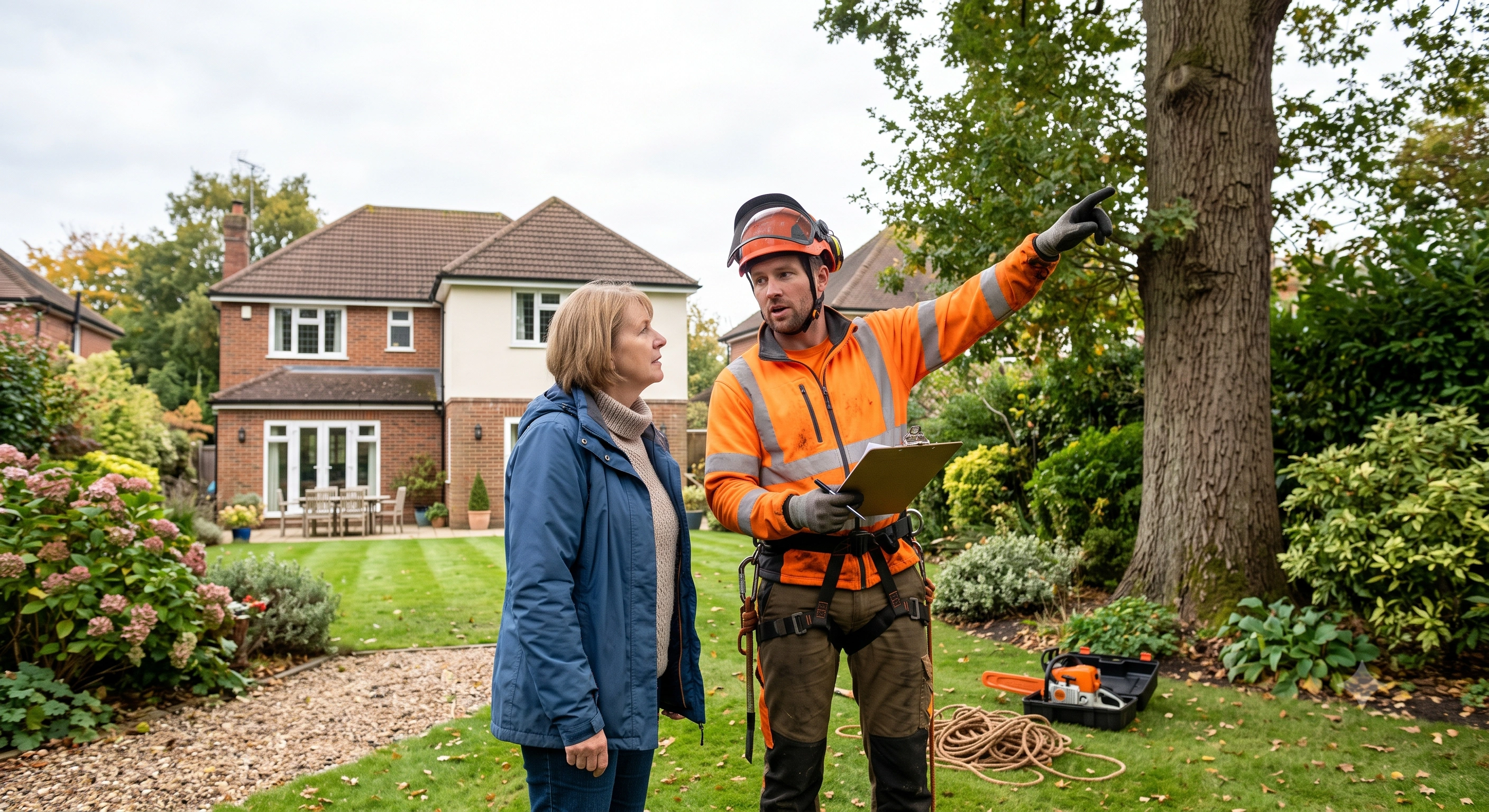
A Hertfordshire tree surgeon lost a £4,200 oak removal contract in March 2025 after submitting a single-line verbal estimate with no itemised breakdown or insurance documentation. The homeowner hired another firm that provided a three-page written quote with measurements, safety certifications, and a clause-by-clause scope of work. One quote was a number; the other was a contract the client could trust.
A professional tree work quote must include a detailed written scope identifying every task, itemised pricing showing labour and equipment separately, and proof of both public liability insurance and employer's liability insurance with policy numbers and valid dates. Quotes missing these elements fail consumer protection standards and lose jobs to competitors who document their work properly.
Tree Service Quote – a written estimate provided to a potential client before tree work begins, detailing the exact tasks to be performed (removal, crown reduction, stump grinding, debris clearance), itemised costs, insurance coverage details, and expected timeline, serving as a binding offer once accepted by the client.
Key Takeaways
- Every quote requires proof of £5M public liability insurance and valid employer's liability cover (£5M minimum under the Employers' Liability Act 1969)
- DBH (diameter at breast height) pricing of £40–£65 per inch of trunk diameter is the UK standard for felling quotes, adjusted by access, proximity to structures, and species
- Written quotes should remain valid for 30–60 days. Most clients expect at least three service-level options: economy, standard, and premium
- Debris removal and disposal often costs 20–30% of total job value in the UK—underestimating here is the most common pricing mistake tree surgeons make
- Never quote without verifying tree ownership and boundaries. Citing the wrong tree or crossing a neighbour's boundary exposes you to civil liability for trespass and negligence
What Should Every Tree Service Quote Include?
A professional quote must contain five non-negotiable components: a complete written scope of work, itemised pricing, proof of insurance, a validity period, and clear payment terms. These elements establish shared understanding before any work begins and protect both you and the client.
Why You Need a Written Scope of Work for Every Tree Job
The scope of work is the single most important section of your quote. It lists every task you will perform: crown reduction to a specific height, felling to ground level, stump grinding to 300mm below grade, chipping all arisings under 150mm diameter, and removing all waste from site. Without this detail, clients claim you promised services you never quoted for.
Use plain language but be specific. "Remove large oak tree" is a disaster waiting to happen; "Fell 18m oak (DBH 28 inches) in sections using MEWP, grind stump to 300mm depth, chip and remove all debris" is a contract. State what you will not do: "Does not include repair to lawn or replacement of turf damaged during access." If the work requires a Forestry Commission felling licence or local authority planning permission, specify who secures it—you or the client. This detail prevents scope creep and legal surprises.
What Information Must Be in an Itemised Tree Service Quote?
Itemisation builds trust and justifies your total. Break costs into labour, equipment hire (MEWP, crane, chipper), disposal fees, and materials (mulch or topsoil if you supply them). Here's what this looks like:
- Labour (3-person crew, 1 day): £900
- MEWP hire (12m): £320
- Waste disposal (6-tonne load, green waste): £240
- Stump grinding (28-inch oak): £180
- Total: £1,640 + VAT
Show the breakdown. A client who sees £1,640 as a lump sum often rejects it as "expensive." The same client who sees £900 for a skilled crew, £320 for specialist access equipment, and £240 to comply with waste regulations understands what they're paying for. Always state whether VAT is included or additional—this catches objections before they become problems.
Include your business name, Companies House registration number or sole trader UTR, contact details, and a unique quote reference. Add the client's name, address, and the exact tree location (especially if it sits on a boundary or in a rear garden accessed through a neighbour's property). Date the quote and state the expiry: "Valid until 15 June 2026." If the price expires, you avoid being locked into an old rate if the client accepts weeks later.
| Section | Must Include | Why It Matters |
|---|---|---|
| Business Details | Name, registration number, contact details, quote reference | Legal requirement for consumer contracts; builds credibility immediately |
| Scope of Work | Every task listed separately with specifications (height, depth, diameter) | Prevents "I thought you were doing X" disputes after work starts |
| Itemised Pricing | Labour, equipment, disposal, materials shown separately; VAT stated | Justifies your total cost; defuses "why so expensive?" objections before they arise |
| Insurance Proof | Public liability (£5M), employer's liability (£5M), policy numbers, expiry dates | Legal requirement under Employers' Liability Act 1969; signals professionalism to clients |
| Validity & Terms | Quote valid until [date], payment terms (deposit, balance on completion) | Protects you from price lock-in if the client delays; sets expectations upfront |
Takeaway: A quote that includes all five elements closes more jobs and prevents disputes. Clients choose the tree surgeon who demonstrates professionalism on paper before demonstrating skill in the tree.
How Do You Calculate Accurate Pricing for Tree Removal and Trimming?
Accurate pricing starts with three measurements: the tree's DBH (diameter at breast height), total height, and proximity to structures or hazards. These metrics determine crew size, equipment requirements, and work complexity—all of which drive labour and equipment costs.
How Much Should I Charge Per Inch of Tree Diameter?
The UK industry standard for basic tree felling is £40–£65 per inch of DBH for trees with good access and no complications. Measure DBH at 1.3 metres (4.5 feet) from ground level using a diameter tape or calculate from circumference (circumference ÷ π = diameter). A 24-inch oak in an open field with clear access might price at £45 per inch: 24 × £45 = £1,080 for felling and sectioning. Quote stump grinding, waste removal, and equipment hire as separate line items so the client sees the full picture.
This per-inch formula is a starting point. A 24-inch ash leaning over a conservatory requires rigging, a MEWP, and a larger crew—that job might run £70 per inch or be quoted on a day-rate basis instead. Per-inch pricing works best for straightforward removals where tree size is the main cost driver.
What Factors Affect Tree Removal Pricing the Most?
Access. The single largest pricing multiplier. A tree in an open front garden with direct road access for a chipper costs half what the same tree costs in a rear garden accessed through a 1-metre side gate. Restricted access may require hand-carrying sections, hiring a spider lift instead of a truck-mounted MEWP, or a crane lift at £800–£1,200 per day. The difference is not minor.
Proximity to structures increases risk and time significantly. A tree overhanging a house, garage, or boundary fence requires rigging every section on lowering lines. Rigging adds one or two crew members and doubles the time on site. A tree within 5 metres of overhead power lines requires notification to the Distribution Network Operator (DNO) and may need an isolate-and-make-safe visit, adding £200–£400 to your quote.
Tree condition affects difficulty sharply. Dead or diseased trees are brittle and unpredictable; hung-up deadwood can fall during cutting. Add 20–40% to your base price for trees with significant decay, rot pockets, or unstable lean. Healthy trees with straight trunks and balanced crowns are faster and safer.
Species matters for disposal costs. Oak and ash are dense and heavy; a single 6-metre log section can weigh 400 kg. Conifer and birch are lighter but produce more volume. Green waste disposal is charged by weight or volume; a lorry load (6–8 tonnes) costs £180–£300 depending on your waste contractor and distance to the nearest licenced facility. Factor species into your waste estimate.
What Insurance and Legal Requirements Must You Verify Before Quoting?
Before quoting any tree work, confirm you hold valid public liability insurance of at least £5 million and employer's liability insurance of £5 million (mandatory under the Employers' Liability Act 1969 if you employ anyone). Include your insurer's name, policy number, and expiry date on every written quote. Many clients now request proof, and increasingly they will reject quotes without it.
Do Tree Service Companies Need Both General Liability and Workers' Comp Insurance?
Yes. Public liability insurance covers damage to third-party property (a falling branch crushes a neighbour's car) or injury to third parties (a passerby is hit by debris). Policies typically cover £5 million as standard, though £10 million is increasingly common for commercial work. One serious accident without cover bankrupts your business.
Employer's liability insurance is a legal requirement if you employ anyone, including subcontractors who are not genuinely self-employed. The Employers' Liability Act 1969 mandates at least £5 million of cover. Display your certificate at your business premises and provide a copy on request. The Health and Safety Executive (HSE) can fine you £2,500 per day for operating without valid cover—that's £17,500 per week.
Many insurers now offer combined policies covering public and employer's liability, tools, and legal expenses. Expect to pay £1,200–£2,500 per year depending on turnover, claims history, and the scope of work (felling vs. pruning only).
What Are the Legal Penalties for Cutting Down the Wrong Tree?
Removing a tree without the owner's permission is trespass and potentially criminal damage. If the tree is protected by a Tree Preservation Order (TPO) or sits in a conservation area, unauthorised felling is a criminal offence under the Town and Country Planning Act 1990. Magistrates can fine up to £20,000 per tree for deliberate TPO breaches. Crown Court fines are unlimited. Always verify ownership and check the local authority register for TPO status before submitting your quote.
Even unprotected trees carry legal teeth. Remove one from a neighbour's land by mistake, and they can sue for the tree's amenity value—calculated using the Capital Asset Value for Amenity Trees (CAVAT) method. A mature oak sits at £50,000–£150,000. Wrongful removal damages can dwarf your public liability cover if you're not careful.
Before quoting work on or near a boundary, verify ownership. Check the title plan at HM Land Registry (£3 per download) and request the client's deeds. Uncertainty? Recommend a joint survey with the neighbour or decline the job. Never accept a client's verbal assurance that "it's definitely my tree." You own the risk if you're wrong.
How Do You Conduct an Effective Site Assessment for Quoting?
A proper site assessment runs 20–40 minutes and delivers everything needed for an accurate quote. Bring a diameter tape, clinometer or laser measurer, camera, notepad, and your insurance certificate. Walk the site together—the client points out concerns, you explain what's feasible and what isn't.
What Measurements Do You Need to Take On-Site?
Measure DBH at 1.3 metres from ground. For multi-stem trees, measure each stem and note separately (e.g., "3-stem birch: 8", 10", 12""). Record height using a clinometer, laser, or educated eyeballing if experienced (a two-storey house reaches roughly 8 metres to the eaves). Height matters less for pricing than DBH, but it steers equipment choice: trees over 15 metres typically need a MEWP; those over 20 metres may demand a crane for large sections.
Next, clearance distances. How far from the house? Garage? Fence? Boundary? Overhead cables? Measure access paths and gates—critical, since a standard towed chipper needs 1.2 metres, a spider lift 0.85 metres, and hand-carrying everything sacrifices speed but eliminates machinery.
Photograph from all four sides: crown, trunk, surroundings. Capture access routes, nearby structures, visible hazards (deadwood, included bark, cracks). These images shield you if the client later claims damage to something already damaged or disputes the agreement.
Note species and condition. Look for decay, fungal brackets, cavities, cracks, dead branches, lean. A tree tilted 15 degrees toward a house demands rigging; the same tree leaning away is faster to fell. Uncertain about hazards? Walk away or bring an experienced climber to the site visit.
Check for overhead cables. Any tree within 5 metres of power lines requires DNO notification. BT or Virgin Media lines carry lower risk but still demand care. Unsure? Phone the DNO (UK Power Networks, National Grid, SSE, etc.) and request a site visit before quoting.
Locate underground services. Ask where water, gas, and drainage run. Look for manhole covers, meter boxes, visible pipework. Stump grinding near services means hand excavation or a permit-to-dig—price this accordingly.
Confirm access consent. If you need to cross a neighbour's driveway or gardens to reach the tree, ensure the client has secured permission in writing. Make access consent a precondition of your quote.
How Should You Present and Deliver Quotes to Customers?
Treat your quote as a professional document. Use a template (Word, Excel, or quoting software) with your branding, contact details, and all the sections above. Send as a PDF via email within 24–48 hours of the site visit. Speed wins: clients often accept the first credible quote they receive.
Should Tree Service Quotes Be Written or Verbal?
Written. Always. Verbal estimates hold no legal weight and give clients nothing to compare. Written quotes prove professionalism, create a clear record, and shield you from "you said you'd do X" disputes. Trading Standards and consumer protection bodies universally recommend written quotes only.
Your written quote should offer three service tiers where feasible:
Economy: Fell the tree, chip and remove waste, leave the stump. "From £980 + VAT."
Standard: Fell, chip, remove waste, grind stump to 300mm, rake and level spoil. "From £1,280 + VAT."
Premium: Standard service plus root barrier if needed, topsoil and turf replacement, same-day completion. "From £1,650 + VAT."
Options boost acceptance. Clients who balk at £1,650 as "too expensive" often embrace £1,280 as sensible middle ground. Frame economy as available, standard as recommended, premium as best for valuable lawns or urgent work.
How Long Should a Tree Work Quote Be Valid?
State validity as 30–60 days from issue. This protects you when clients resurface six months later expecting yesterday's price. After expiry, re-quote at current rates or decline if your schedule is full.
Include payment terms: "A 30% deposit books the work; balance due on completion. Bank transfer, cash, or cheque accepted." For large jobs (£3,000+), stage payments work better—deposit on booking, interim when felling finishes, final on site clearance. Cash flow improves and dispute risk drops.
| Service Level | What's Included | Price (ex VAT) |
|---|---|---|
| Economy | Fell tree in sections, chip up to 150mm, remove all waste, leave stump proud | £1,180 |
| Standard (recommended) |
As Economy, plus grind stump to 300mm depth, rake and level grinding spoil | £1,480 |
| Premium | As Standard, plus supply and lay 150mm topsoil, re-turf affected area, same-day completion | £1,920 |
The reality: Standard wins 60–70% of quotes. Clients see economy as "cheap but incomplete" and premium as "nice but unnecessary." The middle option delivers value and completeness at a defensible price.
Winning quotes but want more of them?
Get more qualified enquiries to quote
A great quote only wins if the enquiry arrives. We bring UK tree surgeons exclusive leads to quote on. Book a free strategy call.
What Common Quoting Mistakes Should Tree Service Companies Avoid?
Three errors cost the most: underestimating disposal, failing to verify ownership, and writing vague scope. Each bleeds money, time, or legal exposure.
Why Do So Many Tree Service Quotes Come In Under Budget?
Tree surgeons routinely underestimate waste disposal volume and cost. A 15-metre oak yields 4–6 tonnes of green waste. At £40 per tonne (South East standard), disposal alone runs £160–£240—often 20–30% of a small job's revenue. Add fuel for the 20–40 mile round trip to the waste site (another £40–£60), and disposal consumes profit before the saw starts. A flat "remove all waste" line at £150 is a loss maker.
Weigh or measure waste accurately. A 6-tonne tipper of fresh oak logs and branchwood fills to the top with tailgate up. Conifer branchwood might weigh half that but occupy the same volume. Know whether your waste contractor charges by weight or volume, then price accordingly. When in doubt, add 25% to disposal estimates; clients rarely dispute waste fees once they see the volume leaving site.
Second: quoting without verifying tree ownership. You arrive to fell a boundary oak and discover the neighbour claims ownership—or joint ownership. The client insists you proceed anyway. Two weeks later, a solicitor's letter arrives alleging trespass and demanding £30,000 for wrongful removal. Your public liability insurer declines because you didn't verify ownership before work commenced.
Always check the title plan and ask for deeds on boundary trees. Ownership unclear? Require written neighbour consent or a boundary surveyor's report. Make it explicit: "This quote is conditional on the client confirming tree ownership and providing written consent from any affected neighbours." Declining a disputed tree costs £200 in lost work. Removing the wrong one costs £50,000.
Third: omitting permit and compliance notes. Trees in conservation areas or protected by TPO require Local Planning Authority permission before work. Your quote must state: "Client is responsible for obtaining permission from the Local Planning Authority before work begins. Work cannot commence without valid consent." If pressure comes to start before consent, refuse. Criminal liability sits with you, not the client.
Frequently Asked Questions About Tree Work Quoting
How do I calculate stump grinding into my tree removal quote?
Price stump grinding separately, based on stump diameter at ground level and depth required. UK standard is 300mm below grade—allowing turfing or replanting. Charge £3.50–£6.00 per inch of diameter: a 30-inch oak stump ground to 300mm runs £105–£180. Grinding to 600mm (for root barriers or building foundations) doubles the cost. Grinding spoil can stay on-site, get raked level, or be removed for extra cost—clarify this in the quote.
What should I do if a customer questions my tree service estimate?
Break down pricing. Walk them through itemised costs—labour, equipment hire, disposal fees, insurance. Clients often assume tree work means "just cutting it down," oblivious to rigging time, traffic management, waste regulations, and insurance. Offer a re-visit to explain what each crew member does and why equipment is necessary. If they're comparing to a cheaper quote, ask what that bid includes; many lowballs omit stump grinding, waste removal, or insurance.
Do I need separate quotes for emergency tree work vs. scheduled work?
Yes. Emergency callouts—storm damage, dangerous trees, roads blocked—come with premium rates. You're responding immediately, working nights or weekends, and bumping scheduled clients. Charge a callout fee (£150–£300) plus labour at 1.5–2× your standard rate. Be explicit in writing: "Emergency callout: £250 + £180 per hour (minimum 2 hours)." Scheduled work gets a fixed price per job, no surprises.
How do I handle additional work discovered after providing the initial quote?
Build a discovery clause into every quote: "This quote is based on conditions visible at the time of survey. Additional work required due to unforeseen hazards, hidden decay, or client requests will be quoted separately before proceeding." Once you hit a hidden cavity, rot pocket, or underground service during execution, stop. Take photos. Contact the client. Provide a written variation quote before you touch anything else. Never—even under pressure—proceed verbally. You'll struggle to collect if the client later disputes the cost, and you've already invested labour.
What's the difference between an estimate and a bid for tree work?
An estimate is rough ("around £1,200–£1,500") with no legal commitment on either side. A quote or bid is fixed: once the client accepts, you're locked in at that price unless conditions genuinely change. Clients love quotes because they know their final bill. Only estimate when the picture is genuinely unclear—tree health requires a climbing inspection, or site access depends on ground conditions you can't confirm yet. The moment you have solid details, convert it to a firm quote.
How do workers' compensation insurance costs affect my pricing?
Employer's liability premiums scale with payroll and risk. Arboriculture sits in the high-risk bracket, so budget 3–6% of gross wages. A three-person crew earning £90,000 combined will cost you £2,700–£5,400 annually in premiums—roughly £10–£20 per crew per day. Over a 200-day working year, that's £13–£27 added to daily costs. Ignore this number when pricing, and you'll slowly bleed margin on every single job.
Published by Tree Surgeon Leads UK, a specialist marketing and lead generation agency working with UK tree surgeons.