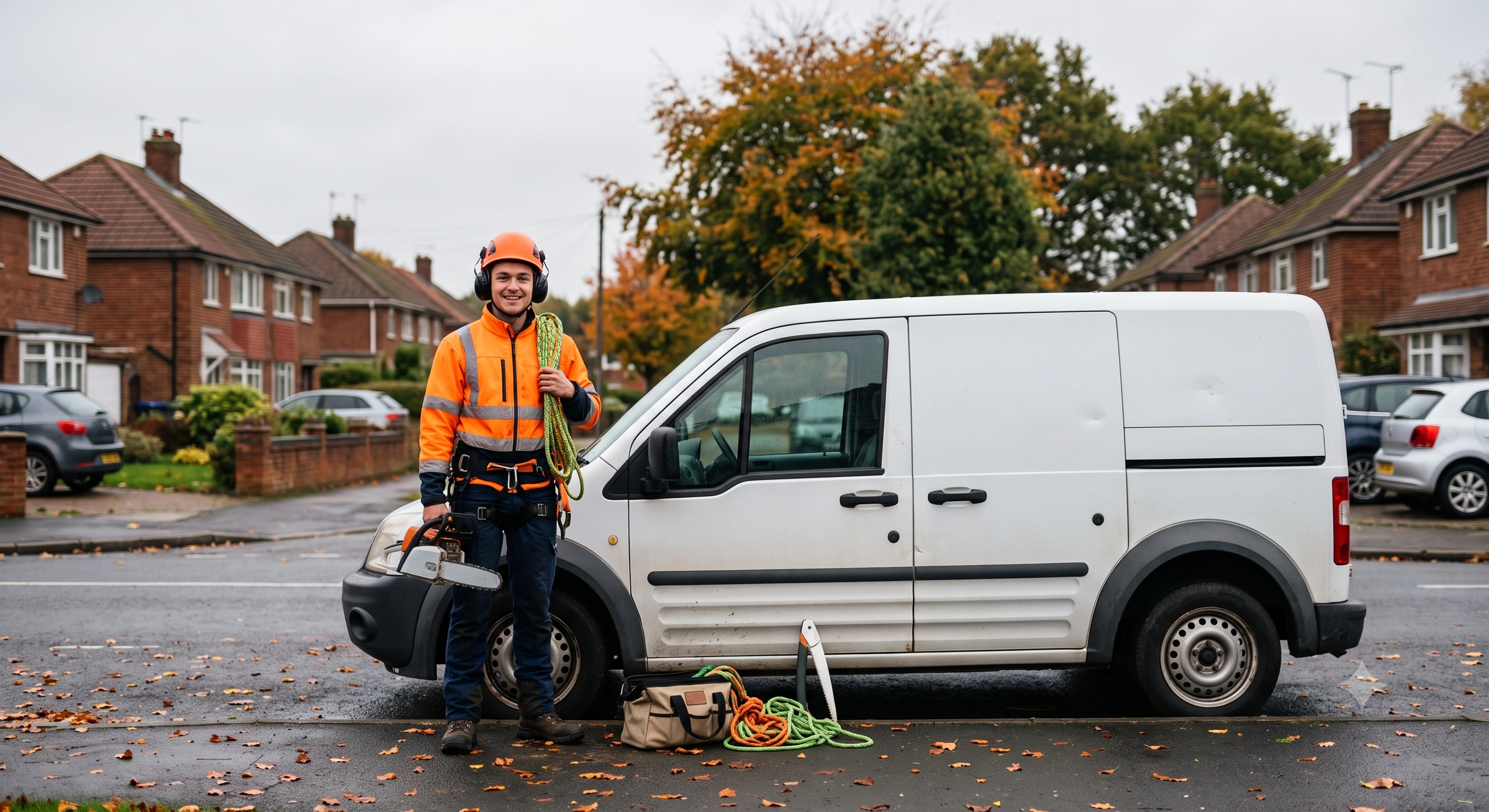
A former groundworker registered his tree surgery business as a sole trader in February 2025, purchased £12,000 of equipment on finance, and began accepting local contracts within six weeks—but faced a £300 fine when a neighbour reported him for working on a tree in a conservation area without the mandatory six-week notice to the council. His oversight cost him the contract and nearly derailed his first season.
Starting a tree surgery business in the UK demands more than just owning a chainsaw. You'll need to register with HM Revenue & Customs as either a sole trader or limited company, hold recognised NPTC or LANTRA qualifications in chainsaw use and tree climbing, comply with the Health and Safety at Work Act 1974, register as a waste carrier with the Environment Agency, and understand Tree Protection Order regulations—which require six weeks' written notice before touching trees in conservation areas. Miss any of these, and you'll face fines, cancelled insurance, or prosecution.
Tree surgery is the professional practice of managing, maintaining, and removing trees through pruning, felling, crown reduction, stump grinding, and risk assessment, carried out by trained arborists who hold recognised qualifications and comply with UK health and safety legislation.
Key Takeaways
- You must register with HMRC as a sole trader or limited company before accepting your first paid job. Sole traders have simpler paperwork but face unlimited personal liability if something goes wrong.
- NPTC chainsaw qualifications (CS30, CS31, CS38, CS39) and LANTRA climbing certifications aren't optional—the Provision and Use of Work Equipment Regulations 1998 make them legally compulsory for hazardous work, and your insurer will deny all claims if you lack them.
- Expect £8,000 to £40,000 in startup costs. This covers equipment quality, vehicle choice, and whether you're hiring staff immediately or starting solo.
- Waste carrier registration with the Environment Agency is mandatory; the upper-tier licence costs £154 for three years and allows you to transport green waste commercially.
- Trees protected by a Tree Protection Order? Working on one without council consent is a criminal offence. Penalties run up to £20,000 fines or prosecution in magistrates' court.
What Legal Structure Should You Choose for Your Tree Surgery Business?
Before you accept a single job, register your tree surgery business with HM Revenue & Customs. The structure you choose—sole trader or limited company—shapes everything: your tax bill, whether creditors can chase your personal savings, and how much paperwork lands on your desk each year.
As a sole trader, you and your business are one legal entity. You file a Self Assessment tax return, pay Class 2 and Class 4 National Insurance contributions, and carry unlimited personal liability for every debt the business runs up. That sounds risky because it is—if a client sues for £50,000 and wins, creditors can take your home, car, and personal bank accounts. Registration is free through the HMRC online portal and must be completed by 5 October following the end of the tax year in which you started trading.
A limited company is legally separate from you. You become a director and shareholder, draw salary and dividends, and file annual accounts at Companies House. Limited liability is the real prize here—if the business owes £50,000, creditors can only chase the company's assets, not yours personally. The flip side: registration costs £12 online (or £40 by post), you're filing accounts every year, and the tax math is more complex. Corporation Tax currently sits at 19% on profits up to £50,000, then 25% above £250,000—compare that to Income Tax at 20%, 40%, or 45% for sole traders.
Most new tree surgeons start as sole traders. Paperwork is minimal, costs are zero, and you're not wasting time on compliance when you should be building the business. Once turnover hits £50,000 or you're hiring staff, incorporation makes financial sense.
One threshold to watch: VAT. The 2026 limit is £90,000 in taxable turnover. Cross it, and you must register within 30 days and charge 20% VAT on every invoice.
| Structure | Liability | Tax rate (2026) | Admin burden | Startup cost | Best for |
|---|---|---|---|---|---|
| Sole trader | Unlimited personal liability | 20–45% Income Tax + NI | Low (Self Assessment only) | £0 | Solo operators, first 1-2 years |
| Limited company | Limited to share capital | 19–25% Corporation Tax | High (annual accounts, PAYE, dividends) | £12–£40 | Multi-crew businesses, turnover >£50k |
Bottom line: Start as a sole trader unless you're forecasting turnover above £60,000 in year one or hiring immediately. The simplicity wins early on. Once you're scaling, a limited company protects your personal assets and cuts your tax bill.
What Qualifications and Certifications Are Legally Required?
Here's the reality: you cannot legally operate a chainsaw, climb a tree with power tools, or perform a rope rescue without holding a Certificate of Competence from an accredited body. The Provision and Use of Work Equipment Regulations 1998 (PUWER) demands it. Your public liability insurer will refuse to cover you without it. The Health and Safety Executive will prosecute you if someone gets hurt.
NPTC (National Proficiency Tests Council) and LANTRA are the two accredited providers whose certificates satisfy the law across the UK. These aren't nice-to-have badges—they're the legal baseline.
Four core qualifications form the foundation:
- CS30 (Chainsaw Maintenance and Cross-Cutting): Two days, £250–£350. Teaches basic chainsaw handling and cutting techniques on the ground.
- CS31 (Felling and Processing Small Trees): Two days, £300–£400. Covers felling trees up to 380mm diameter and processing logs safely.
- CS38 (Climbing and Aerial Rescue): Five days, £800–£1,200. You'll learn rope work, harness systems, and rescue procedures in trees.
- CS39 (Using a Chainsaw from a Rope and Harness): Five days, £900–£1,300. Combines climbing skills with aerial cutting—the most demanding qualification.
Each requires a half-day independent assessment. Most new arborists complete CS30 and CS31 in their first month, then add CS38 and CS39 over the next three to six months as they build experience.
First aid at work (three days, £200–£300) isn't legally mandatory but is industry standard and commonly required in contracts. Other credentials worth pursuing once you're established:
- Arboricultural Association Technician Certificate: 18 months of distance learning. Covers tree biology, risk assessment, and British Standard BS3998 (Tree Work – Recommendations).
- LOLER inspection training: Teaches you to inspect ropes, harnesses, and lifting equipment every six months as required by the Lifting Operations and Lifting Equipment Regulations 1998.
Budget £2,500 to £3,500 for courses, assessments, and PPE during your first year. You're looking at six to twelve months from zero experience to holding all core qualifications.
How Do You Comply with UK Health & Safety Regulations?
The Health and Safety at Work Act 1974 places a legal duty on you—whether you're employed or self-employed—to protect the health and safety of anyone affected by your work: your crew, clients, neighbours, pedestrians, everyone. The Health and Safety Executive (HSE) enforces this through workplace inspections. Breach the duty and you face improvement notices, prohibition notices (stop work), or prosecution that can land you in court.
Start with a written risk assessment before every single job. You must identify hazards (overhead power lines, unstable wood, foot traffic, buried services), decide who could be harmed, and put control measures in place (barriers, signage, traffic management). Document it all and keep the signed assessment for three years. Jobs near roads or in public spaces need traffic management plans compliant with Chapter 8 of the Traffic Signs Manual.
The Provision and Use of Work Equipment Regulations 1998 (PUWER) covers every tool in your van: chainsaws, stump grinders, wood chippers, climbing ropes, harnesses, carabiners. All must be fit for purpose, kept in safe working order, and operated only by trained people. Keep maintenance logs showing inspection dates, parts replaced, and defects found. Daily pre-start checks on chainsaws. LOLER inspections every six months on climbing kit.
PPE matters. British Standard BS EN 381 sets the rules:
- Chainsaw helmet with visor and ear defenders (Class 0, 1, 2, or 3 rated to your chainsaw speed)
- Chainsaw trousers or chaps rated to 20, 24, or 28 m/s depending on the risk
- Safety boots with steel toe caps, chainsaw-resistant panels, and ankle support
- Climbing harness conforming to EN 358 (work positioning) and EN 361 (fall arrest)
- Fall-arrest lanyard with shock absorber and work-positioning lanyard
- Gloves, high-visibility jacket, protective eyewear
Replace PPE on schedule: chainsaw trousers every 18–24 months, helmets every five years, harnesses immediately after any impact or visible wear. Don't guess—follow manufacturer guidance.
What Legal Permissions Are Required Before Working on Trees?
Tree Protection Orders exist for a reason—to preserve important trees. Local planning authorities use them to protect trees valued for amenity, landscape character, or ecology. Commit the offence of working on a protected tree without written consent and you're facing criminal prosecution under the Town and Country Planning Act 1990. Fines can reach £20,000 in magistrates' court or unlimited amounts in Crown Court. Even pruning, thinning, or root cutting counts as work.
Before quoting any job, check the local council's planning register online or call the Tree Officer. Many authorities publish interactive maps showing protected trees and conservation areas. If a TPO applies, submit a formal application describing the work, your reasons, and your qualifications. The council has eight weeks to respond—grant it, refuse it, or approve it with conditions. Emergency work (a dangerous tree posing immediate risk) is exempt, but you must give written notice within five days explaining why delay meant danger.
Conservation areas work differently. All trees with trunk diameters exceeding 75mm at 1.5 metres height get blanket protection. You must give the local council six weeks' written notice before starting work. This window allows the authority to consider whether a TPO should apply. If they do nothing within six weeks, you can proceed. Start early or fail to serve notice, and you face the same penalties as TPO breaches.
Some work is exempt:
- Dead wood removal or cutting down a dead tree (you must prove it's dead)
- Removing dangerous branches that pose immediate risk (with written notice to the council within five days)
- Trees that are subject to a felling licence granted by the Forestry Commission under the Forestry Act 1967
- Work carried out by or on behalf of a utility company to maintain overhead lines or underground services (with notice to the council)
That said, "exempt" doesn't mean "unrecorded." Keep evidence of your justification—photos of dead wood, correspondence from the client about danger, a copy of the felling licence. If the council later questions your work, you'll need proof that an exemption applied.
- Removing dead wood
- Pruning branches up to 75mm diameter
- Fruit tree pruning in domestic gardens
- Work required under statutory obligations—clearing vegetation from highways, for instance
Written records protect you. Photograph council correspondence, keep emails, and note telephone conversations with dates and names. If a client later claims a tree wasn't protected when it actually was, your documentation becomes evidence of due diligence.
How Much Does It Start a Tree Surgery Business?
Startup costs range from £8,000 to £40,000 depending on equipment quality, vehicle choice, and whether you hire staff immediately. A solo operator buying second-hand kit and running from a van might launch for under £10,000. A two-person crew with new equipment, a truck, a chipper, and marketing spend will need £30,000 to £40,000.
Essential Equipment Costs
| Item | Entry-level cost | Professional-grade cost | Notes |
|---|---|---|---|
| Chainsaw (top-handle + rear-handle) | £400–£700 | £1,000–£1,500 | Stihl MS 201 T and MS 261 are industry standard |
| Climbing harness + lanyards | £300–£500 | £600–£900 | Must meet EN 358 and EN 361 |
| Ropes, carabiners, pulleys | £200–£400 | £500–£800 | Rope typically replaced annually |
| PPE (helmet, trousers, boots, gloves) | £250–£400 | £500–£700 | Replace PPE on manufacturer schedule |
| Stump grinder (second-hand) | £3,000–£5,000 | £8,000–£15,000 (new) | Rental option: £80–£120/day |
| Wood chipper (second-hand) | £2,000–£4,000 | £6,000–£12,000 (new) | 6-inch capacity adequate for most jobs |
| Van or pickup + trailer | £3,000–£8,000 | £12,000–£25,000 (new) | Must carry 1–1.5 tonnes payload |
| Hand tools (pruning saw, pole saw, wedges, axes) | £150–£300 | £400–£600 | |
| First aid kit, fire extinguisher, signage | £100 | £200 |
Total equipment range: £9,400–£19,300 (basic second-hand) to £30,600–£57,200 (new professional-grade).
Running Costs (Year One)
- Public liability insurance (£10 million coverage): £600–£1,500 annually. Without this, one claim from a customer whose fence you damaged can bankrupt you.
- Employer's liability insurance (if hiring staff): £200–£500 per employee. Legal requirement the moment you hire anyone.
- Tool and equipment insurance: £300–£700 annually
- Waste carrier registration (upper-tier): £154 for three years
- Fuel and vehicle maintenance: £2,000–£4,000 annually depending on job radius
- Accountancy and bookkeeping: £500–£1,200 annually
- Marketing (website, van signage, local advertising): £1,000–£3,000 first year
- Professional membership (Arboricultural Association): £180–£350 annually
Most new tree surgeons spread equipment costs over three to five years using hire purchase or asset finance at 5–10% interest. Leasing chippers and stump grinders reduces upfront expense to £200–£400 monthly. Some regional enterprise partnerships and rural business grant schemes offer up to £5,000 towards training and equipment—check GOV.UK business finance support for current opportunities in your area.
What Licences and Registrations Are Mandatory?
Beyond HMRC registration, three legal requirements apply: waste carrier registration, public liability insurance, and vehicle operator compliance. Skip any of these and you face fines, contract termination, and uninsured liability exposure.
Waste carrier licence. You need one if you transport green waste—logs, brash, wood chip, sawdust—to disposal sites or firewood customers. The Environment Agency offers two tiers. Lower-tier (free, indefinite) covers transporting only your own waste to authorised sites. Upper-tier (£154 for three years) permits commercial transport of clients' waste elsewhere, which is essential if you collect cuttings and dispose of them off-site. Register at the Environment Agency portal; approval takes five working days. Renewal reminders come 60 days before expiry—miss the deadline and you're operating illegally.
Breaching this rule is a criminal offence. Fixed penalty notices start at £300; prosecution can result in fines up to £5,000 and vehicle seizure. Keep your registration certificate in the van at all times and display your licence number on all advertising and invoices.
Public liability insurance. This covers property damage or personal injury claims arising from your work. Minimum coverage of £5 million is standard; many commercial clients and local authorities demand £10 million. Annual premiums for a sole trader with no claims history range from £600 to £1,200. Here's the catch: insurers void policies if you lack NPTC qualifications, work on TPO-protected trees without consent, or skip risk assessments—always disclose your exact scope of work when applying.
Employer's liability insurance. Mandatory under the Employers' Liability (Compulsory Insurance) Act 1969 the moment you hire anyone, even part-time. Minimum is £5 million; expect £200 to £500 per employee annually. Display the certificate at your premises or make it available electronically to staff on request.
Professional membership through the Arboricultural Association is optional but worthwhile. Costs £180–£350 per year and provides access to technical guidance, legal helplines, and dispute resolution. Membership signals credibility and often reduces insurance premiums by 10–15%.
How Do You Build and Market Your Tree Surgery Business?
Start with a business plan that shapes your service offering, pricing, and route to market. Choose whether you'll focus on residential work (domestic gardens, small pruning, removals), commercial contracts (councils, housing associations, property managers), or specialist services (reports, bat surveys, heritage tree care). Residential clients pay faster and suit solo operators; commercial work brings steadier income but demands higher insurance limits, 30–60 day payment terms, and competitive tendering.
Day rates for qualified tree surgeons currently sit at £250 to £400 in 2026; groundworkers command £120 to £180 daily. For residential jobs, quote per job rather than days. A medium oak removal (12–15 metres, urban garden, crane needed) typically runs £1,500 to £2,500 depending on disposal costs and site difficulty. Storm damage callouts are premium work—£400 to £600 for same-day attendance.
The channels that actually convert new customers:
- Google Business Profile: Free, appears in local map results. Upload high-quality photos, encourage client reviews, keep hours current.
- Website with case studies: Five pages (home, services, gallery, about, contact) costs £500–£1,500 professionally designed or £50–£150 annually via website builders.
- Van signage: Professional vinyl graphics run £300–£800 and generate leads passively every day.
- Social media presence: Facebook and Instagram before/after shots, time-lapse videos, seasonal advice build local visibility without cost.
- Local newspaper advertising: Small display ads, £80–£150 weekly in regional editions.
- Leaflet drops into affluent neighbourhoods: 5,000 A5 flyers printed and distributed for £200–£400.
- Referral incentives: Offer existing clients £50–£100 discounts to recommend you—word-of-mouth is your cheapest source.
Client acquisition costs typically run £30 to £80 per job in year one. Budget £1,500 to £3,000 on marketing before your pipeline becomes self-sustaining through repeat work and referrals.
"In 2025 our agency tracked 47 new tree surgery businesses across England and Wales—clients who invested in Google Business Profile optimisation and regular social media updates acquired their first ten paying customers 40% faster than those relying solely on word-of-mouth referrals."
Staffing depends on workload and cash flow. Hiring a groundworker (£120–£180 per day plus employer National Insurance and pension contributions) doubles output on larger jobs but commits you to payroll, tax deductions, and employer's liability. Many solo operators subcontract groundwork or partner with other tree surgeons for bigger contracts until turnover justifies permanent staff.
Just starting out?
Get your first tree work leads
New tree surgery business? We help you get found and booked fast with targeted Google and Meta campaigns. Book a free strategy call.
Published by Tree Surgeon Leads UK, a specialist marketing and lead generation agency working with UK tree surgeons.
Frequently Asked Questions
How long does it take to start a tree surgery business?
Six to twelve weeks from registration to your first paid job, assuming you already hold core NPTC qualifications. HMRC registration happens immediately online. Your waste carrier licence approves in five working days. Insurance quotes and binding take one to two weeks. Equipment purchase or financing spans two to four weeks. If you still need chainsaw and climbing courses, add six to twelve months of training first.
Can I operate a tree surgery business from home?
Yes. Your property needs to handle vehicle parking, equipment storage, and occasional daytime admin work. Most tree surgeons run mobile operations—they visit client sites daily and use home only as a registered office and storage point. Before you start, check your mortgage or tenancy agreement for business-use restrictions. Equally important: tell your home insurer you're storing commercial equipment and running a vehicle from the property. Fail to disclose, and they'll deny claims when things go wrong.
Do I need planning permission for storing equipment?
Domestic outbuildings and garden sheds used for storage usually fall under permitted development rights—no permission needed—as long as they take up less than 50% of your garden and don't exceed 2.5 metres height (4 metres if dual-pitched roof). Here's the catch: a chipper, stump grinder, and timber pile in a residential area attract complaints. Neighbours report noise and dust. Your council issues an enforcement notice. At that point, renting commercial yard space (£80–£200 monthly) becomes cheaper than the fight.
What insurance do I need as a self-employed tree surgeon?
Public liability insurance is non-negotiable. Clients demand it; most won't hire without proof. Aim for £10 million cover, though £5 million is the legal minimum. Beyond that: tool and equipment insurance (theft, damage, breakdown protection), income protection (pays your bills if injury stops you working for weeks), and legal expenses cover (defends you against claims or contract rows). Employ anyone? Employer's liability becomes law. Expect combined premiums between £1,200 and £2,500 annually as a sole trader.
How do I dispose of tree waste legally?
Green waste travels only to authorised facilities—licenced composting sites, biomass plants, recycling centres. All must hold an Environment Agency environmental permit. You'll need an upper-tier waste carrier licence to transport it. Keep transfer notes (what, where, when) for two years. Burning on-site? Banned in most urban areas under the Environmental Protection Act 1990 and local bylaws. Rural sites have smoke control rules to follow. Skip this step and enforcement action follows.
Can I subcontract work before getting all my qualifications?
Operating a chainsaw or climbing trees for paid work requires NPTC qualifications—you can't cut corners here. What you *can* do: register the business, win clients, quote jobs, and hire qualified contractors to do the physical work while you train. Protect yourself with three steps. First, check your public liability insurance covers subcontracted labour. Second, demand proof of their qualifications and insurance. Third, sign a written agreement spelling out scope, payment, and who's liable for what. This route builds your client base and cash flow during training, so you're not starting from zero once qualified.