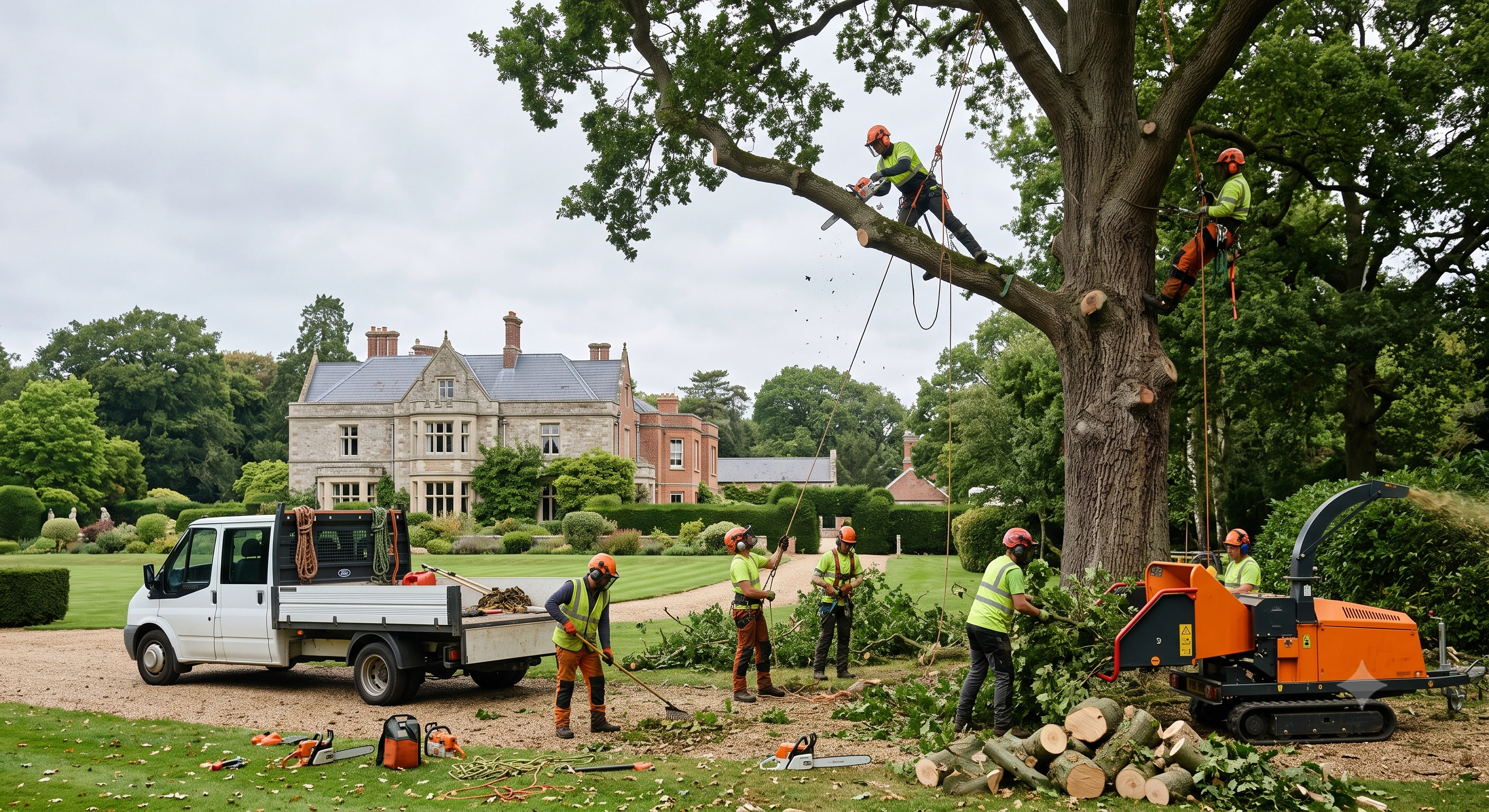
A Midlands tree surgery firm lost five consecutive municipal tenders in spring 2025 before discovering their bids lacked the certifications and evidence frameworks that procurement officers score highest. Once they restructured their submissions around public sector compliance standards, their win rate climbed to sixty per cent within eight months.
Winning commercial tree contracts in the UK demands structured tender responses that meet procurement scoring criteria, verifiable insurance and certification, and evidence of past performance tailored to the buyer's sector. Success hinges on understanding competitive procurement rules under the Public Contracts Regulations 2015 and demonstrating technical competence through Arboricultural Association membership, British Standard compliance (BS 3998, BS 5837), and detailed method statements.
Commercial tree contract – a binding agreement between a tree surgery business and a commercial, public-sector, or institutional client for arboricultural services including maintenance, removal, planting, or consultancy, typically awarded through competitive tender or framework agreements under UK procurement law.
Key Takeaways
- UK public sector advertises contracts over £12,000 (Regulation 106, Public Contracts Regulations 2015) on Contracts Finder. Private-sector opportunities live on construction portals and property management networks instead.
- Winning bids score highest on three fronts: technical competence (certifications, method statements, British Standard compliance), price competitiveness, and documented safety record (HSE compliance, risk assessments, £5–10 million public liability cover).
- Once approved for a framework agreement with local authorities, housing associations, or utilities, you unlock 2–4 years of repeat work and skip the individual tender process.
- Subcontracting through property management firms, facilities companies, and landscapers generates commercial leads faster than tendering alone—especially valuable if you lack dedicated bid-writing capacity.
- Rejected at gateway. Many bids fail screening stage before any scoring happens, typically because required documents (RAMS, insurances, references) are missing or incomplete.
Which commercial tree sectors offer the highest contract volume?
Public-sector clients – local authorities, NHS trusts, schools, highways agencies – account for roughly forty per cent of advertised UK tree contracts by value. These tenders follow strict Public Contracts Regulations 2015 procedures: contracts above £12,000 must be advertised publicly, evaluated against pre-published award criteria, and awarded to the highest-scoring compliant bidder. The formality feels bureaucratic, but it also means transparent deadlines and consistent scoring—no political favouritism.
Private commercial sectors tell a different story. Property management companies overseeing retail parks and business estates, utility firms managing vegetation near overhead lines, housing associations maintaining social housing grounds, and facilities management contractors all subletting arboricultural work. Private tenders move faster but stay equally competitive; buyers prioritise cost certainty, minimal disruption, and a proven track record you can reference by name.
Construction developers need something else entirely: BS 5837 tree surveys, protection plans, and coordinated works during site development. This niche demands both arboricultural consultancy skills and practical tree surgery capability—a rare combination that commands premium fees.
Public vs. private contract characteristics
| Client type | Typical contract value | Award process | Key requirement | Payment terms |
|---|---|---|---|---|
| Local authority | £15,000–£500,000+ | Formal tender (Public Contracts Regulations) | Accreditations, RAMS, references, equality/environmental policies | 30–60 days (often slower) |
| Property management | £5,000–£50,000 | Quotation or mini-competition | Speed, flexibility, commercial insurance | 30 days standard |
| Housing association | £20,000–£200,000 | Framework or tender | Social value, local labour, resident liaison | 30 days |
| Utility (DNO) | £100,000–£2 million+ | Long-term framework (2–4 years) | NRSWA, specialist plant, 24/7 emergency response | 30 days, penalty clauses |
| Private developer | £3,000–£30,000 | Direct award or consultant recommendation | BS 5837 compliance, planning condition discharge | Staged (retention held) |
Takeaway: Public contracts offer volume and repeat frameworks but demand heavy documentation; private work closes faster but requires relationship-building and agility.
How do I find and access commercial tree tenders?
Contracts Finder (www.gov.uk/contracts-finder) publishes every UK public-sector opportunity over £12,000. Search "tree surgery", "arboricultural services", "vegetation management", or "tree maintenance" and filter by region and value. Each notice includes specification documents, award criteria, and submission deadlines—typically 14–28 days from publication. That tight window means you need to check weekly or set up keyword alerts; missing a deadline costs you nothing but the opportunity itself.
Find a Tender (www.gov.uk/find-tender) replaced the EU's OJEU system post-Brexit and lists higher-value contracts above UK thresholds (£213,477 for central government, £663,540 for works contracts as of January 2024). These larger frameworks suit established firms with multi-crew capacity and procurement experience.
Property and facilities management portals—In-Tend, Proactis, Delta eSourcing—host private-sector mini-competitions. Most require supplier registration; approval takes 1–2 weeks. Housing associations often use sector-specific portals (e.g., Aster Group, Clarion Housing supply chains).
Still, the fastest route remains networking. Attend regional Arboricultural Association meetings, introduce yourself to landscape contractors bidding larger maintenance contracts, and approach property managers directly with a capability statement (two-page summary of services, insurances, past projects, and certifications). You'll move slower through formal channels than through a conversation with someone who already knows your work.
What certifications and standards must my bid demonstrate?
Arboricultural Association Approved Contractor status signals technical competence and adherence to the association's code of practice. Public-sector buyers often list it as a minimum or scored criterion. Membership alone isn't enough; the Approved Contractor scheme requires annual audit of insurance, training records, and complaints handling.
British Standards compliance—specifically BS 3998 (Tree Work – Recommendations)—sets out safe working methods, risk assessment, and quality standards. Tenders frequently require written confirmation that all work will follow BS 3998. BS 5837 (Trees in Relation to Design, Demolition and Construction) becomes essential for any development-related work.
Lantra Awards or NPTC (National Proficiency Tests Council) certifications prove operator competence. Common units include CS30 (chainsaw maintenance), CS31 (felling small trees), CS38 (aerial cutting using rope and harness), and CS39 (aerial rescue). Procurement teams expect named operatives' certificates attached to method statements—not the company name, but the person who'll be in the tree.
Mandatory insurance and legal compliance checklist
- Public liability insurance: £5 million minimum (£10 million for public-sector and high-value contracts)
- Employers' liability insurance: £5 million (statutory requirement if you employ anyone)
- Professional indemnity insurance: £1–2 million if you offer consultancy work (surveys, reports, expert witness testimony)
- HSE compliance: Risk assessments, method statements (RAMS), accident record book, training matrix
- COSHH assessments: For herbicides, preservatives, fuel storage
- Waste carriers licence: You need this if removing arisings from site
- NRSWA accreditation: Required for work on or near public highways (streetworks)
- Valid tool and equipment inspection records: LOLER (Lifting Operations and Lifting Equipment Regulations) certification for MEWPs, cranes, winches
Public contracts often demand environmental and equality policies, modern slavery statements, and carbon reduction plans. Template policies work for smaller firms; the requirement is documentation, not expensive consultancy. Missing even one certificate means automatic rejection.
How should I structure a winning tender submission?
Procurement officers score bids against published criteria—typically 60% quality, 40% price for technical services, though the split varies. Quality scoring assesses method statements, relevant experience, resource allocation, risk mitigation, and added value (wildlife protection measures, community engagement, apprenticeship commitment). A cheaper bid loses if your method statement is vaguer or your team's experience doesn't match the scope.
Standard tender structure and content requirements
Executive summary (1 page):
Restate the buyer's requirement in one sentence, confirm your compliance with all mandatory criteria, and summarise your unique strengths—local presence, specialist equipment, sector experience. Buyers read this first; make it specific to their project, not generic company boilerplate. Generic loses.
Technical method statement (2–4 pages per work package):
Describe how you will deliver each element of the specification. Break complex jobs into logical phases. For each phase:
- Site setup, access arrangements, welfare facilities, traffic management
- Equipment and operatives allocated—name qualifications (e.g., "Two CS38-qualified climbers, one CS39 rescue-trained groundworker")
- Step-by-step work sequence with reference to BS 3998 and risk mitigation
- Waste disposal route: recycling targets, licenced carriers
- Programme: Gantt chart or milestone table showing duration and sequencing
High-scoring method statements anticipate site-specific risks (proximity to overhead cables, nesting season constraints, noise-sensitive neighbours) and detail how you'll mitigate them. Generic safety statements don't move the needle.
Relevant experience and references (2 pages):
List 3–5 comparable past projects. For each, state client name, contract value, scope, outcomes, and a contact referee (with permission). Similarity to the current tender matters more than size or prestige. A £20,000 housing association cyclical maintenance contract is more relevant for a similar tender than a £200,000 one-off highway clearance.
Resources and capacity (1 page):
Confirm you can mobilise within the required timeframe. List owned plant (chippers, MEWPs, stump grinders), subcontract arrangements if needed, and evidence of financial standing (turnover, bank reference, or simplified accounts for larger contracts). Buyers use this section to verify you won't overcommit or miss deadlines – a gap here suggests you're bidding on capacity you don't actually have.
Insurances, certifications, policies (appendix):
Attach certificates for public liability, employers' liability, Arboricultural Association membership, NPTC certificates, HSE policy, equality policy, and any requested environmental or safeguarding documents. Omitting even one required document triggers automatic rejection at gateway stage – there are no second chances. Procurement teams cannot waive mandatory requirements, no matter how strong the rest of your bid.
Pricing schedule:
Complete the buyer's pricing template exactly as requested. Most public tenders use bill of quantities (unit rates for measured items) or fixed lump sums per work package. Include all costs: labour, plant, materials, disposal, supervision, contingency. Clarify exclusions and assumptions (e.g., "Price assumes vehicular access within 20 metres of all trees"). Price doesn't guarantee victory – an unrealistically low quote can score zero.
Method statements that reference specific British Standards, name certified operatives, and include site-specific risk controls consistently score 20–30% higher than generic, copied templates. That gap often decides whether you win or rank third.
What are the most common reasons commercial bids fail?
Roughly one in three rejected bids in local-authority tree tenders fail because something is missing. A forgotten insurance certificate. An unsigned declaration. The equality policy. Instant disqualification – before scoring even begins. Procurement teams cannot waive mandatory requirements; a single absent document voids an otherwise excellent bid.
Avoidable bid failures and how to prevent them
| Failure reason | Impact | Prevention |
|---|---|---|
| Missing mandatory document (e.g., insurance cert, RAMS template) | Instant rejection at gateway | Maintain a compliance checklist; tick each required item before submission |
| Generic, non-specific method statement | Low quality score (bottom quartile) | Reference the buyer's site name, tree species, specific constraints; avoid copy-paste text |
| Unrealistic price (too low to be credible) | Zero price-quality score or rejection | Cost every element; include contingency; compare against industry norms (£300–600/day operative rate typical) |
| Failure to answer the question asked | Marks lost for non-responsive answers | Restate each criterion as a heading; answer directly beneath it |
| Late submission | Automatic exclusion (no exceptions) | Submit 24 hours early; portal uploads can time out |
| No relevant case studies or references | Low experience score | Build a portfolio of 6–10 varied past projects; photograph before/after, record client feedback |
Bid late, lose the contract. Public procurement portals lock at the deadline second – a submission at 12:00:01 when the cut-off is 12:00:00 is rejected with no appeal. Upload documents the evening before to allow for technical glitches.
Non-responsive answers waste word count and score zero. You answer the question on your company history when the buyer asks how you'll manage traffic – evaluators score only what directly addresses the published criterion.
How do framework agreements work, and should I pursue them?
A framework agreement pre-qualifies a panel of suppliers for a defined period (typically two to four years) and scope—for example, "tree surgery and arboricultural services across 12 council parks." Once you're on the panel, the buyer can award work through mini-competitions among members or direct call-off, bypassing full tender processes each time.
Frameworks suit buyers who need regular, varied tree work but lack resources to run a new tender constantly. They suit suppliers by reducing bid frequency and building repeat relationships. One caveat: framework membership guarantees no work volume—only the right to quote.
Framework vs. spot contract comparison
| Aspect | Framework agreement | Spot (one-off) contract |
|---|---|---|
| Application effort | High (detailed PQQ, full tender) | Medium (quote or light tender) |
| Work guarantee | None – right to bid only | Guaranteed if you win the tender |
| Duration | 2–4 years (option to extend) | Project-specific (weeks to months) |
| Repeat relationship | Yes – multiple call-offs | No – must re-tender next time |
| Price certainty | Schedule of rates fixed for term | One-off negotiation |
| Best for | Established firms with capacity for multiple concurrent projects | All sizes, especially smaller operators chasing specific jobs |
Joining a framework demands upfront investment—30-page PQQ responses, detailed proposals, compliance evidence. You won't see revenue until call-off work arrives, often 3–6 months after winning your place. Smaller firms frequently succeed faster by targeting spot contracts and building direct relationships with property managers.
Pursue frameworks if: You can resource a detailed application, deliver across multiple sites at once, and afford the months between winning panel membership and receiving your first call-off. Otherwise, focus on quoted work and subcontracts.
What realistic win rates and timelines should I expect?
Win rates for open public tenders range between 10–25% for experienced bidders, lower for newcomers. Competition is fierce. A £30,000 local-authority contract can attract 15–20 bids. Private quotations and framework call-offs perform better—40–60% conversion—because the field is already pre-qualified or smaller.
Public-sector timelines span 8–16 weeks: two weeks to prepare and submit, four weeks for evaluation and clarifications, two weeks for standstill period (mandatory cooling-off allowing losers to challenge), then mobilisation. Private contracts move faster—often quote to instruction within two weeks. If you bid in January expecting March delivery, you'll likely miss that window on a public tender.
Return on investment improves with tracking. Log every tender—client, value, outcome, feedback scores. After 10–15 bids, patterns emerge. Many firms discover their highest ROI isn't prestigious £200,000 highway frameworks but rather £10,000–£30,000 housing-association cyclical work where competition is gentler and you can deliver consistently.
Building commercial pipeline: strategy by firm size
Sole trader / one crew (up to £150k turnover):
Focus on private quotations, subcontracts, and property-management relationships. Avoid complex public tenders unless the contract is small (sub-£15k) and local. Join local business networks (Chamber of Commerce, landowner forums); word-of-mouth and repeat clients drive most work at this scale.
Small firm / 2–3 crews (£150k–£500k turnover):
Bid selectively for public contracts in your region where you have relevant experience. Join 1–2 frameworks (e.g., local authority, housing association) to secure steady work. Allocate half a day per week to tender-writing or hire a bid consultant for high-value opportunities. Subcontract to larger landscaping or civil-engineering firms.
Established firm / 4+ crews (£500k+ turnover):
Compete for regional frameworks and higher-value contracts (£50k–£200k+). Employ a dedicated bid writer or estimator. Diversify across public, utility, and private sectors to smooth cash flow. Consider joint ventures or consortia for large highway or forestry contracts beyond your solo capacity.
Chasing bigger, repeat clients?
Get in front of commercial buyers
We help UK tree surgeons reach property managers, agents and estates with targeted campaigns. Book a free strategy call.
Published by Tree Surgeon Leads UK, a specialist marketing and lead generation agency working with UK tree surgeons.
Frequently Asked Questions
Do I need Arboricultural Association membership to bid for commercial contracts?
Arboricultural Association Approved Contractor status is not a legal requirement but appears as mandatory or scored in roughly 60% of UK public-sector tree tenders. Private buyers vary—some specify it, others accept equivalent evidence of competence (NPTC certificates, insurances, references). Membership costs £300–500 annually; Approved Contractor audit adds roughly £200. The scheme improves bid competitiveness and signals professionalism, making it worthwhile for any firm pursuing regular commercial work.
How much does it cost to prepare a competitive tender?
A public-sector tree contract typically demands 12–20 hours: reading specifications, drafting method statements, pricing, collating certificates, proofreading. At £30–50 per hour (director or estimator time), that's £400–£1,000 in opportunity cost per tender. Hiring a bid consultant costs £500–£2,000 depending on complexity. With a 15–20% win rate, expect to invest £3,000–£8,000 in bid costs to secure a £50,000 contract. Frameworks reduce this burden over time through faster call-off quotes.
Can I subcontract if I win a contract I cannot fully resource?
Most public contracts permit subcontracting with prior written approval from the buyer, provided you retain overall responsibility and your subcontractor meets the same insurance and competence standards. Disclose intended subcontractors in your tender; swapping them later without approval can breach contract terms. Private contracts are more flexible but still require transparency. Never bid for work you cannot supervise or quality-assure; your reputation and insurance cover remain on the line regardless of who performs the physical work.
What is a pre-qualification questionnaire (PQQ), and how is it different from a tender?
A PQQ is a gateway document used by buyers—especially in two-stage public procurement—to shortlist capable suppliers before inviting full tenders. It assesses financial standing, insurance, past experience, technical capacity, and policies (health and safety, equality, environment). Only firms passing the PQQ threshold receive the detailed specification and pricing schedules. Completing a PQQ takes 4–8 hours; it's less detailed than a full tender but equally critical—fail here, and you never see the full opportunity.
How can I improve my chances if I have no track record of large contracts?
Start small. Take contracts in the £5,000–£15,000 range to build case studies and references you'll need later. The risk here is minimal, but the credibility you gain is substantial – buyers want to see you've delivered before they hand you £50,000+ projects.
Partner with experienced firms as a named subcontractor. Their framework agreement or tender can include your resources, giving you both the exposure and—critically—a reference you can cite on future solo bids. This sidesteps the chicken-and-egg problem where no one will hire you because you've never been hired.
Reframe your existing work. Dismantling large trees near residential buildings? That mirrors public park work. Estate maintenance in sensitive locations? That's the same technical discipline as local-authority contracts. Emphasise the skill, not the sector.
Show up in person. Attend local-authority or housing-association "meet the buyer" events before tenders even launch. A face and a conversation beat a cold application every time – and you'll hear what they actually care about, not what you guessed they care about.
If you're still short on capacity, consider consortium bidding. Team with a firm that complements your strengths, and you split both the risk and the workload. You meet their thresholds; they get your specialist skills. It works.