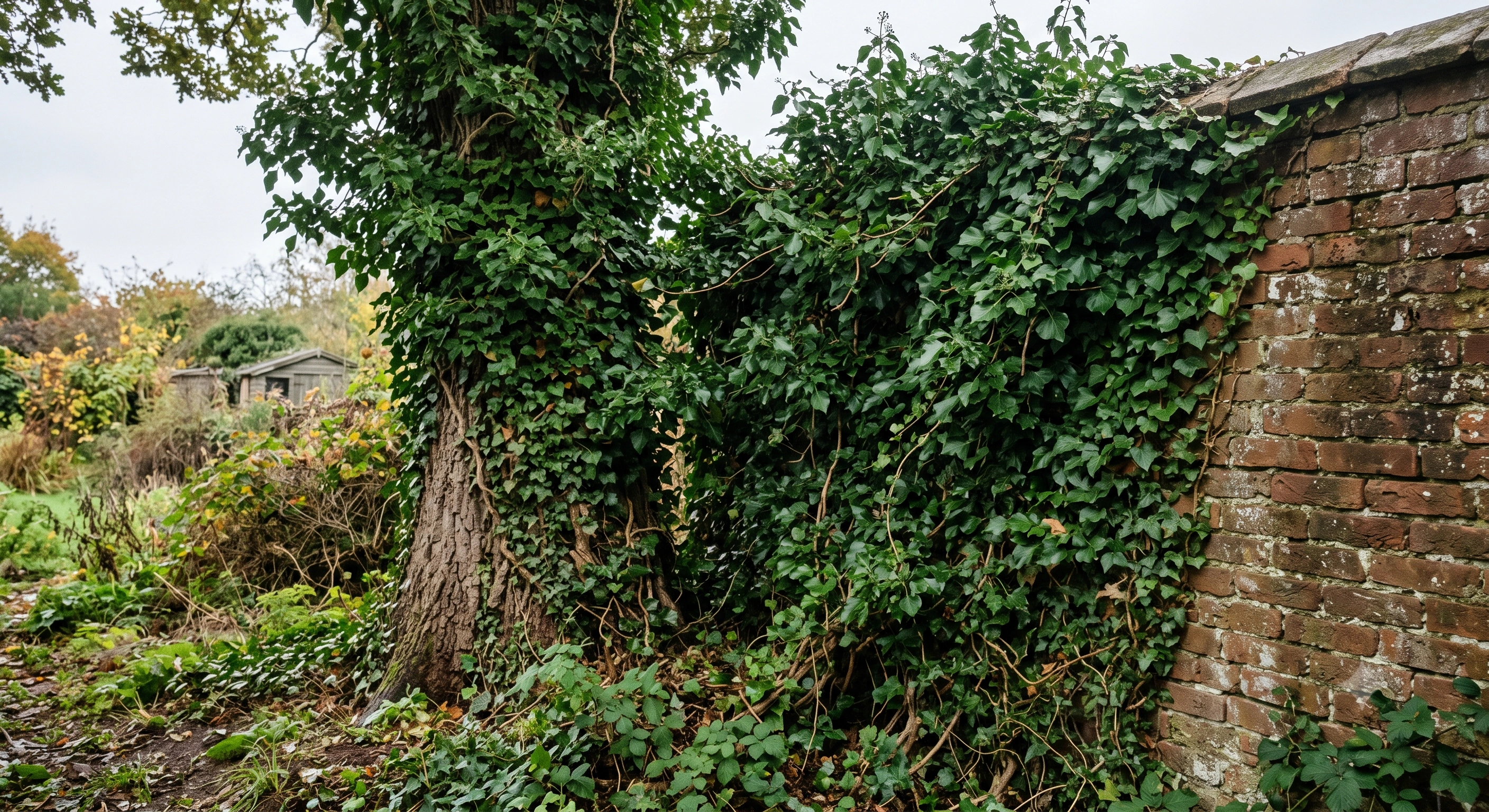
A homeowner in Surrey discovered hairline cracks spreading across her Victorian brickwork in February 2025. The culprit: 15-year-old ivy roots that had penetrated the lime mortar joints. Her insurer refused the claim, citing "gradual deterioration from vegetation" — explicitly excluded under her policy. She faced a £4,200 repair bill and twelve weeks of scaffolding work.
Ivy removal in the UK is legal year-round on your own property, but the Wildlife & Countryside Act 1981 prohibits disturbing nesting birds during breeding season (March through August). Professional removal typically costs £200–£800 depending on wall height, coverage area, and ivy maturity. No planning permission is required for ivy removal unless your property is listed.
Ivy (Hedera helix) — a woody evergreen climbing plant native to the UK that attaches to surfaces using adventitious roots, capable of reaching 30 metres in height and living over 100 years (Royal Horticultural Society classification).
Key Takeaways
- On private property, ivy removal needs no permission. But between March and August, disturbing active bird nests carries criminal liability under the Wildlife & Countryside Act 1981 — fines up to £5,000 per nest.
- Professional removal costs £200–£800 in 2025; listed buildings require specialist approaches at £600–£1,500.
- Cut stems at ground level, then apply herbicide within five minutes. Pulling live ivy tears mortar and brickwork.
- Neighbour disputes over encroaching ivy fall under common-law nuisance — you need documented evidence of actual property damage, not just aesthetic objection.
- Ivy roots stay viable for 18 months after cutting. Without herbicide or stump grinding, regrowth happens roughly 70% of the time.
Is Ivy Actually Damaging Your Property or Just a Nuisance?
Ivy damages buildings through three mechanisms: root penetration into mortar joints, moisture retention against wall surfaces, and physical weight loading on older structures. The Royal Horticultural Society's 2024 research distinguishes between ivy growing on sound masonry — which poses minimal risk — and ivy on deteriorating walls, where adventitious roots exploit existing cracks and accelerate mortar degradation.
Can ivy really damage bricks and mortar?
Ivy causes structural damage primarily to pre-1919 buildings constructed with soft lime mortar. The plant's adhesive rootlets secrete a glue-like substance that penetrates porous surfaces. On walls already suffering from pointing failure or damp penetration, these roots widen existing gaps and trap moisture against the masonry. The Arboricultural Association's technical guidance notes that ivy rarely damages modern cement-pointed brickwork but can destabilise 18th and 19th-century lime-mortared walls within 10–15 years of establishment.
British Standard BS3998:2010 (tree work recommendations) classifies mature ivy as a "significant structural load" when covering more than 60% of a wall surface. A square metre of mature ivy weighs approximately 15–20 kilograms; on a typical two-storey Victorian terraced house, full coverage can add 400–600 kilograms of vegetative mass. That's equivalent to parking a family car against your wall. This weight exerts lateral pressure on already-weakened mortar joints, particularly at eaves level where pointing deteriorates fastest.
The moisture-retention effect matters more than root penetration in most cases. Ivy foliage creates a microclimate of consistently high humidity against wall surfaces, preventing brickwork from drying after rainfall. The Building Research Establishment's 2023 study found that ivy-covered walls retained moisture for 48–72 hours longer than exposed walls — significantly increasing frost-damage risk when temperatures drop below freezing in winter months.
When does ivy become a legal nuisance between neighbours?
Ivy becomes actionable nuisance under common law when it causes material interference with a neighbour's reasonable enjoyment of their property. Courts assess nuisance claims using the test established in Hunter v Canary Wharf — the interference must be substantial, continuing, and unreasonable in the context of the locality.
For ivy specifically: you must demonstrate measurable harm. Photographic evidence of root penetration. Surveyor reports documenting mortar damage. Blocked guttering requiring emergency clearance. Simply disliking the appearance of a neighbour's ivy does not meet the legal threshold. The Civil Procedure Rules require claimants to attempt pre-action correspondence and consider mediation before filing nuisance claims; most county courts expect a minimum of two written requests for removal before accepting a case.
Overhanging vegetation remains the property and responsibility of the tree or plant owner, even when it crosses boundary lines. You may cut back to the boundary line without permission, but you must offer the cuttings back to the neighbour — they remain their property under common law.
Property-line disputes typically cost £1,500–£4,000 in legal fees if they reach county court. That said, alternative dispute resolution through mediation services (average cost £400–£800) resolves approximately 70% of neighbour plant disputes without court proceedings, according to the Civil Mediation Council's 2025 statistics.
What Does UK Law Say About Removing Ivy from Your Garden?
No statute requires or prohibits ivy removal on private property. The Wildlife & Countryside Act 1981, Section 1, makes it an offence to intentionally damage or destroy the nest of any wild bird while it is in use or being built. Ivy provides dense nesting habitat for wrens, robins, blackbirds, and spotted flycatchers; the breeding season runs March through August, with peak nesting activity in April and May.
Do I need permission to remove ivy from my property?
You need no permission to remove ivy from an unlisted building. Grade I, Grade II*, or Grade II listed buildings are different. You must notify your local planning authority if ivy removal will require repointing or structural repairs that alter the building's character. The Planning (Listed Buildings and Conservation Areas) Act 1990 requires Listed Building Consent for works affecting the special architectural or historic interest of a listed structure.
Conservation Area Consent is not required for ivy removal alone, but if the ivy grows on a boundary wall exceeding one metre in height abutting a highway, or two metres elsewhere, and removal necessitates rebuilding, you must submit a Section 74 notice to the local planning authority six weeks before commencing work. Approximately 12% of UK properties fall within Conservation Areas as of 2025 data from Historic England.
Tree Preservation Orders (TPOs) do not cover ivy unless the ivy is growing on a protected tree. If ivy completely envelops a TPO-protected tree, you may remove it without consent under the exception for "preventing or abating a nuisance", but best practice involves notifying the local authority tree officer beforehand. Damage the host tree during ivy removal? You breach the TPO and face fines up to £20,000 in magistrates' court.
What are the legal consequences of removing ivy during nesting season?
Disturbing active bird nests constitutes a criminal offence under the Wildlife & Countryside Act 1981, punishable by fines up to £5,000 per nest or six months' imprisonment. The offence is strict liability — intent is irrelevant; if you damage a nest, you are liable whether or not you knew it was there.
Before starting ivy removal between March and August, instruct a qualified ecologist to conduct a nesting-bird survey. Surveys cost £150–£350 depending on property size and typically take one to two hours. If active nests are found, you must wait until fledging completes — usually four to six weeks from egg-laying. Robins and wrens may produce two or three broods in a single season, potentially delaying work until September.
The Royal Society for the Protection of Birds recommends removal work between October and February when birds are not nesting. This timing also benefits the plant-removal process: ivy sap flow reduces in winter, making herbicide treatment more effective on cut stems.
How Do You Actually Remove Ivy Without Damaging Your Property?
The cut-and-treat method prevents wall damage and kills ivy permanently. Cut all stems at ground level using loppers or a pruning saw, leaving the upper growth attached to the wall. Apply glyphosate-based herbicide (such as Roundup Pro Vantage or Gallup Hi-Aktiv) to the cut stumps within five minutes — the stem's vascular system draws herbicide into the root mass before the wound seals.
What is the best method to kill ivy permanently?
Glyphosate application to freshly cut stems achieves 95% kill rates when applied between April and October, according to the Arboricultural Association's technical guidance. Dilute glyphosate to manufacturer specifications (typically 1:50 for woody climbers) and paint directly onto cut surfaces using a brush. Spraying foliage is less effective because mature ivy's waxy leaf cuticle repels water-based herbicides.
Triclopyr-based herbicides (such as Vitax SBK Brushwood Killer) work better on ivy than glyphosate in cold weather. Triclopyr remains active at temperatures as low as 5°C, whereas glyphosate efficacy drops sharply below 12°C. Apply triclopyr as a basal bark treatment to stems up to 10 centimetres diameter: mix with penetrating oil and paint onto the lowest 30 centimetres of stem bark. The herbicide penetrates bark and kills the root system within 8–12 weeks.
Stump grinding removes ivy root crowns after herbicide treatment takes effect. Hire a stump grinder (£80–£120 per day) or instruct a tree surgeon to grind stumps 15–20 centimetres below ground level — this prevents regrowth from dormant buds in the root crown. Without herbicide or grinding, regrowth occurs in roughly 70% of cases, sometimes within months.
Should I pull ivy off walls or cut it first?
Never pull live ivy off walls. Living ivy clings to masonry using thousands of adhesive rootlets; pulling tears away mortar, renders, and brick faces. The Arboricultural Association's best-practice guidance requires cutting all stems first, waiting 6–12 months for upper growth to die and desiccate, then removing dead ivy by hand.
Dead ivy releases from walls far more easily than living growth. After six months, desiccated stems lose adhesive strength and can be peeled away with minimal force. Use a stiff brush or wooden spatula to remove residual root pads — avoid wire brushes or pressure washers on soft brick or lime-rendered surfaces, as these erode the substrate.
For urgent removal (such as pre-sale property preparation), professional ivy-clearance teams use steam cleaners to soften adhesive pads without damaging masonry. Steam treatment costs £15–£25 per square metre but allows same-day removal of dead ivy from Victorian brickwork without repointing damage.
| Removal Method | Cost | Timeline | Wall Damage Risk | Regrowth Prevention |
|---|---|---|---|---|
| Cut + herbicide (DIY) | £40–£80 (materials) | 6–12 months (die-back period) | Minimal | 95% effective |
| Professional cut + treat + removal | £200–£800 | 1 day cutting + 6 months die-back + 1 day removal | Minimal | 95% effective |
| Pull live ivy (not recommended) | £0 (DIY) | 1 day | High (mortar + render damage) | 70% regrowth rate |
| Steam + mechanical removal | £15–£25/m² | 1–2 days | Low (if done by specialists) | Requires separate herbicide treatment |
Takeaway: cut-and-treat wins for structural safety and permanent results. Pay the £200–£800 for professional work if your property is listed, over three storeys, or has existing masonry damage.
What Are Your Rights When a Neighbour's Ivy Crosses Property Lines?
You may cut back overhanging ivy to the boundary line without seeking permission. This follows common law — the same principle that governs tree branches encroaching on your side. The catch: you cannot trespass onto their land, lean equipment over the boundary, or let herbicide drift across. Clippings technically remain their property, though most neighbours don't care.
Can I force my neighbour to remove ivy encroaching on my property?
Not unless you prove nuisance in law. Common-law nuisance requires evidence of material harm — not mere annoyance — and that the harm is unreasonable given your neighbourhood's character. A 50-year-old ivy on a rural Cotswold cottage's boundary wall? Typical. The same on a suburban Manchester semi-detached house? Courts might view it differently.
To build a winnable case, document damage with time-stamped photographs, get a surveyor's report showing repair costs, and keep written records of every conversation with your neighbour. Send a formal letter (recorded delivery) requesting removal and giving them 28 days to respond. If they refuse or ignore you, instruct a solicitor to issue a Letter Before Action threatening court proceedings unless the nuisance stops within 14 days.
County court injunction proceedings cost £1,500–£4,000 in legal fees alone. The case takes 4–8 months to hearing. Win, and the court orders removal plus may make them pay your costs. Lose, and you pay both your costs and theirs. Before court, try mediation through the Civil Mediation Council or your local authority — it costs £400–£800 split between you, typically resolves disputes in 6–8 weeks, and succeeds about 70% of the time.
Who pays for ivy removal when it crosses boundaries?
The owner of the land where the ivy originates pays for removal on their side. You pay for cutting overhanging growth on your side. If ivy damages guttering, blocks drains, or penetrates mortar, you can claim those specific repair costs from your neighbour as damages arising from nuisance — but only if you keep receipts, photographs, and a surveyor's statement linking the damage directly to the ivy, not general wear.
Your neighbour's home insurance may cover this under public liability (usually £2 million minimum), but insurers often reject vegetation claims, arguing the owner should have maintained the property to prevent it. Don't expect quick reimbursement.
Party Wall Act 1996 doesn't apply to ivy removal unless it grows from a party wall (a wall straddling the boundary). If removal requires digging near a shared wall or underpinning work affecting their foundations, you must serve a Party Wall Notice three months ahead.
How Much Does Professional Ivy Removal Cost in the UK?
Expect £200–£800 for a typical semi-detached or terraced house with ivy coverage up to 40 square metres. London and the South East run £600–£800; Midlands and North England £300–£500; Scotland and Wales £200–£400. Regional labour costs and contractor density explain the spread.
A quoted price normally covers initial cutting, herbicide application, waste disposal, and one follow-up visit six months later to remove dead growth. Add £400–£1,200 if scaffolding or a mobile elevated work platform (MEWP) is needed — height and site access drive the cost. Listed buildings require specialists trained in lime mortar and historic fabric. Budget 50–100% more: £600–£1,500 total.
Is ivy removal covered by home insurance?
No. Standard buildings insurance excludes gradual deterioration from vegetation. Storm damage to trees is covered; ivy creeping across your wall for years is not. The distinction: sudden, unforeseen events are in; predictable maintenance is out.
The one exception is sudden ivy collapse. If a mature crown tears away render in a single event, your insurer might pay. Trace-and-access cover (included in most comprehensive policies) pays for investigative work to find hidden damage but not the vegetation removal or the gradual damage itself.
If a neighbour's ivy damages your property, chase their public liability insurance. If they have no cover or the insurer refuses, take them to small claims court for claims up to £10,000, or county court for larger amounts.
What Should You Do After Ivy Removal to Restore Your Property?
After dead ivy removal, address the stubborn brown adhesive pads — the rootlets left behind. Scrape with a wooden or plastic tool, never metal (metal gouges soft brick). For stubborn pads on hard surfaces, try 10% washing-up liquid in warm water, let it sit 15 minutes, then scrub with a stiff nylon brush.
How do you clean walls after removing ivy?
Pressure washers work well on modern hard brick and cement render. Modern buildings, yes. Victorian soft brick or lime render? No. If you do use a pressure washer, stay below 1,000–1,500 psi and keep the nozzle 30 centimetres from the wall. Pre-1919 buildings benefit from low-pressure steam or the DOFF system — superheated water at 150°C and low pressure, approved for listed buildings, removes organic stains without harming masonry.
Chemical cleaners for biological growth (Baticlean CR, Tensid) dissolve sap and adhesive residue. Mix as instructed, brush on, wait 10–20 minutes, rinse hard. These are alkaline; wear gloves and eye protection. Keep runoff away from planted areas.
Repoint any damaged mortar joints to seal against weather. Use lime mortar (NHL 3.5 or 5) for pre-1919 buildings, matching the original mix as closely as you can. Cement-based pointing traps moisture in old brickwork and causes spalling. Lime mortar costs £50–£90/m² (labour-intensive) versus £30–£50/m² for cement. Book lime-mortar specialists 8–12 weeks ahead.
When replanting, the Royal Horticultural Society recommends climbers less damaging than ivy: star jasmine uses twining stems rather than adhesive roots; climbing hydrangea suits shaded north-facing walls; wall-trained shrubs like pyracantha and cotoneaster need trellis support and never contact masonry directly.
Ivy taking over your trees or walls?
Find a local tree surgeon
Removing established ivy safely takes the right approach. We connect UK homeowners with vetted, insured tree surgeons who can help.
Frequently Asked Questions About Ivy Removal in the UK
Is it illegal to remove ivy from trees in the UK?
Legal on your own property unless a Tree Preservation Order or Conservation Area applies. Ivy rarely kills healthy trees, but it can topple weakened ones. Have a TPO? Notify your local tree officer before work to confirm it counts as maintenance, not prohibited tree work.
How long does it take for ivy roots to die after cutting?
Roots die in 8–16 weeks after cutting and herbicide treatment. Above-ground growth takes 6–12 months to fully dry out. Visible die-back starts within four weeks: leaves brown, stems turn brittle, adhesive pads lose their grip. Wait at least six months before removing dead ivy from walls — it minimises damage to masonry.
Will removing ivy damage my wall?
Dead, desiccated ivy causes minimal damage. Live ivy? Pulling it tears mortar, render, and brick because thousands of adhesive rootlets bond to porous surfaces. Cut stems first, apply herbicide, wait 6–12 months for die-back. Professional removal by qualified arborists using proper technique rarely damages sound masonry.
Can ivy removal be done in winter?
Winter (November through February) is optimal. Birds aren't nesting, herbicide avoids breeding-season disturbance, and reduced sap flow makes chemical treatment more effective. Triclopyr-based herbicides outperform glyphosate in cold weather and remain active down to 5°C.
Do I need to notify anyone before removing ivy?
Unlisted buildings outside Conservation Areas need no notification. Listed buildings? Inform your local planning authority if removal requires repointing or structural repairs. One more rule: if ivy hides a bird's nest between March and August, you must stop immediately and wait for fledging — the Wildlife & Countryside Act 1981 treats this seriously.
What happens if I accidentally disturb a bird's nest while removing ivy?
Disturbing an active nest is a strict-liability criminal offence under Section 1 of the Wildlife & Countryside Act 1981. The penalties are severe: fines up to £5,000 or six months' imprisonment. Even accidental disturbance counts, though courts do weigh intent and whether you took reasonable precautions before starting work.
If you find a nest mid-removal, stop immediately. Cordon off the area and wait—typically four to six weeks—until fledging completes. The financial and reputational cost of halting work is real, but continuing is far worse. Document everything: take photographs, record the date and location, and if you're hiring contractors, get written confirmation that they've paused operations.
That said, you can protect yourself. A pre-work nesting-bird survey (ideally March to August, peak breeding season) identifies active nests before you touch anything. If a survey finds birds, you have a clear record of due diligence. Courts recognise this as reasonable precaution and it substantially weakens any prosecution case if something unexpected happens later.