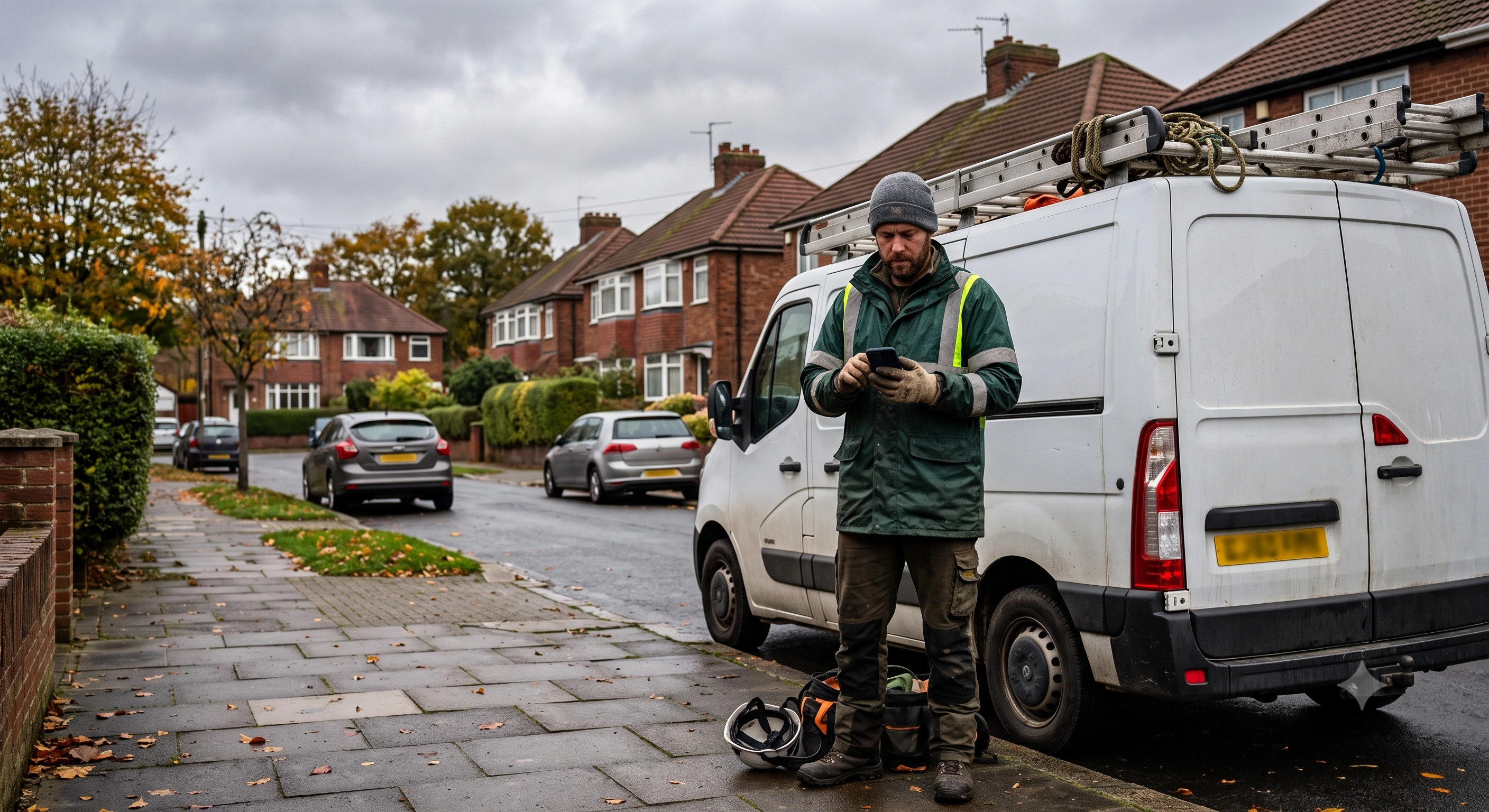
A Hertfordshire tree surgeon with 15 years' experience watched a three-month-old competitor appear above him on Google Maps for "emergency tree removal Watford" in January 2026. The new firm had booked eight jobs from that single search term while his phone stayed quiet. The difference wasn't skill, insurance, or price—it was understanding how search engines rank tree care businesses.
Tree surgeons can dominate local search by optimising their Google Business Profile with the correct primary category, building location-specific service pages with 800–1,200 words each, and earning citations from industry directories like the Arboricultural Association's Find a Tree Surgeon tool. Successful SEO for tree care businesses combines technical website improvements with consistent NAP (Name, Address, Phone) data across all online directories.
Search Engine Optimisation (SEO) for tree surgeons is the process of improving a tree care business's visibility in Google's organic search results and local pack (the map-based listings that appear for searches like "tree surgeon near me") through website content, technical improvements, citation building, and reputation management.
Key Takeaways
- Google's local pack shows three tree surgery businesses for most "near me" searches; ranking here drives 42% more calls than fourth position, which means being fourth is essentially invisible
- Service pages targeting specific work (oak tree removal, stump grinding, TPO applications) outrank generic homepage content by 3:1 in UK markets
- Citations from Arboricultural Association, Checkatrade, and local council approved-contractor lists carry more weight than generic business directories
- Mobile searches for "tree fallen on house" peak during October–February storm season; 67% of emergency calls originate from mobile devices—miss this window and you lose the entire year's high-value work
- Google Business Profile posts published weekly increase local pack visibility by an average of 18% within 90 days
Why Do Tree Surgery Businesses Struggle to Get Found Online?
Most tree surgeons built their reputation through word-of-mouth referrals and council-approved contractor lists. That model worked when householders rang three local firms from the Yellow Pages. Today, 89% of UK homeowners search online before booking tree work, and 76% choose a business that appears in Google's top three local results.
Here's the friction point: arboriculture expertise and digital marketing knowledge rarely sit in the same person. A NPTC-certified climber with £10 million public liability insurance loses work to a competitor who simply claimed their Google Business Profile first. The technical skill that keeps workers safe in a 30-metre beech means nothing to an algorithm.
Then there's seasonality. Emergency storm damage queries ("tree fallen on conservatory Guildford") spike during autumn and winter, while planned maintenance searches ("crown reduction quote Surrey") peak in March and September. A digital marketing strategy that ignores these patterns wastes budget during quiet months and leaves capacity unfilled during peak demand.
What Makes SEO Different for Tree Surgery Companies Compared to Other Trades?
Emergency tree removal operates on a completely different timeline. When a 200-year-old ash drops a limb onto a neighbour's fence at 2am, the householder searches on their phone immediately. They ring the first number with a local address and 24-hour availability. Ranking fourth means you don't exist.
Planned tree care works differently. A homeowner researching "oak tree preservation order application" reads three or four articles, checks reviews, then requests quotes from two firms. Content marketing—blog posts explaining TPO rules, pollarding regulations, BS3998 pruning standards—builds authority that converts weeks later.
How Do Customers Search for Tree Surgery Services?
Informational queries like "how much does tree removal cost UK" or "do I need permission to fell a tree" attract readers months before they book work. These searchers become customers after reading well-written content that demonstrates expertise—which means ranking for these terms today creates pipeline for next season.
Transactional searches signal immediate hiring intent. "Tree surgeon Berkshire", "stump grinding near me", "emergency tree removal Reading"—these are the calls you'll answer this week. Voice search through mobile devices increasingly uses natural phrasing: "tree company open now", "who can remove a fallen tree today". Optimising for these long-tail phrases captures high-value emergency calls.
Image search matters more for tree surgery than most trades. Before-and-after photos of crown reduction work, images showing climbing equipment and safety protocols, and shots of qualified arborists holding Arboricultural Association credentials all appear in Google Images. Properly tagged photos (file names like "oak-crown-reduction-before-henley-on-thames.jpg" rather than "IMG_4721.jpg") drive additional traffic.
How Do You Optimise Your Google Business Profile to Attract Tree Surgery Clients?
Google Business Profile (formerly Google My Business) determines which three tree surgery firms appear in the local pack for any given search. Get this right, and it drives more enquiries than any other single tactic.
Start with category selection. Choose "Tree Service" as your primary business category, not "Landscaper" or "Gardener"—Google treats these as distinct industries with different ranking signals. Secondary categories can include "Arborist and Tree Surgeon" and "Stump Grinding Service" if you offer both. Adding irrelevant categories (like "Landscape Designer") dilutes your relevance signal and confuses the algorithm about what you actually do.
NAP consistency matters more than most business owners realise. If your Checkatrade listing shows "J. Smith Tree Care Ltd" but your website header reads "John Smith Tree Surgeons", Google interprets these as separate businesses. Standardise formatting across every platform: always include "Ltd" or always exclude it, never mix.
Define your service area precisely. Listing "Oxfordshire, Berkshire, Buckinghamshire" appears spammy; instead select individual towns where you actively work: "Henley-on-Thames, Marlow, Wallingford, Thame". Google rewards specificity.
Weekly Google Posts keep your profile active. Share seasonal advice ("Check your ash trees for dieback before spring growth"), storm preparation tips in September, and emergency availability during winter. Posts appear in your profile for seven days and signal an active business. Include a clear call-to-action: "Call for free tree health assessment" rather than generic "Learn more".
Photo optimisation requires volume. Upload at least 30 images: team photos showing PPE and climbing equipment, completed projects with recognisable local landmarks (with client permission), and credential photos (NPTC certificates, Arboricultural Association membership, £10M liability insurance certificate). Add three to five new photos monthly—Google favours recently updated profiles over static ones.
Review generation follows a pattern: ask satisfied customers immediately after job completion, while the clean site and removed hazard tree remain fresh. Text or email a direct link to your Google review page. Respond to every review—positive or negative—within 48 hours. A profile with 40+ reviews and a 4.8-star average outranks competitors with five perfect reviews; volume and recency matter more than perfection.
What Should Tree Surgeons Put in Their Google Business Profile Description?
The 750-character business description must balance keyword inclusion with natural language. Open with your primary service and location: "Professional tree surgery serving Reading, Wokingham, and Bracknell since 2011." Follow with credentials that matter to risk-averse homeowners: "Qualified arborists holding NPTC CS38 and CS39 certificates, full Arboricultural Association members, insured to £10 million."
Describe your service range without keyword stuffing: "We provide tree removal, crown reduction, pollarding, stump grinding, and emergency storm damage response. Specialists in oak, ash, and beech work, with experience managing Tree Preservation Order applications and conservation area notifications."
End with a specific differentiator. "All sites left cleaner than we found them, with wood chip and timber offered free to clients or donated to community projects" builds trust more effectively than generic claims about "quality service" or "competitive prices".
What On-Page SEO Elements Matter Most for Tree Surgery Websites?
Homepage optimisation targets your primary service area and main keyword. The title tag should read "Tree Surgeon Reading | Emergency & Planned Tree Care Berkshire" (not "Welcome to Our Website" or "Home"). The H1 heading differs from the title: "Professional Tree Surgery Across Reading, Wokingham & Bracknell" works because it includes the keyword but frames it conversationally.
Individual service pages outrank generic "Services" pages by a significant margin. Create separate pages for tree removal, crown reduction, pollarding, stump grinding, tree health surveys, and emergency storm damage work. Each page needs 800–1,200 words covering the service definition, when it's needed, legal considerations (TPOs, conservation areas), pricing factors, and process explanation.
Location pages require more than thin content. A page reading "We serve Maidenhead. Call us for tree surgery in Maidenhead" triggers Google's low-quality filter. Instead, each location page should cover local tree species common to that area, local planning authority contact details for TPO checks, and case studies of completed work in that town. Embed a Google Map showing your service radius from that location.
Schema markup tells search engines what your content means, not just what it says. LocalBusiness schema for your homepage includes business name, address, phone, and service area. Service schema for each service page defines the service type, area served, and pricing range. Review schema displays star ratings in search results, increasing click-through rates by 12–18%.
Mobile optimisation determines rankings. Google's mobile-first indexing means your site's mobile version controls your position, even for desktop searches. Click-to-call buttons must appear prominently on mobile screens. Quote request forms should require only name, postcode, phone, and brief description—never force mobile users to fill ten fields on a small screen.
E-E-A-T signals matter for YMYL topics—and tree removal absolutely qualifies. Improper work causes property damage, injury, or death, which is why Google scrutinizes who's giving advice. Demonstrate expertise through author bios mentioning NPTC qualifications, Arboricultural Association membership numbers, and years of experience. Display insurance certificates, HSE compliance statements, and professional body memberships prominently. This isn't bureaucratic busywork—it's your shield against being ranked below less credible competitors.
How Long Should Service Pages Be for Tree Surgery Websites?
Aim for 800–1,200 words per service page. This lets you cover what the service actually involves, why customers need it, legal requirements (TPO regulations, BS3998 standards), safety protocols, and pricing factors—all while staying focused and scannable.
Balance technical jargon with plain English. Explain that "crown reduction" means "reducing the height and spread of a tree's canopy while maintaining its natural shape" before discussing BS3998 pruning standards. Use subheadings to break content into digestible chunks: "When Crown Reduction Is Needed", "Legal Requirements for Protected Trees", "Our Crown Reduction Process", "Pricing Factors".
Integrate local context naturally. Instead of generic text that could apply anywhere, write "Oak trees in the Chilterns often require crown reduction after reaching 80–100 years, when limb weight exceeds the tree's ability to compartmentalise decay." Specificity signals relevance for Chilterns-area searches—and demonstrates you actually understand the region, not just the technique.
What Keywords Should Tree Surgeons Target?
Commercial-intent keywords drive immediate revenue. "Emergency tree removal [town]" and "[tree species] removal cost [area]" show someone's ready to hire. Prioritise these for Google Ads campaigns and Google Business Profile optimisation. Organic rankings take months; paid search converts in days.
Service-specific long-tail phrases attract fewer searches but far higher conversion rates. "Oak tree crown reduction Henley-on-Thames" pulls fewer searches than "tree surgeon Henley", yet the person searching knows exactly what they want. Create dedicated pages for high-value services combined with your core service towns.
Seasonal keyword opportunities track the tree care calendar and UK weather patterns. "Storm damage tree removal" spikes October through February. "Tree preservation order application" surges in March and September when building work starts. "Ash dieback survey" shows growing volume as the disease spreads. Match your content and Google Posts to these seasonal waves—it's free traffic waiting.
Question-based keywords suit blog content. "Do I need permission to cut down a tree in my garden UK" and "How much does it cost to remove a large oak tree" attract informational searchers months before they're ready to hire. Answer these thoroughly, and you're building authority with future customers.
How Can Tree Surgeons Build Local Citations and Backlinks That Actually Matter?
Citations—online mentions of your business name, address, and phone number—form local SEO's foundation. Start with directories where homeowners actually search: Checkatrade, Rated People, TrustATrader, MyBuilder. Ensure your NAP details match exactly across all listings. Mismatches confuse Google's algorithms and weaken your rankings.
Industry-specific directories carry more weight than generic business listings. The Arboricultural Association's Find a Tree Surgeon directory (if you're a professional member) signals credibility to both Google and potential clients. Local council approved-contractor lists, Forestry Commission regional directories, and Constructionline registration all strengthen your profile.
Quality beats quantity. Fifty consistent citations across reputable directories outperform 200 inconsistent listings scattered everywhere. Audit existing citations using Moz Local or BrightLocal to find and correct mismatches.
Community involvement creates natural link opportunities. Sponsor a local cricket club—they list you on their sponsors page with a link. Donate wood chip to a community garden and request a newsletter mention. Offer free Arbor Day workshops at primary schools. Local papers often cover these stories with a link back to your site.
Digital PR works when tied to newsworthy events. A storm response story—"Local tree surgeon clears 40 fallen trees after Storm Kathleen hits Oxfordshire"—attracts regional newspaper and radio coverage. Heritage tree preservation appeals to local history groups. Before-and-after restoration of Victorian parkland generates interest from conservation organisations.
Partnership link building targets complementary businesses. Nurseries and garden centres recommend tree surgeons to clients. Landscape architects need qualified arborists for project planning. Property management companies require regular maintenance contractors. Approach partners simply: "We'll refer pruning and planting clients to you if you recommend us for tree surgery."
Do Tree Surgeons Need Backlinks to Rank Locally?
The local pack (map-based top three results) weights Google Business Profile signals—review quantity, review recency, NAP consistency, relevance—far more heavily than traditional backlinks. A tree surgeon with 60 recent reviews, weekly Google Posts, and perfect NAP consistency across 30 directories can rank in the local pack with few backlinks.
Organic rankings below the local pack follow different rules. Positions four through ten on page one require backlink authority. Domain authority (determined largely by quality backlinks) influences these rankings significantly. If your local pack positioning is solid, backlinks become the lever to improve organic visibility for informational keywords.
Competitive markets demand higher quality thresholds. Central London, Cambridge, or Oxford—where a dozen established firms compete—require both strong citations and quality backlinks for either ranking position. In rural areas with fewer competitors, optimising your Google Business Profile alone often reaches the top three.
What Content Marketing Strategy Works for Tree Surgery Digital Marketing?
Blog topics that attract and convert address the questions homeowners ask before hiring. "How to tell if a tree is dangerous and needs removal" targets early-stage research. "What happens if I cut down a tree without permission UK" answers legal concerns (and hiring you avoids that fine). "How much does tree surgery cost in 2026" addresses budget planning. Each post should provide genuine value—not thinly veiled sales pitches.
Video content suits tree surgery exceptionally well. Time-lapse videos showing a mature oak removal from first cut to final cleanup rack up thousands of YouTube and social media views. Safety explanation videos—"Why we use two climbing lines on every ascent"—build trust. Equipment showcase videos satisfy curiosity about specialist machinery. Embed videos on relevant service pages to increase time-on-site metrics.
A seasonal content calendar aligns with actual tree care needs. January focuses on storm damage response and emergency availability. March features TPO application articles before spring building work begins. June covers oak processionary moth management. September emphasises autumn tree health assessments before winter storms. December highlights winter pruning benefits and New Year availability.
FAQ content targets "near me" searches and question-based queries. A page titled "Tree Surgery FAQs Reading & Wokingham" answers 15–20 common questions in 100–150 words each. Structure each answer with the question as an H3 heading, enabling Google to extract featured snippets. Include FAQPage schema markup to enhance search appearance.
Case studies showcase complex jobs and build credibility. "Removing a 25-metre ash from a confined terraced garden in central Oxford" demonstrates problem-solving ability. "Managing a TPO application for veteran oak removal in the Cotswolds AONB" shows regulatory expertise. "Emergency storm response: clearing 12 fallen trees across a Berkshire estate overnight" highlights capability and availability. Include specifics: tree species, height, site constraints, equipment used, time required, and client outcome.
Email marketing drives repeat business and referrals. After completing work, add clients to a seasonal maintenance list. March emails: "Spring tree health checks now available—book your inspection." September emails: "Prepare trees for winter storms with autumn crown reduction." Mix educational content with sales messages, and include a referral incentive: "Recommend us to a neighbour and receive £50 off your next job when they book."
How Often Should Tree Surgeons Blog for SEO?
Frequency matters far less than consistency and depth. One comprehensive 1,500-word article monthly outperforms four thin 300-word posts. Search engines reward expertise over publishing cadence.
A realistic schedule for a working tree surgeon running a small business: publish one substantial blog post every three to four weeks. Choose topics that answer genuine customer questions or address seasonal needs. Research thoroughly, include local examples, and add original photos from your own projects.
Content refresh strategy extends evergreen topic value. Update your "Tree surgery costs UK" article every January with current pricing. Revise your "TPO application process" post when planning regulations change. Google rewards freshness—a well-maintained 2023 article, updated in 2026, often outranks a newer but neglected competitor piece.
What Technical SEO Issues Do Tree Surgery Websites Commonly Face?
Site speed becomes critical for image-heavy portfolios. High-resolution before-and-after photos often exceed 5MB each. Compress images to under 200KB using TinyPNG or ShortPixel before uploading. Use WebP format (supported by all modern browsers) for 25–35% smaller file sizes than JPEG.
Mobile-first indexing means Google crawls and ranks your site based on its mobile version. Over 70% of emergency tree surgery searches happen on mobile devices—often during storms or immediately after discovering damage. Test your site on actual phones, not just desktop browser simulators. Click-to-call buttons, legible text without zooming, and forms that work with on-screen keyboards determine whether mobile visitors convert.
SSL certificates (HTTPS rather than HTTP) have been a ranking factor since 2014, yet some small trade sites still use HTTP. Browsers display "Not Secure" warnings for HTTP sites, immediately destroying trust. SSL certificates cost £0–50 annually and take 15 minutes to install through most hosting control panels.
Search engines need help understanding what you do. LocalBusiness schema on your homepage tells Google your business name, address, phone, opening hours, and service area. Service schema on individual service pages defines what you offer and where. Review schema displays star ratings in search results—which directly increases click-through rates because people trust ratings. Test your setup using Google's Rich Results Test tool.
Duplicate content kills rankings fast. Service area pages often use identical template text: "We provide tree surgery in [Town]" repeated across 15 location pages. Google's filters catch this and penalize you. Instead, write unique content for each location—cover local planning authority requirements, the specific tree species common in that area, and projects you've completed there. This takes more time upfront but prevents being flagged as low-quality.
Core Web Vitals now affect rankings directly. Google measures three things: Largest Contentful Paint (how quickly your main content loads), First Input Delay (how fast the site responds when someone clicks), and Cumulative Layout Shift (how much content jumps around while loading). Tree surgery sites commonly fail on the third metric when images load without height/width attributes—text shifts down, frustrating visitors. Add explicit dimensions to every image tag and you'll fix this immediately.
How Do You Measure SEO Success for a Tree Surgery Business?
Rankings alone don't tell you if SEO actually works. Track phone calls using a dedicated call tracking number on your website—something different from your Google Business Profile number. This reveals how many enquiries actually come from organic search versus your local pack listing or paid ads.
Form submissions matter more. When someone fills out "Get a quote" or "Book a survey," that's genuine intent. Set up Google Analytics goals to track form completions, then build a conversion funnel showing which pages people visited before enquiring. You might discover your homepage converts poorly while a specific blog post about storm damage drives all your leads.
Coverage across your service area determines whether you're truly visible where your customers search. If you serve ten towns, monitor at least 30 keyword-location combinations: "tree surgeon [each town]", "tree removal [each town]", and "emergency tree surgery [each town]". Gaps here mean you're invisible in certain markets.
| Metric | What It Measures | Target |
|---|---|---|
| Local pack position | Visibility in map-based top 3 results | Top 3 for primary town + service combinations |
| Organic page-one rankings | Visibility in standard search results | 15+ page-one positions across target keywords |
| Google Business Profile views | How often your profile appears in search/maps | 500+ monthly views for established single-operator firms |
| Website sessions from organic search | Traffic volume from non-paid Google results | 300+ monthly sessions for single-operator firms, 1,000+ for multi-crew businesses |
| Phone calls from website | Direct enquiries attributable to website | 20–40 monthly calls for single-operator firms |
| Conversion rate | Percentage of website visitors who enquire | 3–6% (tree surgery averages higher than most trades due to high-intent traffic) |
Cost per acquisition tells you whether SEO actually pays. Divide your monthly SEO costs (£200–800 if you're doing it yourself, £800–2,000 from an agency) by the number of new clients you won through organic search. Since tree surgery jobs average £600–2,500, a cost per acquisition under £150 means your SEO investment is genuinely profitable.
Review velocity—how fast you accumulate new reviews—predicts local pack movement. Five to eight reviews monthly while maintaining 4.7+ stars typically moves you up one position in competitive markets every two to three months. Stop collecting reviews and you'll stagnate or drop.
Click-through rate from search results shows whether your title tags and meta descriptions actually stand out. Google Search Console tells you impressions (times you appeared) and clicks (times people chose you). Anything below 3% suggests your titles and descriptions need rewriting to compete.
Want to rank without the guesswork?
Get found on Google — done for you
We handle SEO and local ranking for UK tree surgeons so you can focus on the work. Book a free strategy call.
Published by Tree Surgeon Leads UK, a specialist marketing and lead generation agency working with UK tree surgeons.
Frequently Asked Questions
How long does it take to see results from tree surgery SEO?
Google Business Profile optimisation shows results within 30–45 days as reviews accumulate and your business information becomes consistent across directories. Organic rankings take longer—90–180 days of consistent work including content creation, technical fixes, and citation building. Emergency keywords move faster, typically within 45–60 days, because fewer competitors target these terms.
Do I need a new website or can I optimise my existing one?
Most existing tree surgery websites can be optimised rather than rebuilt. Check for: mobile responsiveness, HTTPS security, page load speed under 3 seconds, and the ability to add new pages and blog posts. If your site predates 2018 or runs on outdated code, rebuilding on WordPress saves time and frustration compared to trying to patch old technology.
Should tree surgeons pay for Google Ads or focus entirely on organic SEO?
Both work best together. Google Ads delivers immediate visibility for high-intent keywords like "emergency tree removal [town]" while organic SEO builds lasting rankings. Run ads during storm season and summer when demand spikes—this generates immediate cash flow and shows you which keywords actually convert. Meanwhile, invest in organic SEO for planned maintenance keywords you'll rank for permanently.
What's the most important ranking factor for local tree surgery searches?
Your Google Business Profile matters more than anything else. A profile with 50+ reviews (averaging 4.7+ stars), weekly posts, dozens of photos, complete service listings, and consistent business information across the web beats competitors with technically superior websites but neglected profiles. Recency counts heavily—ten reviews in the past 60 days signal you're active and trustworthy.
Can I do SEO myself or should I hire an agency?
DIY works if you'll commit 4–6 hours weekly. Handle Google Business Profile optimisation, citation building, content creation, and review collection yourself—these have the highest impact and lowest learning curve. Agencies run £800–2,000 monthly and excel at technical website work and link building. Many tree surgeons split the difference: manage your own profile and reviews while outsourcing website optimisation to specialists.