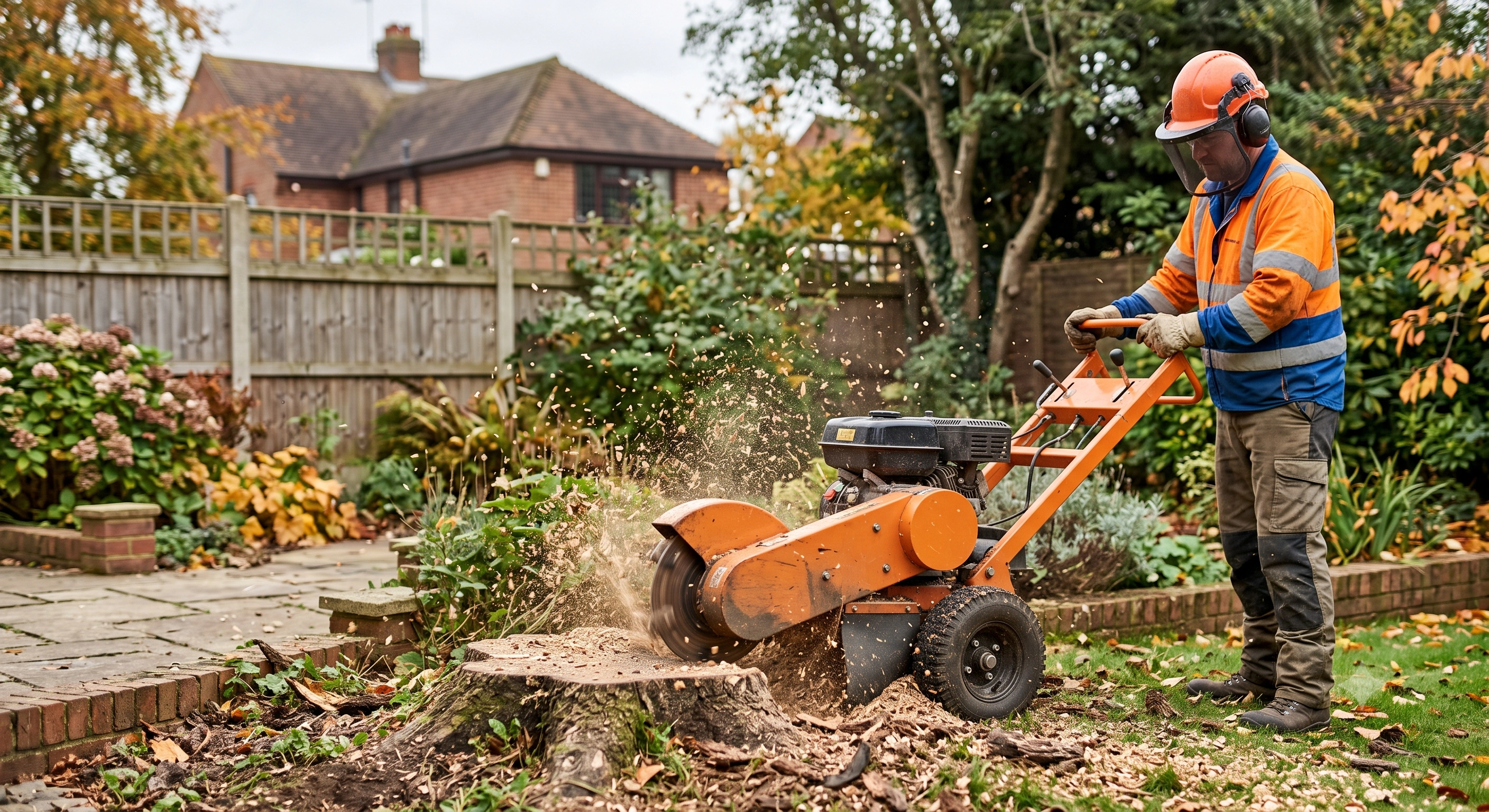
A Surrey homeowner had an oak stump ground out in February 2025 to replant grass, then learnt six months later that the remaining roots had sent up shoots across the lawn. The tree surgeon explained that grinding stops at soil level—only full removal extracts the roots that were still alive underground.
Stump grinding grinds the visible wood 150–300 mm below the surface, leaving roots in place to decay naturally. Stump removal excavates the entire root ball, taking everything out of the ground. Grinding costs £90–£350 per stump and suits replanting grass or flower beds, while removal costs £370–£675 and is necessary for building projects or replanting a tree in the same spot.
Stump grinding is a mechanical process that uses a rotating disc fitted with tungsten-carbide teeth to chip the visible stump and surface roots into mulch, typically to a depth of 150–300 mm below grade, without excavating the underground root system (BS3998:2010, Recommendations for tree work).
Root ball excavation (full stump removal) involves digging out the entire stump and its main structural roots—often extending two to three times the trunk diameter—using hand tools, winches, or excavators, then backfilling the resulting hole with topsoil.
Key Takeaways
- Stump grinding costs £90–£350 per stump; full removal costs £370–£675 due to excavation labour and disposal. That gap widens if your property is more than thirty kilometres from the nearest waste facility.
- Grinding leaves roots underground that decompose over 3–10 years; removal takes the whole root ball out in one operation and prevents future regrowth.
- You can replant grass or ornamentals over a ground stump within days, but replanting a tree in the exact location requires full removal—otherwise nitrogen lock-up stunts growth for two seasons or more.
- UK Health and Safety Executive (HSE) guidance requires risk assessment for both methods under the Health and Safety at Work Act 1974, particularly near utilities or structures.
- No local-authority permit is needed for private stump work in England unless the tree was protected by a Tree Preservation Order (TPO) or stood in a conservation area.
What's the Real Difference Between Stump Grinding and Stump Removal?
Stump grinding uses a specialist machine to chip the wood horizontally, working down to about 150–300 mm below the lawn or soil surface. The grinder's rotating disc, fitted with hardened teeth, reduces the stump to sawdust and small chips—these can be mixed into flowerbeds as mulch or removed in bags. The roots deeper than 300 mm stay in place and rot slowly, releasing nutrients back into the soil. Grinding disturbs only the immediate stump footprint and is fast. A typical 400 mm oak stump takes thirty to forty-five minutes.
Full stump removal digs out the underground root plate. A tree surgeon uses mattocks, spades, a winch, or a mini-excavator to expose and sever the lateral roots, then lifts the entire stump and root ball onto a trailer. The hole left behind—often a metre wide and half a metre deep for a mature specimen—needs backfilling with topsoil and compacting. Otherwise, subsidence occurs over the next twelve months as organic matter decomposes. Removal is labour-intensive: the same 400 mm oak may take three to four hours, especially if roots run under paving or wrap around drains.
How does stump grinding work?
A petrol or diesel stump grinder mounts a horizontal cutting wheel on an articulated arm. The operator lowers the wheel onto the stump and sweeps it side to side, peeling away layers of wood. Modern machines fitted with Sandvik or Greenteeth cutters can tackle stumps up to 900 mm diameter; smaller handlebar models suit domestic gardens with narrow side access. Depth is adjustable: shallow grinding (100–150 mm below turf) suffices for lawns; deeper cuts (250–300 mm) are needed if you plan to lay a patio or path over the site. The process produces 0.1–0.2 cubic metres of chippings per stump, depending on species and diameter.
BS3998:2010 (section 6.4) recommends grinding to at least 150 mm below the intended finished surface level. If roots cross property boundaries, written permission from the neighbour is required before grinding them out—roots belong jointly to both landowners under common law.
How does stump removal work?
Excavation begins by cutting a trench around the stump, roughly one metre out from the trunk for every 300 mm of diameter. The tree surgeon severs visible roots with a pruning saw or chainsaw, then rocks the stump to expose the tap root—if present—and cuts it. A chain or strap attached to a vehicle or hand winch applies upward force to lift the root ball. For stumps larger than 600 mm, a 1.5-tonne or 3-tonne mini-excavator with a thumb attachment speeds the work and reduces back injury risk (HSE guidance AFAG 803).
Once out, the root ball goes to a waste-wood recycling site or is chipped on site. The hole is backfilled with the excavated soil or imported topsoil, then compacted in layers to match the surrounding ground level. Subsidence can still occur over the next twelve months as organic matter in the backfill decomposes. Some tree surgeons advise overfilling by 50–100 mm initially.
How Much Does Stump Grinding Cost Compared to Stump Removal?
Stump grinding in the UK costs £90–£350 per stump, with most tree surgeons charging £2.50–£5.00 per inch (25 mm) of diameter. A typical 400 mm oak therefore runs £160–£200. Prices include chipping and carting away the arisings; if you keep the mulch, many firms deduct £20–£40. Access affects cost sharply: a stump twenty metres from the nearest vehicle access adds a surcharge for handheld machines and extra labour.
Full stump removal ranges from £370 to £675 per stump. The higher figure reflects excavator hire (£150–£250 per half-day), disposal of soil and roots (£80–£120 per tonne at most waste-transfer stations), and backfill topsoil (£40–£60 per bulk bag). Jobs requiring traffic management, crane lifts over buildings, or confined-space entry can exceed £1,000. There are no government-mandated fees or timelines for tree work; these are private commercial rates set by individual businesses.
What factors affect the cost of stump grinding?
- Stump diameter: Pricing scales linearly—double the diameter roughly doubles the time and carbide-tooth wear. A 200 mm silver birch may cost £100; an 800 mm beech £400.
- Depth required: Standard 150 mm depth is included; going to 300 mm for a driveway base adds 20–30 % to the quote.
- Surface roots: Roots fanning two metres from the trunk need extra passes. Expect £40–£80 per hour for additional machine time.
- Access width: Standard tracked grinders need 900 mm clearance. Tight side-gate access (750 mm or less) forces use of a handlebar walk-behind model and higher labour cost—add £50–£100.
- Wood hardness: Oak, beech, and sweet chestnut blunt teeth faster than softwoods. Some firms apply a 10–15 % hardwood surcharge.
What factors affect the cost of stump removal?
- Root-ball spread: Roots often extend two to three times the trunk diameter. A 500 mm trunk may have a 1.5-metre root spread, tripling excavation volume.
- Soil composition: Heavy London clay grips roots tightly and requires a larger excavator; sandy loam loosens easily and suits hand tools, cutting hire costs by half.
- Underground hazards: Roots entwined with drains, service ducts, or old foundations need careful hand-digging. Expect day rates (£250–£400) rather than per-stump pricing.
- Disposal distance: If the nearest green-waste facility is 30 km away, haulage adds £60–£100 per load (a large root ball fills a 3.5-tonne tipper).
- Backfill material: Imported topsoil certified to BS3882:2015 costs more than reusing excavated spoil but guarantees replanting success.
| Factor | Stump Grinding | Full Stump Removal |
|---|---|---|
| Typical cost (400 mm stump) | £160–£200 | £400–£550 |
| Time on site | 30–60 minutes | 3–4 hours |
| Equipment | Tracked or walk-behind grinder | Excavator (1.5–3 t) or hand tools + winch |
| Depth treated | 150–300 mm below grade | Full root ball (600–1 200 mm depth) |
| Roots left in ground | Yes—decompose over 3–10 years | No—everything extracted |
| Ground disturbance | Minimal (stump footprint only) | Large hole requiring backfill |
| Best for replanting grass | Yes—mulch and overseed within days | Yes, but costlier than needed |
| Best for replanting tree | No—roots block new hole | Yes—clear site for immediate replanting |
Bottom line: If you plan to turf, pave, or plant shrubs, grinding delivers the result you need at lower cost. If a new tree goes in the same location—or if you are building a conservatory or outbuilding over the stump—only full removal provides stable, root-free ground.
Which Method Is Better for Your Landscaping Goals?
Choose stump grinding when the finished use tolerates shallow roots underground: lawns, flower beds, gravel paths, ornamental borders, or raised planters. The wood chips left after grinding are pathogen-free (heat from the cutting process pasteurises them) and make good mulch for rhododendrons, camellias, or woodland-edge planting. Grinding also suits situations where mature trees stand close by; excavation risks damaging their roots, while a grinder works in a confined circle.
Choose full removal when you need guaranteed root-free ground for structures, hard landscaping, or replanting a tree. Building regulations (Approved Document A) require foundations on stable, non-compressible subsoil; a decaying stump beneath a conservatory footing can void structural warranties. Removal is also necessary if the stump hosted disease—honey fungus (Armillaria), for instance, spreads through root contact. Extracting infected roots helps protect neighbouring trees (Forestry Commission guidance FCPN 005).
Can you plant a new tree after stump grinding?
Not in the exact spot. The ground stump leaves a core of wood chips and severed roots, both of which lock up nitrogen as they decompose, starving a new tree's roots of nutrients. Replanting on top typically results in chlorosis (yellowing leaves) and stunted growth in the first two seasons. If you must plant a tree nearby, offset the new planting hole by at least one metre from the stump centre, or wait three to five years for the chips to break down fully.
For immediate tree replacement in the same location, full removal is non-negotiable. Dig out the old root ball, backfill with BS3882-certified topsoil, and plant the new specimen to BS8545:2014 standards. This approach is common in street-tree schemes where spacing is fixed and the local authority requires like-for-like replacement under planning conditions.
Can you build over a ground stump?
No, not for loadbearing structures. A ground stump decays unevenly—hard heartwood may persist for a decade while sapwood rots in three years—creating voids and differential settlement. The National House Building Council (NHBC) Standards chapter 4.2 states that tree stumps within the building footprint must be grubbed out to at least 600 mm depth, or deeper if roots extend below foundation level. This matters practically: if your mortgage lender commissions a pre-purchase survey (most do), unremoved stumps will be flagged as defects requiring remediation before completion. You won't be able to exchange contracts until the stump is dealt with.
You can lay a patio, deck, or permeable paving over a ground stump, provided the surface is flexible and non-structural. Use a geotextile membrane over the chipped area to prevent subsidence-related dips, then spread 100–150 mm of compacted MOT Type 1 aggregate before laying slabs on a sand bed or installing deck joists on adjustable pedestals. Expect minor settlement (10–20 mm) over five years as the wood compresses. Simple re-levelling with packers or extra sand maintains a flat surface.
When is stump removal absolutely necessary?
- Honey fungus or Phytophthora infection. These pathogens survive in dead roots and infect living trees via root contact. The Forestry Commission advises removing infected stumps and roots to a radius of at least two metres, then installing a vertical root barrier if replanting susceptible species (FCPN 005, updated July 2024). Skip this step and the disease spreads to your neighbour's trees—and potentially their legal claim against you.
- Building foundations or drainage. Any construction with concrete footings—extensions, garages, retaining walls—requires root-free ground certified by the structural engineer. Roots left under footings can cause heave as they decay, cracking masonry and voiding your building warranty.
- Tree Preservation Order compliance. If a protected tree was felled with local-authority consent, the consent notice may specify "stump to be removed to below ground level." Grinding satisfies this only if the planning officer confirms in writing that 300 mm depth is acceptable; otherwise, excavation is required to discharge the condition. Ignore this and the council can serve an enforcement notice—and you'll be forced to pay for removal anyway.
- Aesthetic preference. Some clients want no trace of the old tree; removal delivers a clean slate for redesigning the garden, especially in formal or minimalist schemes.
What Are the Pros and Cons of Stump Grinding?
Advantages:
- Speed. A single operative grinds an average domestic stump in thirty to forty-five minutes. An entire garden of four or five stumps can be cleared in half a day.
- Low ground disturbance. Only the stump footprint is affected; surrounding turf, roots of adjacent trees, and buried services remain untouched.
- Mulch by-product. Chippings are pathogen-free and rich in lignin, ideal for paths, borders, or composting (mix 3:1 with green waste to balance carbon).
- Cost-effective for landscaping. At £2.50–£5.00 per inch, grinding fits modest budgets. You can plant grass, shrubs, or perennials within a week.
Disadvantages:
- Roots remain underground. Decay releases nitrogen slowly, tying up nutrients. Suckering species (cherry, poplar, lime) may send up shoots from lateral roots for two to three years.
- Cannot replant tree in same spot. The stump void and wood chips prevent healthy establishment. New trees need offset planting or years of decomposition time.
- Depth limitation. Standard 150–300 mm grinding does not reach tap roots, which can persist and cause issues if you later excavate for foundations or a pond.
- Noise and mess. Grinding produces wood chips that blow into borders and require sweeping. The machine generates 95–100 dB(A), necessitating ear protection. Working hours are limited to 08:00–18:00 Monday–Friday, 08:00–13:00 Saturday under common local-authority nuisance bylaws.
Does stump grinding damage surrounding plants?
Rarely, if the operative maintains a 300 mm clearance from other stems and sets depth to 150 mm. The rotating disc throws chips outward, so delicate ground-cover plants within a metre may be buried; lay tarpaulins or boards to protect them. Root grafts between the old stump and a neighbouring tree of the same species (common in beech, oak, and hornbeam) can transmit decay fungi, but grinding severs surface connections and the risk is low. The Arboricultural Association's Arboricultural Practice Note 1 advises hand-digging surface roots near veteran trees rather than grinding close to the root collar.
What Are the Pros and Cons of Stump Removal?
Advantages:
- Complete elimination. The entire root ball leaves the site. No underground decay, no suckering, no nutrient lock-up—plant anything immediately.
- Immediate tree replanting. Fill the hole with topsoil and install the new specimen the same day, maintaining garden structure and screening.
- Stable ground for construction. Engineers and building-control officers accept a root-free site without further investigation, streamlining planning.
- No residual hazard. Honey fungus, bracket fungi, or pest larvae in the stump are hauled away, eliminating any reservoir of infection.
Disadvantages:
- Higher cost. At £370–£675 per stump, removal is two to four times the price of grinding. Multiple stumps in one visit attract minor bulk discounts but still exceed grinding totals.
- Longer job duration. Excavation takes three to five hours per large stump, meaning the tree surgeon occupies your drive or garden for a full working day.
- Significant ground disturbance. Digging exposes and severs roots of nearby trees (legal if roots cross your boundary, but ethically contentious if it destabilises a neighbour's tree). Soil biology is disturbed and subsoil compacted under machinery tracks.
- Large void to backfill. A 600 mm stump leaves a hole one cubic metre or larger. Imported topsoil costs £40–£60 per bulk bag (approximately 0.7 m³), and poor compaction causes subsidence, requiring topping-up six months later.
How long does stump removal take?
A 400 mm stump in free-draining loam with no underground services takes two to three hours: one hour for excavation, thirty minutes for extraction and loading, thirty minutes for backfilling and compacting, and thirty minutes for site clean-up. An 800 mm oak in clay with roots under a patio can extend to a full day—six to eight hours—especially if the root ball weighs over 500 kg and needs mechanical lifting over a fence. Weather compounds delays: saturated clay becomes unworkable, and hire companies often impose wet-weather cancellation fees. Unlike court procedures with statutory deadlines, tree work runs on practical timescales agreed between client and contractor.
What equipment is needed for stump removal?
- Mini-excavator (1.5–3 tonnes). Hydraulic arm and toothed bucket break out roots. Rubber tracks minimise lawn damage (rut depth 20–40 mm on soft ground). Hire costs £150–£250 per day. Narrow models (990 mm width) fit through standard gates.
- Winch or tirfor. A 1-tonne hand-winch with tree-sling and ground anchor pulls stumps up to 500 mm. Slower than an excavator but cheaper (£40–£80 per day hire) and suitable where machine access is impossible.
- Chainsaw and hand tools. Mattock, spade, pruning saw, and root axe sever lateral roots. A professional carries these as standard. The chainsaw requires HSE-compliant training (CS30, CS31 certificates for ground-level use).
- Tipper or flatbed trailer. A 1-tonne root ball needs a 3.5-tonne-GVW vehicle. The operator must hold a current driving licence (C1 category if gross vehicle weight exceeds 3.5 t, though most domestic stumps suit a standard car-licence trailer).
- Personal protective equipment. Steel-toe boots, chainsaw trousers, helmet with visor and ear defenders, and high-visibility jacket meet HSE requirements under the Personal Protective Equipment at Work Regulations 1992.
Do You Need Professional Tree-Surgery Services or Can You DIY?
Hiring a qualified tree surgeon (typically holding NPTC certificates CS30, CS38, and CS39 for chainsaw and stump-work competence) ensures safe, insured work. Professional operators carry public-liability insurance (minimum £5 million, often £10 million) that covers damage to property, vehicles, or underground services. They assess the site for buried cables (using Cable Avoidance Tools that detect live mains within 50 mm), map drains with the homeowner, and notify neighbours if vibration or falling debris might affect boundary structures—all required under common-law duty of care.
DIY stump grinding is possible if you hire a small walk-behind machine (£80–£120 per day from tool-hire shops) and follow the manufacturer's safety instructions. You remain legally liable for any damage: a grinder can sever mains water pipes, electricity cables, or telecoms ducts within seconds, triggering repair costs of £1,000–£5,000 and potential prosecution under the Health and Safety at Work Act 1974 if a third party is injured. The HSE does not require a licence for private, non-commercial stump work, but hiring a professional transfers risk and often proves cheaper once insurance excess, hire fees, and your time are factored in.
DIY stump removal is hard physical labour. A 300 mm stump may have a root ball weighing 100–150 kg; a 600 mm specimen exceeds 500 kg. Manual extraction risks back injury. The HSE's musculoskeletal-disorder statistics show that lifting and digging cause 30 % of reported injuries in arboriculture. Without a winch or excavator, you may spend two days digging and still fail to extract the stump, then need to call a contractor anyway. Our consistent advice: unless the stump is under 200 mm diameter, in loose soil, and you have a mattock, pruning saw, and a helper, hire a professional.
Can I grind a stump myself?
Yes, provided you hire a grinder that fits your access width and you follow PPE and operational rules. Tool-hire companies supply safety instructions; read them and watch the manufacturer's training video (most post these on YouTube). Key points:
- Check for buried services first. Contact your distribution network operator (Northern Powergrid, UK Power Networks, etc.) for cable-location data. Then use a CAT (Cable Avoidance Tool) and Genny to scan for live mains. A single severed electric cable can kill you; a gas main creates criminal liability.
- Clear the area. Chips travel three to four metres at high speed. Children, pets, and bystanders must stay indoors; cover windows within five metres with tarpaulin or board. One flying chip through glass can cause serious injury.
- Wear full PPE. Steel-toe boots, chainsaw trousers (or heavy denim), safety glasses, ear defenders, gloves. Non-negotiable. Most hire shops won't rent without proof you have them—they've seen what happens without them.
- Start shallow and feel for obstacles. Lower the cutting wheel slowly. A buried brick or metal spike will shatter a carbide tooth instantly—replacement sets cost £40–£80 per incident, and you may not notice damage until the wheel fails mid-cut.
- Dispose of chips legally. Wood chips are garden waste, not household rubbish. Councils fine illegally dumped chips. Bag them and take them to your local household-waste-recycling centre (HWRC), or compost on-site if space allows.
Machine-hire insurance covers equipment damage only, not third-party liability. Your home insurance probably excludes commercial or high-risk activity, which means you—personally—cover neighbour claims. Professional tree surgeons carry £10 million public-liability cover as standard. Their £160 fee often beats a £100 hire rental plus your uninsured exposure.
What are the risks of DIY stump removal?
- Injury is common. The Arboricultural Association reports 15–20% of non-fatal tree-work injuries stem from manual stump extraction: strains, crush injuries when stumps roll, chainsaw kickback when cutting roots under tension. One wrong move and you're in A&E explaining why you didn't call a professional.
- Hitting services is a criminal offence. Water, gas, electricity, and telecoms ducts hide where you least expect them. Sever a gas main and you've committed a crime under the Gas Safety (Installation and Use) Regulations 1998—unlimited fines apply. Even after locating services, hand-digging nearby requires a permit from the utility company if the service crosses from public road to your property.
- You can destabilise trees that haven't been cut. Excavating near a retained tree severs stability roots; the tree leans or falls months later, sometimes without warning. The Occupiers' Liability Act 1957 makes you liable for injuries to visitors caused by a tree you destabilised. Civil damages can exceed the cost of professional removal.
- Poor backfilling causes subsidence. Voids left in the ground settle over weeks or months. A path or drive sinks unevenly; excavation, re-compaction, and new surface cost far more than professional removal would have upfront.
Need a stump gone for good?
Find a trusted local tree surgeon
We connect UK homeowners with vetted, insured tree surgeons who handle stump grinding and removal. Get matched for an honest quote.
Frequently Asked Questions
How deep does stump grinding go?
Stump grinding typically reaches 150–300 mm below the surface. Turf only needs 150 mm; patios or driveways need 300 mm to prevent surface settling. Deeper grinding (450 mm) is possible with commercial machines but costs 30–50% more—carbide teeth wear faster and the job takes significantly longer. Most homeowners don't need to go that deep.
Will stump grinding remove all the roots?
No. The grinder handles the visible stump and surface roots within its reach—usually a circle 300–600 mm wider than the trunk. Lateral roots beyond that, and any tap root deeper than 300 mm, stay in the ground. They decompose naturally over three to ten years depending on the tree species and your soil conditions. If you're planning to replant a tree, those deeper roots become relevant.
How soon can I replant after stump grinding?
Grass, perennials, or shrubs can go in within one week. Rake the chippings level, add 50 mm of topsoil, and overseed or plant. Replanting a tree in the exact stump location is different—you either need full removal or three to five years of waiting for wood chips and roots to decay. Otherwise nitrogen lock-up starves the new tree and it never thrives.
Is stump removal better than grinding?
Removal makes sense if you're replanting a tree in that spot, building a permanent structure, or eliminating disease-harbouring roots like honey fungus. Grinding wins on speed, cost, and minimal disruption when you're landscaping for lawn, flower beds, or uses that tolerate shallow subsurface roots.
Do I need permission to remove a tree stump?
Usually no. Exceptions exist if the tree was protected by a Tree Preservation Order (TPO) or sat in a conservation area—your felling consent from the local planning authority may specify stump conditions. If the stump straddles a boundary, you need your neighbour's written permission before excavating or grinding roots on their side. Property rights don't stop at the visible trunk.