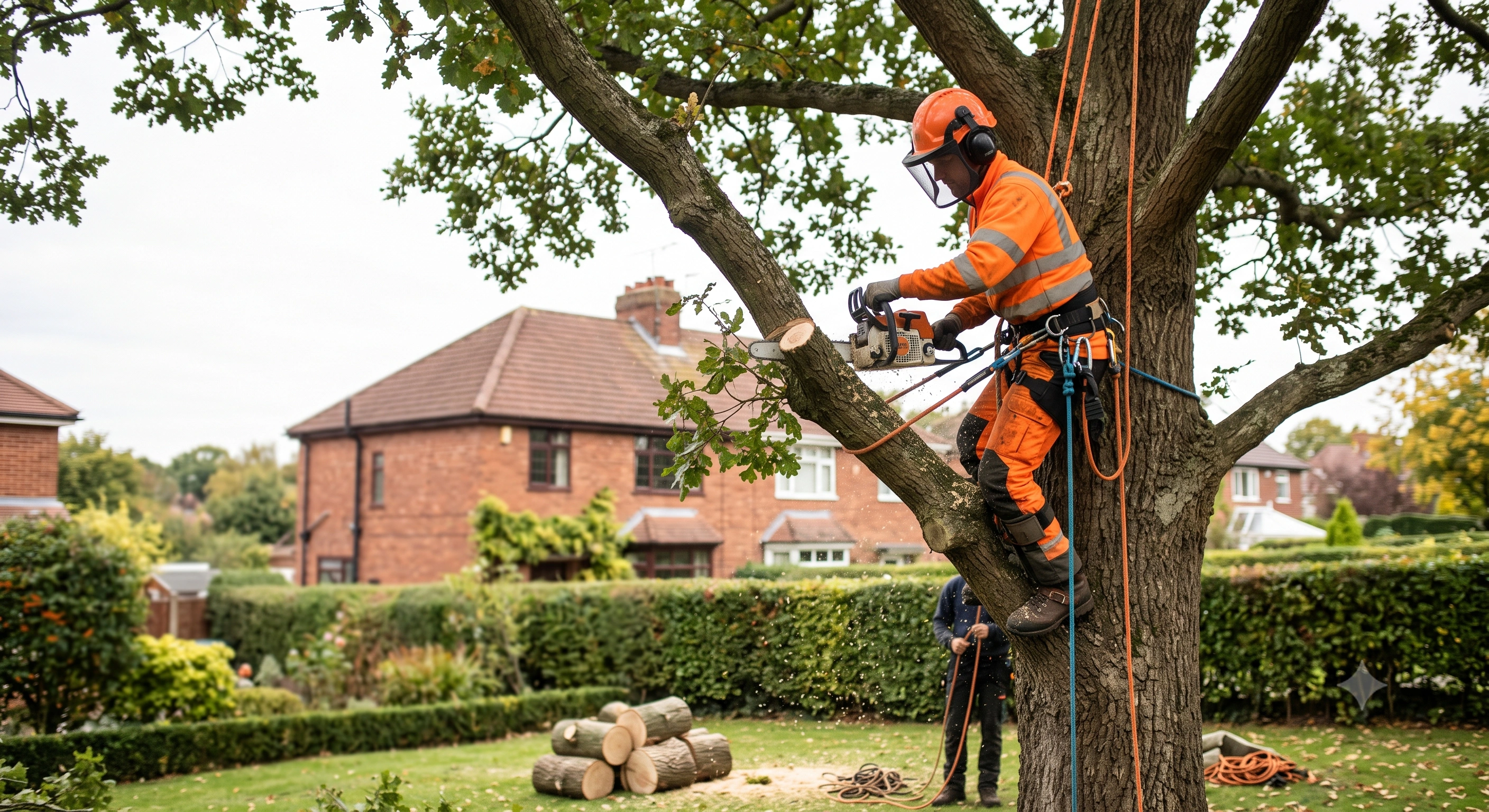
A homeowner in Surrey began cutting down two mature oaks in his garden in March 2025 to make room for an extension. A neighbour reported the work to the local planning authority, which halted the project immediately. The homeowner faced a £2,500 fine and a mandatory replanting order – the trees were protected by a Tree Preservation Order he had never checked for.
You need a felling licence from the Forestry Commission (or equivalent national body) to fell most trees in the UK, but volume, diameter, and location exemptions apply. Felling without a licence where required is a criminal offence under the Forestry Act 1967. Even when a licence is not required, Tree Preservation Orders and wildlife protection laws may still prohibit removal.
Felling licence – a legal authorisation issued by the Forestry Commission (England), Scottish Forestry (Scotland), or Natural Resources Wales (Wales) permitting the removal of growing trees above specified volume and diameter thresholds, as required by the Forestry Act 1967 (section 9).
Key Takeaways
- You may fell up to 5 cubic metres of timber per calendar quarter without a licence, though this drops to 2 cubic metres if you sell any of the wood
- Trees under 8 cm diameter at 1.3 m height need no licence; 10 cm for thinning work, 15 cm for growth improvement
- Garden trees usually sidestep felling licence requirements, but a Tree Preservation Order overrides this entirely
- Immediate danger – a tree leaning after a storm, or one with substantial decay – allows emergency felling without prior approval
- Active bird nests and bat roosts are protected under criminal law; disturbing them during felling is an offence under the Wildlife and Countryside Act 1981
Do You Need a Felling Licence to Cut Down Trees in the UK?
A felling licence is required for removing most growing trees in England, Scotland, and Wales unless a specific exemption applies. The Forestry Act 1967 establishes this framework, making unlicensed felling a criminal offence where a licence should have been obtained. The Forestry Commission administers licences in England, Scottish Forestry in Scotland, and Natural Resources Wales in Wales. Northern Ireland operates under separate legislation (the Forestry Act (Northern Ireland) 2010).
Why does the law exist? It controls felling to protect woodland resources, maintain tree cover, and ensure sustainable forestry. Even private landowners must comply – owning land does not grant automatic permission to remove trees.
What is a felling licence and when is it legally required?
A felling licence is a legal consent to fell trees above the exemption thresholds. Before beginning work, you must apply. The regulating authority assesses environmental impact, consults statutory bodies, and may attach conditions such as replanting requirements. Licences typically run for five years, though shorter or longer periods may be granted depending on the project. If approved, you'll receive a licence number valid only for the specified trees and timescale – exceeding the scope invites prosecution.
You need a licence if your felling exceeds the volume or diameter exemptions and does not fall within one of the specific location or danger exceptions. The law applies to all growing trees, including those you planted yourself.
What are the penalties for felling trees without a licence?
Unlicensed felling is a criminal offence under section 17 of the Forestry Act 1967. Magistrates' courts may impose a fine; the Crown Court has no upper limit. Prosecutions are rare but do occur, particularly for large-scale or commercially motivated breaches.
Beyond fines, the authority can issue a restocking notice requiring you to replant trees at your own expense, often with specific species and planting densities – a cost that typically far exceeds any fine.
Breaching a Tree Preservation Order carries separate penalties under planning law: fines up to £20,000 in magistrates' courts or unlimited fines in the Crown Court for deliberate destruction.
When Can You Fell Trees Without a Licence? Understanding the Key Exemptions
The Forestry Act 1967 provides three main categories of exemption: volume limits, diameter thresholds, and specific locations. Understanding these matters because they reduce administrative burden for small-scale or routine tree work while still controlling larger operations.
One critical rule: exemptions do not stack. You cannot combine the volume exemption with the diameter exemption to fell more timber. You must satisfy at least one exemption fully, and you must still comply with all other legal restrictions – Tree Preservation Orders, wildlife protection laws, and conservation area rules all remain in force.
How much timber can I fell without a licence?
You may fell up to 5 cubic metres of timber in any calendar quarter (January–March, April–June, July–September, October–December) without a licence. This is the volume exemption. Sell any of that timber – as firewood or logs – and the limit drops to 2 cubic metres per quarter. That single transaction changes the threshold permanently for that quarter.
Cubic metres refer to the volume of the trunk and branches, not the canopy spread. A mature oak might yield 3–4 cubic metres; a large conifer 6–10. Keep records of what you felled and when, because the burden of proving compliance rests with you if questioned.
What size trees can be felled without permission?
Trees with a diameter less than 8 cm at a height of 1.3 metres from ground level may be felled without a licence under the diameter exemption. Measure at breast height on the main stem. Thinning to improve woodland? The threshold rises to 10 cm. Thinning specifically to improve the growth of other trees? 15 cm applies instead.
For multi-stemmed trees, measure the largest stem only. Do not add diameters. Exceed the threshold on any single stem, and a licence is required unless another exemption covers you.
Do trees in my garden require a felling licence?
Trees in gardens, orchards, churchyards, or public open spaces immediately adjacent to a dwelling do not require a felling licence under the location exemption. This reflects practical reality: homeowners routinely manage trees near buildings for safety, light, and amenity.
But here's the catch: this exemption does not apply if the tree is protected by a Tree Preservation Order or located in a conservation area. Always check with your local planning authority before felling garden trees. The exemption also excludes commercial orchards or woodland managed for timber, even if near a house.
Trees in hedgerows are generally not covered by the garden exemption and usually require a licence unless the danger rule applies.
What About Tree Preservation Orders and Other Planning Restrictions?
A Tree Preservation Order (TPO) is a legal protection placed on specific trees or woodland by a local planning authority. TPOs override all felling licence exemptions. You cannot fell, top, lop, uproot, or wilfully damage a protected tree without written consent from the planning authority, regardless of tree size, location, or volume.
Can I cut down a tree with a Tree Preservation Order?
You must apply to the local planning authority for consent. The authority considers amenity value, health, safety risks, and your stated reason. Consent may be granted with conditions – replanting, for instance. This process is separate from the felling licence regime and is governed by the Town and Country Planning Act 1990.
Breaching a TPO is a criminal offence. Check your local authority's planning register or contact the tree officer to confirm whether a TPO applies before you start work. Trees in conservation areas receive similar protection: give six weeks' notice before carrying out work, and the authority may impose a TPO during that notice period, which would then block your work entirely.
Ancient woodland, Sites of Special Scientific Interest (SSSIs), and Areas of Outstanding Natural Beauty carry additional restrictions. Felling often requires environmental impact assessment and consultation with Natural England, NatureScot, or Natural Resources Wales – a process that typically takes several months.
When Can You Fell Dangerous Trees Without a Licence?
You may fell a tree without a licence if it poses an immediate risk of serious harm or is required urgently to abate a nuisance, under section 9(4) of the Forestry Act 1967. Safety takes precedence over administrative process in genuine emergencies.
"Immediate risk" means imminent danger. A tree leaning over a road after a storm, a stem split and liable to fall onto a building, substantial decay that could cause sudden collapse – these qualify. Routine maintenance, a tree you dislike, or general future concern do not.
Do I need permission to remove a dangerous tree?
Not if the danger is immediate and the work genuinely urgent. You should notify the Forestry Commission (or equivalent body) within 14 days after felling, explaining the danger and providing photographic evidence. Keep records – a tree surgeon's report, photographs taken before work, or inspection notes all demonstrate that the risk was real and urgent.
If the tree is covered by a Tree Preservation Order, you still need planning authority consent unless the danger is so immediate that waiting even 24–48 hours would create unacceptable risk. In that scenario, fell the tree and notify both the planning authority and the Forestry Commission immediately. Expect scrutiny – have evidence ready.
Wildlife Protection: What You Must Check Before Felling Any Tree
Before felling any tree, you must ensure you will not commit an offence under the Wildlife and Countryside Act 1981. It is illegal to intentionally or recklessly disturb, damage, or destroy an active bird nest or a bat breeding site or roost. These obligations apply regardless of whether you need a felling licence, whether a TPO exists, or whether the land is yours.
Can I fell trees during bird nesting season?
You may fell trees during the nesting season (broadly March to August, though exact dates vary by species) only if you have checked thoroughly and confirmed no active nests are present. "Active" means eggs or chicks are present, or a bird is actively building or attending. An old nest from a previous year is not protected.
Inspect carefully before starting. Find an active nest, and you must stop and wait until the young have fledged and left. Disturbing nesting birds is a criminal offence with fines up to £5,000 per nest or six months' imprisonment.
Large projects call for an ecological survey by a qualified ecologist. The survey identifies protected species, nesting sites, and the right timing to begin work without breaching wildlife law.
What if bats are roosting in the tree I want to remove?
All 18 UK bat species are protected by law. Damaging or destroying a bat roost is illegal—even if no bats are currently inside. Droppings, scratch marks, or holes suggest bat use. If you spot any of these signs, you must commission a bat survey before felling.
Bats confirmed? You'll need a bat mitigation licence from Natural England, NatureScot, or Natural Resources Wales. Here's the practical reality: the licensing process typically runs several months, and you'll be required to provide alternative roost sites plus a detailed method statement for how the work proceeds. Violate bat protection law and you face unlimited fines—the courts take this seriously.
How to Apply for a Felling Licence in England, Scotland, and Wales
If no exemption covers your situation, a felling licence is mandatory before any work starts. England, Scotland, and Wales each have their own regulating authority and application portal, though the underlying process mirrors across all three.
Your application goes to the Forestry Commission (England), Scottish Forestry (Scotland), or Natural Resources Wales (Wales). No fee. Complete it online. You'll need three things: a map marking the trees for felling, details on species and rough volumes, and your justification for removing them.
How long does it take to get a felling licence?
Timeline depends on site complexity. Straightforward applications with no environmental red flags? Six to eight weeks. But if the authority must consult Natural England, the Environment Agency, or local planners—which happens often—expect three to six months instead.
Environmental impact assessment kicks in for larger felling (1 hectare of woodland, or 0.5 hectares in sensitive areas). That means more delays. The authority may ask for additional detail or attach conditions to your licence.
Do I need to replant trees after felling?
Most licences impose a restocking condition: replant with specified species within two planting seasons. The goal is straightforward—keep woodland cover continuous and sustainable.
Restocking can be waived if the land moves to a higher-value use: habitat restoration, agricultural conversion, or development with planning permission already secured. You must request an exemption and submit evidence. Don't assume it'll be granted without documentation.
Need a tree felled safely and legally?
Find a qualified local tree surgeon
Felling permissions and safe work are best handled by a professional. We connect UK homeowners with vetted, insured tree surgeons.
Published by Tree Surgeon Leads UK, a specialist marketing and lead generation agency working with UK tree surgeons.
Frequently Asked Questions About Tree Felling in the UK
Can I fell trees on my own land without permission?
Ownership doesn't equal unlimited felling rights. You may fell without a licence if an exemption applies: under 5 cubic metres per quarter, under 8 cm diameter, or in a garden or orchard. Still, Tree Preservation Orders, conservation area rules, and wildlife protection laws all override ownership. Break one of these and a fine or enforcement notice will follow regardless of whose land it is.
What's the difference between tree felling and tree pruning regulations?
Felling means removing the tree entirely or cutting to ground level. The Forestry Act 1967 requires a licence unless exempt. Pruning—cutting branches while the tree remains—doesn't need a felling licence. But if the tree is protected (TPO or conservation area), you need planning consent even for pruning that affects the tree's health or shape.
Do I need insurance to fell trees?
The law doesn't mandate insurance for felling on your own land for personal use. Yet tree work is genuinely high-risk. Hire a tree surgeon? Verify they carry public liability insurance (minimum £5 million) and employers' liability if they have staff. Near a property line or a neighbour's building, your home insurance may exclude damage caused by work you do yourself—a costly blind spot.
Can the council force me to cut down a tree?
Yes, if the tree constitutes a statutory nuisance—blocking light beyond reason, causing subsidence—or poses a genuine safety risk, the council can serve an abatement notice. You have a right to appeal. A council cannot force removal simply because a neighbour dislikes it or wants a better view.
How do I report illegal tree felling?
Contact the Forestry Commission (England), Scottish Forestry (Scotland), or Natural Resources Wales (Wales). Include location, photos if you have them, and details of the activity. If a Tree Preservation Order was breached, report to the local planning authority instead. Investigations can lead to prosecution or enforcement notices requiring restocking.