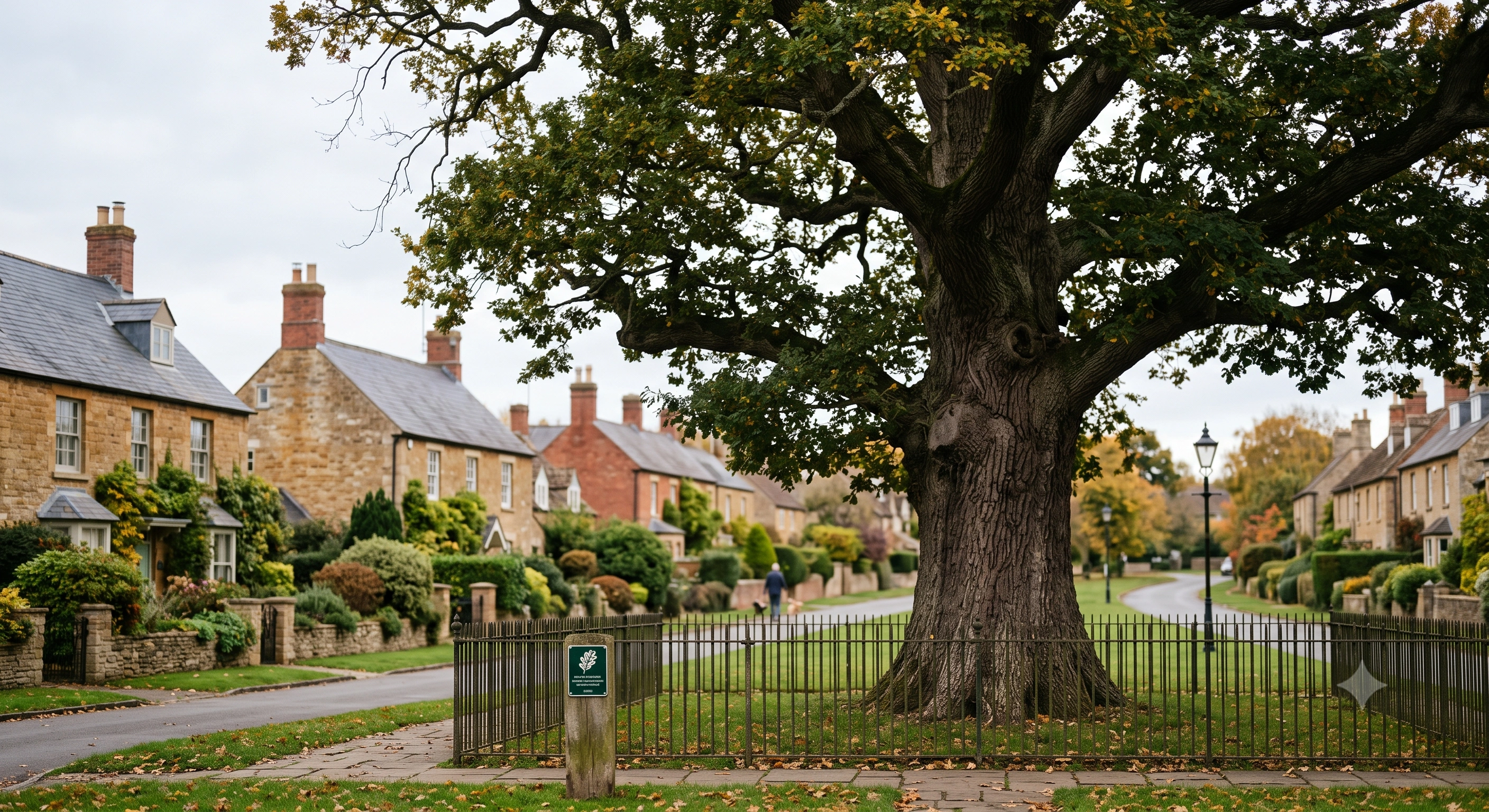
A Hertfordshire homeowner booked a tree surgeon in January 2026 to remove an ageing oak that was blocking light to her kitchen extension. Within an hour, work stopped. A neighbour's complaint triggered a council inspection, and the oak turned out to be protected by a Tree Preservation Order. She now faces a £20,000 fine and mandatory replanting—all because she never checked the local planning register.
A Tree Preservation Order is a legal instrument made by a local planning authority in England to protect specific trees, groups of trees, or woodlands deemed to have amenity value. Any unauthorised cutting, topping, lopping, or removal without written consent is a criminal offence, punishable by fines up to £20,000. Applications for work on protected trees can take up to 8 weeks, and approval is required for nearly every intervention—including root cutting. Before you hire a contractor or reach for a saw, understanding whether a tree carries a TPO, and what that protection actually means for you, is non-negotiable.
Tree Preservation Order (TPO) — a legal order made under Part VIII of the Town and Country Planning Act 1990 and the Town and Country Planning (Tree Preservation) (England) Regulations 2012, protecting specific trees, groups, or woodlands deemed to offer significant public amenity by prohibiting cutting down, topping, lopping, uprooting, wilful damage, or destruction without the local planning authority's written consent.
Key Takeaways
- Tree Preservation Orders prohibit all tree work without written consent from the local planning authority: cutting down, topping, lopping, uprooting, root cutting, or wilful damage.
- Applications take up to 8 weeks from validation. Once approved, consent lasts 2 years—miss that window and you apply again from scratch.
- Breaking a TPO is a criminal offence. Magistrates Court fines reach £20,000; the Crown Court has no upper limit.
- Conservation area trees are automatically protected even without a TPO. You must give 6 weeks' notice before any work—and the council can slap a TPO on the tree during that waiting period.
- You remain legally responsible for keeping TPO trees safe. Emergency work for genuine imminent danger may proceed without prior consent, but "imminent" has a high bar.
What Is a Tree Preservation Order and Why Do They Exist?
The Town and Country Planning Act 1990 empowers local planning authorities to make Tree Preservation Orders to protect trees, groups of trees, or woodlands that contribute meaningfully to their surroundings. The Town and Country Planning (Tree Preservation) (England) Regulations 2012—which took effect 6 April 2012—sets the modern framework for how these orders are made, modified, and enforced.
Why does this matter to you? Because a TPO exists to preserve trees that define neighbourhood character, absorb carbon, provide wildlife habitat, or hold local significance. It's not about saving every tree. It's about protecting the ones that people rely on—visually, ecologically, or historically. An old oak shading a street, a beech screening an eyesore, a row of chestnuts that residents have watched grow for decades. These are candidates for protection.
How does a tree qualify for protection under a TPO?
A tree does not need to be rare, ancient, or conventionally beautiful. The criterion is amenity—whether the tree makes a measurable positive contribution to how the area looks and feels. Planning authorities weigh visibility from public roads or footpaths, its role in the character of a conservation area, its health and expected lifespan, and whether it screens or softens the visual impact of buildings or infrastructure.
Often a TPO appears because residents or councillors push for it. A neighbour threatens to fell a beloved tree, a developer eyeing the land wants it gone—someone notices the risk and alerts the council. When that happens, the authority can issue a provisional TPO that takes effect immediately, with consultation to follow. Once confirmed, the order stays in place indefinitely unless it's revoked or the tree dies or is lawfully removed.
What Activities Are Prohibited Under a Tree Preservation Order?
The Town and Country Planning Act 1990 and the 2012 Regulations forbid the following on TPO-protected trees without written council consent: cutting down, topping, lopping, uprooting, wilful damage, and wilful destruction. Root cutting also falls within this prohibition—even underground work affecting a protected tree's root system requires approval.
"Topping" means cutting the main stem or large branches back to stubs, a practice that severely damages tree health. "Lopping" is cutting side branches. Both differ from careful pruning, but here's the critical point: any deliberate cutting of living wood on a TPO tree requires consent. Safety work, disease management, formative shaping—all require council approval. "Wilful damage" covers soil compaction from machinery, chemical application to roots, or bark wounding, provided the damage is deliberate or reckless rather than accidental.
Can you trim branches or roots on a TPO-protected tree without permission?
No. Written council consent is mandatory before you trim anything on a TPO tree—above ground or below. This includes minor pruning, deadwood removal, and root cutting during excavation or building work.
One narrow exception: if branches hang over your boundary and the tree stands on your neighbour's land, common law lets you cut back overhanging branches to the boundary line without asking permission. But if that tree carries a TPO, you still need written council consent before making any cut—even on your side of the fence.
What counts as "wilful damage" to a protected tree?
Wilful damage means deliberate or reckless harm to a TPO tree's health or structure. Poisoning roots with chemicals, driving machinery over the root protection area, ring-barking the trunk, severing major roots during groundworks without consent—these are all examples. The act must be intentional or show disregard for the tree's protection. Accidental damage caused despite reasonable precautions typically doesn't meet the prosecution threshold, though the council may still demand remedial work or replacement planting.
How Do You Get Permission to Work on a Tree with a TPO?
Submit a formal application to your local planning authority detailing the proposed work, why you need it done, and supporting evidence—an arboricultural report, photographs, or design plans. Most councils provide online application forms on their planning portals. There's no fee.
The clock starts when the authority validates your application—meaning it confirms all necessary information has arrived. Incomplete applications don't get validated, so the 8-week decision window doesn't begin until you've supplied what they ask for. If 8 weeks pass with no response, consent is deemed granted, but it's wise to get written confirmation before your contractor arrives.
Approved consent lasts 2 years. If you don't start the work within that time, apply again. The council may attach conditions—perhaps pollarding to a specific height instead of full removal, or planting a replacement tree of defined species and size.
What information do you need to include in a TPO application?
Clearly identify the tree (species, location, TPO reference if you know it), describe the proposed work precisely (which branches, how much, what method), and justify it. Common reasons: safety concerns (disease, structural defect, proximity to buildings), nuisance (excessive shade, blocked access, utility interference), or good arboricultural practice (crown thinning, deadwood removal, formative pruning).
Supporting documents carry weight. A report from a qualified arborist—ideally a member of the Arboricultural Association—provides professional assessment of the tree's condition and whether the work is justified. Add photographs showing the tree's position, size, and any visible defects. Include plans if the work relates to construction or development. The stronger your evidence that the work is necessary and proportionate, the more likely approval becomes.
What happens if your TPO application is rejected?
You'll receive a written decision with reasons. Common grounds for refusal: insufficient justification, excessive scope, or availability of milder alternatives. You can appeal to the Planning Inspectorate within 28 days—submit a statement of case and, depending on the appeal, attend a hearing.
Or revise and reapply. If full removal was refused, perhaps propose crown reduction or removal of specific dangerous limbs only. Many councils offer pre-application advice services where you can discuss the work informally before submitting formally, saving time and reducing rejection risk.
According to the Town and Country Planning (Tree Preservation) (England) Regulations 2012, local planning authorities have up to 8 weeks from validation to decide TPO applications, and approved consent remains valid for 2 years.
How Do Tree Preservation Orders Differ from Conservation Area Tree Protection?
Trees within a designated conservation area gain automatic protection under section 211 of the Town and Country Planning Act 1990, regardless of whether a specific TPO exists. Before work on a conservation area tree, submit a section 211 notice describing what you propose. The council then has 6 weeks to allow it, refuse it, or impose a TPO for permanent protection.
The procedural difference matters: a TPO requires a formal application and up to 8 weeks for a decision; conservation area work requires notice with a 6-week waiting period, after which you may proceed if the council hasn't objected or made a TPO. Both processes yield consent valid for 2 years once granted or deemed granted.
| Aspect | Tree Preservation Order (TPO) | Conservation Area Protection |
|---|---|---|
| Legal basis | Town and Country Planning Act 1990 Part VIII; 2012 Regulations | Town and Country Planning Act 1990 section 211 |
| Trigger | Made by local planning authority for specific tree(s) of amenity value | Automatic for all trees in a designated conservation area |
| Application type | Formal application for written consent | 6 weeks' notice (section 211 notice) |
| Decision timeline | Up to 8 weeks from validation | 6 weeks from receipt of valid notice |
| Consent validity | 2 years once granted | 2 years once notice period expires or consent given |
| Possible outcome | Consent granted, refused, or granted with conditions | Work allowed, refused, or TPO imposed on the tree |
| Overlap | A tree in a conservation area can also have a TPO for extra protection | Trees with both protections require full TPO application process |
Takeaway: If your tree sits under both conservation area rules and a TPO, the stricter TPO process wins—file a full application instead of just a notice. Think of conservation area protection as the council's safety net: it buys time to decide whether a permanent TPO is necessary, whereas a TPO locks in permanent protection for trees with real visual or environmental value.
What Are the Penalties for Breaking a Tree Preservation Order?
Carrying out prohibited work on a TPO-protected tree without written consent is a criminal offence under section 210 of the Town and Country Planning Act 1990. Convicted in Magistrates Court? Up to £20,000. Crown Court? Fines are unlimited. The conviction goes on your record—which matters for employment, insurance, and any future planning application you submit.
The local planning authority doesn't just fine you and move on. They have enforcement teeth. Remove a TPO tree unlawfully, and you must replant a suitable tree of appropriate size in the same spot. That replacement is automatically protected by the same TPO. Ignore an enforcement notice to do this? That's another criminal offence. Fines stack.
There's also a rarely invoked but potent sanction: if a tree is felled or destroyed shortly before a development application on that site, the authority can issue a "land use freeze." The tree is treated as still standing when assessing your planning application—meaning you gain nothing from having removed it illegally. The scheme collapses.
Can you go to prison for cutting down a protected tree?
No. The 1990 Act caps penalties at fines, never imprisonment. That said, the consequences cut deep enough: £20,000 in fines, mandatory replanting, potentially unlimited fines if heard in Crown Court, especially for ancient or high-value trees. Local press loves a TPO breach story—which can wreck personal reputation or business standing, particularly for developers or contractors who should have known better.
Tree protected by a TPO?
Find a tree surgeon who knows the rules
Work on protected trees needs the right permissions and a professional who understands them. We connect UK homeowners with vetted, insured arborists.
How Can You Find Out If a Tree Has a TPO?
Contact your local planning authority and request a TPO register search—that's the definitive method. Most councils publish planning registers online. Search by address or postcode, and you'll see TPO maps and the full written orders. Individual trees, groups, woodlands: all listed.
If the tree sits in or near a conservation area, check both the TPO register and the conservation area map. Protection can apply either way. Many councils now offer interactive GIS maps that layer TPOs, conservation boundaries, and other planning constraints—you can usually spot your tree in seconds.
Purchasing a property? TPO information surfaces in the local authority search during conveyancing. But orders can be made after contracts are exchanged, so run your own register check before you hire a tree surgeon, even if you've owned the place for years. It takes ten minutes and costs nothing.
Are all trees in conservation areas automatically protected?
All trees with a trunk diameter greater than 75 millimetres (measured 1.5 metres above ground), or 100 millimetres if you plan to fell it. Smaller trees can come down or be pruned without notice, though the council might object on other planning grounds if the work damages the area's character.
This automatic protection kicks in regardless of whether a TPO also exists. The 6 weeks' notice still applies. If the council responds to your notice by making a TPO, the full TPO consent process then takes over—you wait for written approval before work begins.
Frequently Asked Questions About Tree Preservation Orders
How long does a Tree Preservation Order last?
Indefinitely. Once confirmed, a TPO stays in force for the life of the tree unless formally revoked by the council or the tree dies, is legally removed, or falls to natural disaster or disease. No expiry date. Groups and woodland TPOs protect any regeneration or replacement trees within the designated area indefinitely as well.
Can you appeal a Tree Preservation Order?
You can object during the consultation period—usually 28 days from notice. If you believe the TPO is unjustified (the tree has low amenity value, poses a safety risk, or the order relies on faulty information), submit written objections before the authority confirms. They must weigh all objections before deciding to confirm, modify, or revoke the provisional order.
Once confirmed, you can't appeal the TPO itself. You can, however, appeal a refusal of consent for specific work through the Planning Inspectorate. Different weapon, same battle.
Who is responsible for maintaining a tree with a TPO?
You are, as the landowner. TPO or not, the tree is your responsibility. Keep it from posing danger, manage overhanging branches, maintain its health. A TPO doesn't shift that burden to the council, nor does it block legitimate safety work. Applications for genuine safety concerns—dead limbs, structural defects—are usually approved if the work is proportionate and backed by a professional arborist's report.
Does a TPO affect property value or insurance?
It cuts both ways. Some buyers see a protected mature tree as an asset—privacy, visual amenity, environmental gains. Others see it as a restriction on future development, ongoing maintenance costs, or risk of root damage. Insurance premiums don't typically rise simply because a tree carries a TPO, though subsidence claims involving tree roots become more complicated if protection exists. Insurers may require TPO consent before approving root work, which delays remediation.
Can emergency work be carried out on TPO trees without consent?
Yes, but only in genuine emergencies where immediate serious harm to people or property is imminent. Section 198(6) of the 1990 Act allows work to prevent or stop a nuisance, or to meet a statutory obligation (such as a dangerous tree notice from the council). Routine maintenance, preventive deadwood removal, or speculative felling because a tree *might* cause problems later? None of these count as emergency. After emergency work, notify the authority in writing with evidence: photographs, a tree surgeon's report, details of the risk you faced.
What happens if a TPO tree is dangerous or diseased?
The authority will typically grant consent for necessary work, including felling if no safer alternative exists. Support your application with a professional arborist's report that documents the defect, describes the risk, and recommends action. Councils understand their duty of care to residents and won't stubbornly refuse safety work, though they may demand an independent check or impose conditions like phased removal or mandatory replanting. Diseases such as ash dieback affecting large TPO populations have prompted some authorities to issue blanket consents or fast-tracked processes—they recognise the scale and urgency.