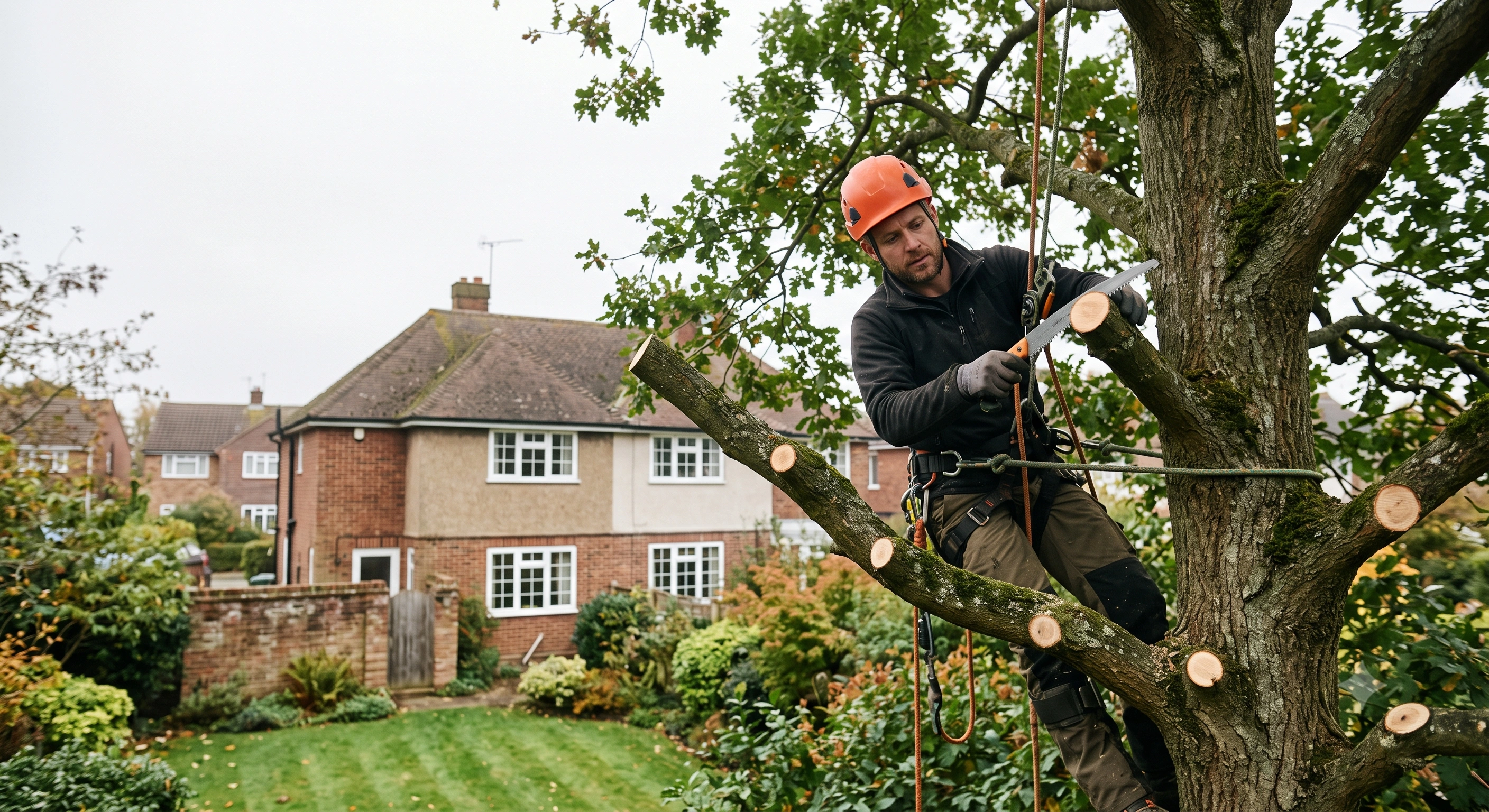
A Hampshire homeowner removed three large oak branches in February 2026 to let more light into her garden. Four weeks later, a council enforcement officer arrived with a stop-work notice. The tree carried a Tree Preservation Order. Unauthorised work meant fines up to £20,000. She'd never checked the local authority register.
Proper tree pruning in the UK sits at the intersection of three demands: timing it right seasonally, navigating legal restrictions like Tree Preservation Orders, and using techniques that keep trees healthy rather than weakening them. Most deciduous trees thrive when pruned during winter dormancy (November to March), but protected trees demand something different—written permission from your local planning authority before you even touch a branch.
Tree Preservation Order (TPO) – a legal protection placed on specific trees or woodlands by local planning authorities in England, Wales and Scotland under the Town and Country Planning Act 1990, making it an offence to cut down, top, lop, uproot, wilfully damage or wilfully destroy a protected tree without written consent.
Branch collar – the slightly swollen area where a branch joins the trunk or parent limb, containing specialised cells that compartmentalise decay and seal pruning wounds; cutting through this zone damages the tree's natural defence system and invites disease.
Key Takeaways
- Remove dead, diseased and damaged branches first, then weak or crossing growth. Never exceed 20% of total canopy in one year.
- Winter dormancy (November–March) is the safest pruning window for most UK species, minimising sap loss and disease transmission.
- Tree Preservation Orders require written consent from your local planning authority before any pruning work. Unauthorised cutting can result in fines up to £20,000—and courts have imposed penalties exceeding £50,000 for deliberate breaches involving valuable mature trees.
- The three-cut method prevents bark tearing on branches over 2.5 cm diameter: undercut 20 cm from final position, overcut 2.5 cm further out, then remove stub just outside the branch collar.
- Professional tree surgeons should hold NPTC certification and Arboricultural Association membership, plus minimum £5 million public liability insurance.
When Is the Right Time to Prune Trees in the UK?
Winter dormancy between November and March offers the safest window for most British trees. Deciduous species have dropped their leaves by then. Sap flow slows. Fungal spores lie dormant. All three factors reduce infection risk when you open pruning wounds. The Royal Horticultural Society confirms what arborists have known for decades: dormant pruning minimises stress and allows wounds to seal before spring growth kicks in.
Evergreen species—holly, laurel, conifers—tolerate light pruning year-round but respond best to heavier shaping between April and August when active growth helps them recover quickly. Stone-fruit trees demand something stricter. Cherry, plum, damson must be pruned only between May and August to avoid silver-leaf disease, a fungal infection that enters through winter wounds and can kill a mature tree within two years.
Spring-flowering trees including magnolia, cherry and amelanchier should be pruned immediately after flowering finishes—typically late May through June. Cut later and you remove next year's flower buds, losing bloom for an entire season. Autumn pruning (September–October) creates a different problem: wounds struggle to seal before winter arrives, and falling leaves introduce decay fungi.
Can you prune trees in summer in the UK?
Summer pruning works and sometimes excels for specific purposes. Between June and August you can safely remove up to 20% of live foliage to control size, improve light, or correct structural faults—formative pruning, as arborists call it. Fruit trees particularly benefit because summer pruning redirects energy into fruit production rather than excessive shoot growth.
Three summer risks demand caution. Water stress during dry periods can set trees back weeks. Fresh cuts bleed sap, especially in birch, walnut and maple, which wastes energy. Disease transmission accelerates when fungal spores are airborne. Never prune heavily during drought. Never exceed 20% canopy removal in a single growing season. Light trimming of young shoots causes minimal stress and shapes trees without triggering excessive regrowth.
That said, stone-fruit species break this rule entirely. They must be pruned in summer (May–August) because winter wounds invite silver-leaf fungus. The Forestry Commission confirms this timing as essential for commercial and garden stone-fruit trees across the UK.
What Are the Legal Requirements for Tree Pruning in the UK?
Tree Preservation Orders prohibit cutting down, topping, lopping, uprooting, or damaging protected trees without written consent from the local planning authority. The Town and Country Planning Act 1990 empowers councils to protect trees that contribute significantly to local amenity, with penalties ranging from unlimited fines in magistrates' court to specific penalties of up to £20,000 for less serious offences.
Before you start any work, check your local authority's online TPO register or contact the planning department directly. Most councils maintain searchable maps showing protected trees and woodlands—finding yours takes minutes. Conservation areas layer on additional restrictions: you must give the council six weeks' written notice before pruning any tree with a trunk diameter exceeding 75 mm (measured 1.5 metres above ground), even without a specific TPO.
Consent applications require a written explanation of what you're doing, why you're doing it, and ideally a tree surgeon's report if the work is complex. Local planning authorities must respond within eight weeks for standard applications, though challenging cases stretch to twelve weeks. Emergency work on genuinely dangerous trees may proceed without consent, but you must inform the council within five days and provide evidence of the safety risk.
Do I need permission to prune a tree with a Tree Preservation Order?
Yes. Any work involving cutting living wood on a TPO tree requires written consent before you begin. Reducing crown size, removing branches, pollarding, coppicing—all require permission. The law does carve out narrow exemptions: removing dead wood (if the whole tree isn't dead), preventing immediate danger to people or property, and complying with an Act of Parliament. That's it.
Diseased or dying trees still require consent, though councils typically process these quickly when you submit professional arboricultural reports confirming the condition. Here's where many homeowners stumble: the exemption for "preventing nuisance" is narrow. Overhanging branches, blocked light, leaf fall—none qualify as legal grounds to cut without permission.
Unauthorised work triggers prosecution. Magistrates can impose unlimited fines based on any financial benefit you gained (increased property value from removed trees, for example). Courts have issued fines exceeding £50,000 for deliberate breaches involving valuable mature trees. Enforcement officers also have power to order replanting at the owner's expense.
How do I know if my tree has a Tree Preservation Order?
Start with your local planning authority's online TPO register, available through council websites under planning or environment sections. Most maintain searchable maps showing individual protected trees (marked T1, T2, etc.), groups (G1, G2), and protected woodlands (W1, W2). Online records unclear? Phone the planning department with your property address—officers confirm TPO status within minutes.
Physical inspection offers backup clues. Councils historically placed metal plaques on protected trees, though weathering and removal have eliminated many. When purchasing property, solicitors' searches should reveal TPOs affecting the land, but these searches sometimes miss recent designations. Conservation area status automatically protects qualifying trees (trunk diameter over 75 mm) even without individual TPOs.
The distinction matters for timing: TPO trees require consent before any work; conservation area trees require six weeks' advance written notice, after which work can proceed unless the council issues a formal TPO. Penalties align—both carry similar fines for unauthorised cutting.
How Do You Safely Remove Large Branches Using the Three-Cut Method?
The three-cut method prevents bark tearing and ensures clean wounds that seal quickly, protecting trees from decay. Use it for any branch exceeding 2.5 cm diameter, where weight could strip bark down the trunk as the limb falls. The Royal Horticultural Society recommends this technique universally.
Step 1: Make the undercut. Saw upward from beneath the branch, starting 20 cm out from your intended final cut position (typically just outside the branch collar). Cut one-third of the way through the branch thickness. Stop. This undercut prevents bark from tearing downward when the branch drops.
Step 2: Make the overcut. Move 2.5 cm further along the branch toward the tip. Saw downward through the branch until it falls away. The branch will split cleanly between undercut and overcut, leaving a stub approximately 20 cm long with no torn bark.
Step 3: Remove the stub. Identify the branch collar—the slightly swollen area where the branch meets the trunk or parent limb. Position your saw just outside this collar (typically at a slight angle matching the collar's edge) and cut straight through. The final wound should expose the collar tissue without cutting into it. Never leave a protruding stub.
What is the branch collar and why does it matter?
The branch collar contains specialised cells that form a chemical barrier around pruning wounds, isolating decay fungi and sealing the cut with wound wood. Cut flush to the trunk and you remove those protective cells, exposing heartwood directly to infection. Leave a long stub and the wound never seals, allowing decay to migrate into the main stem.
Identifying the collar requires close observation. Look for a slight swelling or ridge where the branch joins the trunk, often accompanied by rougher bark texture. On species with very acute branch angles (less than 45 degrees), the collar may be subtle. Find the branch bark ridge (a raised line in the branch crotch) and angle your cut away from it without cutting underneath the ridge.
Different species show varying collar prominence. Oak, ash and maple develop obvious swollen collars. Birch and cherry show subtler bulges. As a general rule, if you cannot clearly see a collar, cut at a slight angle starting level with the branch-trunk junction and angling away from the trunk, leaving no stub longer than 1 cm.
Which Branches Should You Prioritise When Pruning?
Dead, diseased and damaged branches—the "3 Ds" rule—always come first. They pose safety hazards and harbour pathogens that spread to healthy wood. Dead branches shed without warning, especially during storms. Diseased wood showing cankers, fungal brackets or oozing lesions infects neighbouring growth if left uncut. The Royal Horticultural Society places these removals at the top of every pruning schedule.
Secondary priorities matter for long-term structure. Weak, crossing or rubbing branches create structural faults and future breakage points. When two branches cross and rub, they wear through bark—and that exposed wood becomes an infection site. Narrow crotches with V-shaped unions and included bark are weak points prone to splitting. Remove the weaker of two competing leaders to establish a single dominant trunk. Take out inward-growing branches that clutter the canopy centre and restrict air circulation.
Here's the thing: live foliage removal should never exceed 20–25% of total canopy in any single year. This one-fifth rule prevents excessive stress that triggers water-shoot growth and makes trees vulnerable to disease. If you need a severe reduction, plan it across two or three years rather than removing half the canopy at once—a single aggressive cut can kill mature trees or create years of unbalanced regrowth.
Structural pruning targets long-term tree form. Remove codominant stems before they grow large, space scaffold branches evenly around the trunk, and maintain a balanced crown shape. Young trees benefit from formative pruning every two to three years; mature trees typically need only minor corrections every five to seven years unless storm-damaged.
How much of a tree can you safely cut back?
Remove no more than 20% of living canopy in a single growing season. The Royal Horticultural Society confirms this one-fifth maximum as the threshold beyond which most trees suffer excessive stress, reduced photosynthesis, and vulnerability to disease and dieback. Mature trees with established root systems tolerate this reduction; young, fast-growing trees sometimes tolerate 25% removal, but conservative pruning produces healthier long-term results.
Over-pruning triggers stress responses: epicormic growth (water shoots from trunk and branches), reduced flower and fruit production, and increased susceptibility to drought, pests and fungal infections. Severe crown reduction can kill mature trees outright or condemn them to years of weak growth and structural instability. Ancient and veteran trees tolerate even less—limit pruning to 10–15% maximum, focusing on safety hazards only.
Need a larger cut? Spread the work across multiple years. Remove one-fifth in year one, allow a full growing season for recovery, then remove another portion in year two. Multi-year strategies maintain tree health and reduce the shock that often proves fatal to mature specimens.
Pruning job too big to DIY?
Find a qualified local tree surgeon
Major pruning is safest left to a professional. We connect UK homeowners with vetted, insured tree surgeons in their area.
What Tools and Techniques Work Best for Different Branch Sizes?
Thin branches under 2.5 cm diameter require sharp secateurs or long-handled loppers. Make cuts 0.5 cm above a healthy bud or side shoot, angled slightly to shed water and prevent rot. Bypass secateurs (with a scissor action) produce cleaner cuts than anvil types, which crush stems and delay healing. For shoots and twigs under 1 cm, quality secateurs handle the job; for branches 1–2.5 cm, long-handled loppers provide the necessary leverage.
Medium branches between 2.5 cm and 10 cm need pruning saws—curved or straight blade depending on access. Curved saws cut on the pull stroke and work well in tight spaces; straight saws cut on both strokes and suit open positions. Always use the three-cut method for branches in this size range to prevent bark tearing. Folding saws offer portability for garden use; fixed-blade saws with coarse teeth (5–7 teeth per inch) cut green wood faster and produce less fatigue.
Thick branches over 10 cm diameter require professional-grade pruning saws or (for qualified operators only) petrol-powered chainsaws. The three-cut method is mandatory: undercut, overcut to drop the limb, then remove the stub just outside the branch collar. Work of this scale often requires scaffolding, aerial platforms or tree-climbing with rigging equipment. Professional tree surgeons carry the training and insurance required for safe high-level work.
Power tools including hedge trimmers suit repetitive small cuts on hedges and topiary but must never be used for structural pruning. Pole saws extend reach into smaller branches up to 6 metres high, though control becomes difficult beyond 4 metres. For any work requiring a ladder above 2 metres or working near power lines, hire a qualified tree surgeon with appropriate equipment and public liability insurance of at least £5 million.
Should I use wound paint or sealant after pruning?
No. The Royal Horticultural Society and Arboricultural Association both advise against wound dressings for routine pruning cuts. Research since the 1980s has shown that paints and sealants do not prevent decay and may actually trap moisture and pathogens against the wound, slowing natural compartmentalisation. Trees evolved to seal wounds through their own chemical barriers—the branch collar tissue produces antimicrobial compounds and wound wood without human intervention.
Modern arboricultural practice leaves pruning cuts untreated. Proper cutting technique (clean cuts just outside the branch collar) promotes rapid natural sealing. Ragged cuts, flush cuts and stubs all delay healing regardless of sealant application. The best "treatment" for a pruning wound is making the cut correctly in the first place and ensuring the tree has adequate water and nutrients for vigorous growth.
Very limited exceptions exist. Some tree surgeons apply fungicidal pastes to high-value specimen trees in specific disease-pressure situations (for example, Verticillium wilt on maples), but this remains controversial and should only follow specialist advice. Standard garden pruning? Leave cuts untreated and allow the tree's natural defences to function.
Common Tree Pruning Mistakes UK Gardeners Must Avoid
Topping—removing the entire upper crown or cutting back main stems to stubs—ranks as the most destructive pruning practice. Topped trees produce weak epicormic shoots with poor attachments that break easily, suffer repeated stress from massive foliage loss, and become structurally unsound hazards within years. It appears to solve height problems quickly, but it destroys tree health and aesthetics permanently. UK arboricultural standards (BS 3998) explicitly forbid topping except when pollarding is historically established.
Lion's tailing removes all small interior branches and foliage, leaving only tufts at branch ends. This concentrates weight at limb extremities and increases storm-breakage risk. It also starves the tree by removing photosynthetic capacity close to the trunk and scaffold branches. Proper thinning maintains foliage distribution throughout the canopy, removing selected branches while leaving others along each limb.
Stubs longer than 1–2 cm prevent wound closure and create entry points for decay fungi. When reducing a branch to a lateral (side branch), that remaining lateral must be at least one-third the diameter of the branch being removed—thinner laterals cannot assume the terminal role and will die back, leaving a dead stub anyway. This mistake, sometimes called "drop-crotching," produces poor long-term results.
Flush cuts that remove the branch collar damage the tree's natural defence zone and expose heartwood to infection. The opposite extreme—cutting several centimetres away from the collar and leaving long stubs—prevents sealing and allows decay to travel into the main stem. Correct cuts remove the branch just outside the collar, typically at a slight angle matching the collar's natural edge.
What happens if you cut a tree branch incorrectly?
Incorrect cuts allow decay fungi to colonise the wound and spread into main stems, creating hidden rot that weakens structural integrity over years or decades. Flush cuts and large stubs rarely seal completely, leaving permanent openings for pathogen entry. Water collects in stub cavities, accelerating decay. On mature trees, internal rot can progress for ten to twenty years before external signs appear—by which time structural failure and limb breakage become serious risks.
Torn bark from improper cutting (failing to use the three-cut method) strips down the trunk, creating large exposed areas that struggle to seal. Multiple poor cuts in successive years compound the damage, leaving trees riddled with weak points and decay columns. Young trees sometimes survive and compartmentalise bad cuts; mature and veteran trees have limited capacity to isolate extensive wounds.
Recovery options depend on damage severity. Small flush cuts or short stubs (under 3 cm) often seal eventually if the tree is vigorous; large wounds may never close, requiring ongoing monitoring for structural stability. Corrective pruning can remove diseased wood and reshape unbalanced crowns, but it cannot reverse internal decay. Trees with extensive trunk rot often require removal on safety grounds, especially near buildings, paths or where people gather.
Remove no more than 20% of living canopy in a single growing season—the one-fifth rule supported by the Royal Horticultural Society prevents stress, disease susceptibility and growth setbacks in garden trees.
Tree Pruning Season and Technique Comparison
The table below compares optimal pruning windows and techniques for common UK tree types, helping you plan safe work that minimises stress and disease risk.
| Tree Type | Best Pruning Season | Avoid Pruning | Technique Notes | Common Mistakes |
|---|---|---|---|---|
| Deciduous (oak, ash, beech) | November–March (dormant) | April–June (active growth) | Remove crossing branches and weak crotches; never exceed 20% canopy removal annually. Staying under 20% means the tree recovers within one growing season instead of struggling for years. | Topping (shortens lifespan); flush cuts (invite rot); summer pruning when sap is rising |
| Stone fruit (cherry, plum) | May–August only | September–April | Prune only in leaf to prevent silver-leaf disease—a fungal infection that spreads through winter wounds and kills trees within two years. Seal large cuts on plum. | Winter pruning (almost always triggers fatal silver-leaf infection) |
| Evergreen (holly, laurel) | April–August | November–February | Light shaping works year-round; heavy reduction belongs in the growing season when new shoots fill gaps quickly | Over-thinning the interior (removes living tissue that won't regenerate); removing more than 30% at once |
| Birch, walnut, maple | July–September | January–May | Sap pressure is lowest in mid-late summer. Prune then and wounds seal within weeks. Winter cuts bleed persistently for months, which alarms homeowners but doesn't harm the tree itself. | January–May pruning causes heavy, persistent sap bleeding from wounds |
| Spring-flowering (magnolia) | Immediately after flowering (May–June) | Autumn/winter | Flower buds form in summer for next spring's display. Pruning before flowering removes next year's blooms entirely. | Winter or autumn work (removes flower buds); pruning before flowers open |
Key takeaway: Winter dormancy suits most deciduous trees, but stone-fruit species require summer pruning to prevent silver-leaf disease, and spring-flowering trees must be pruned only after blooms finish to preserve next year's display. Always stay within the 20% annual removal limit regardless of season.
Frequently Asked Questions About Tree Pruning in the UK
Can I prune my neighbour's tree if it overhangs my property?
You have the legal right under common law to cut back overhanging branches and roots to the boundary line. Exceptions exist: if the tree is protected by a Tree Preservation Order or sits in a conservation area, you must apply for council consent or give notice before cutting—even though the branches overhang your land.
One critical rule: you must return all cut material to the tree owner. Branches and foliage remain their property, and keeping or disposing of them yourself constitutes theft. If overhanging growth has caused actual damage (broken roof tiles, cracked walls), you may have grounds for a damages claim or injunction, but you must notify the owner first and give them reasonable time to fix the problem.
The law allows abatement of nuisance (cutting to the boundary) but prohibits trespass—you cannot enter the neighbour's property or lean over their side to cut.
Do I need insurance to prune my own trees?
Home insurance typically covers accidental damage from property maintenance, including tree pruning. Check your public liability limit (£2–5 million is standard); if your work damages a neighbour's property, this coverage should respond—though insurers often deny claims stemming from reckless or obviously incompetent work.
Professional tree surgeons must carry at least £5 million public liability cover (often £10 million for commercial contracts), plus employers' liability insurance (minimum £5 million, legally mandatory if they employ staff). When hiring, always request proof of current insurance and verify it directly with the insurer. Many legitimate-looking claims fail because the contractor's policy had lapsed.
Boundary trees shared with a neighbour create shared liability: either party can prune (subject to TPO restrictions) but neither can remove the tree without consent. If the tree causes damage through neglect, you could both face claims.
How often should trees be pruned in the UK?
Young trees need formative pruning every two to three years during their first decade. Early intervention removes weak crotches, competing leaders and crossing branches while they're small, so cuts heal quickly and the tree develops good natural shape without major intervention later.
Mature trees (over fifteen years) typically need inspection every three to five years, with pruning only for dead wood, storm damage or hazard removal. Healthy specimens often go seven to ten years between structural sessions. Over-pruning stresses trees and triggers excessive regrowth that defeats size-control goals.
Ancient or veteran trees need specialist assessment. Pruning should generally be limited to safety-critical deadwood removal only—altering crown shape risks harming irreplaceable specimens. Hire a qualified arboricultural consultant to produce tailored management schedules.
What qualifications should a tree surgeon have in the UK?
Look for NPTC (National Proficiency Tests Council) certificates: CS30 (chainsaw maintenance), CS31 (felling small trees), CS38 (tree climbing and aerial rescue), and CS39 (aerial cutting). Insurers typically require these before issuing public liability policies.
Arboricultural Association membership shows professional commitment, though membership alone proves nothing—verify current NPTC certificates and insurance. Some also hold RFS (Royal Forestry Society) qualifications or arboriculture degrees, which indicate deeper technical knowledge beyond chainsaw skills.
Always request proof of public liability insurance (minimum £5 million), employers' liability if they employ staff (minimum £5 million, legally required), and a written risk assessment for your specific job. Check credentials through the Arboricultural Association or Trustmark registers, which list vetted contractors and handle complaints if work quality is poor.
Are there species-specific pruning rules I should know?
Stone-fruit trees (cherry, plum, damson, peach) are absolute exceptions to normal dormancy rules. Prune only between May and August when in leaf, as winter wounds attract silver-leaf fungus—a fatal disease that spreads through exposed wood in cool, wet conditions. Winter pruning of stone fruit routinely kills trees within two years.
Oaks should not be pruned April to July, when oak wilt disease spreads through fresh wounds via sap-feeding beetles. Though oak wilt hasn't yet reached the UK, biosecurity guidance recommends winter pruning as precaution. Acute oak decline (AOD), a bacterial condition already affecting UK oaks, similarly warrants winter-only pruning to reduce infection risk.
Birch, maple and walnut bleed heavily if pruned January to May. The sap flow doesn't harm the tree, but it persists for months and alarms homeowners. Prune these species July–September instead, when sap pressure is lower and wounds seal within weeks. Conifers tolerate year-round pruning but should never be cut back into old brown wood—it rarely regenerates. Keep cuts within the green foliage zone.
Published by Tree Surgeon Leads UK, a specialist marketing and lead generation agency working with UK tree surgeons.