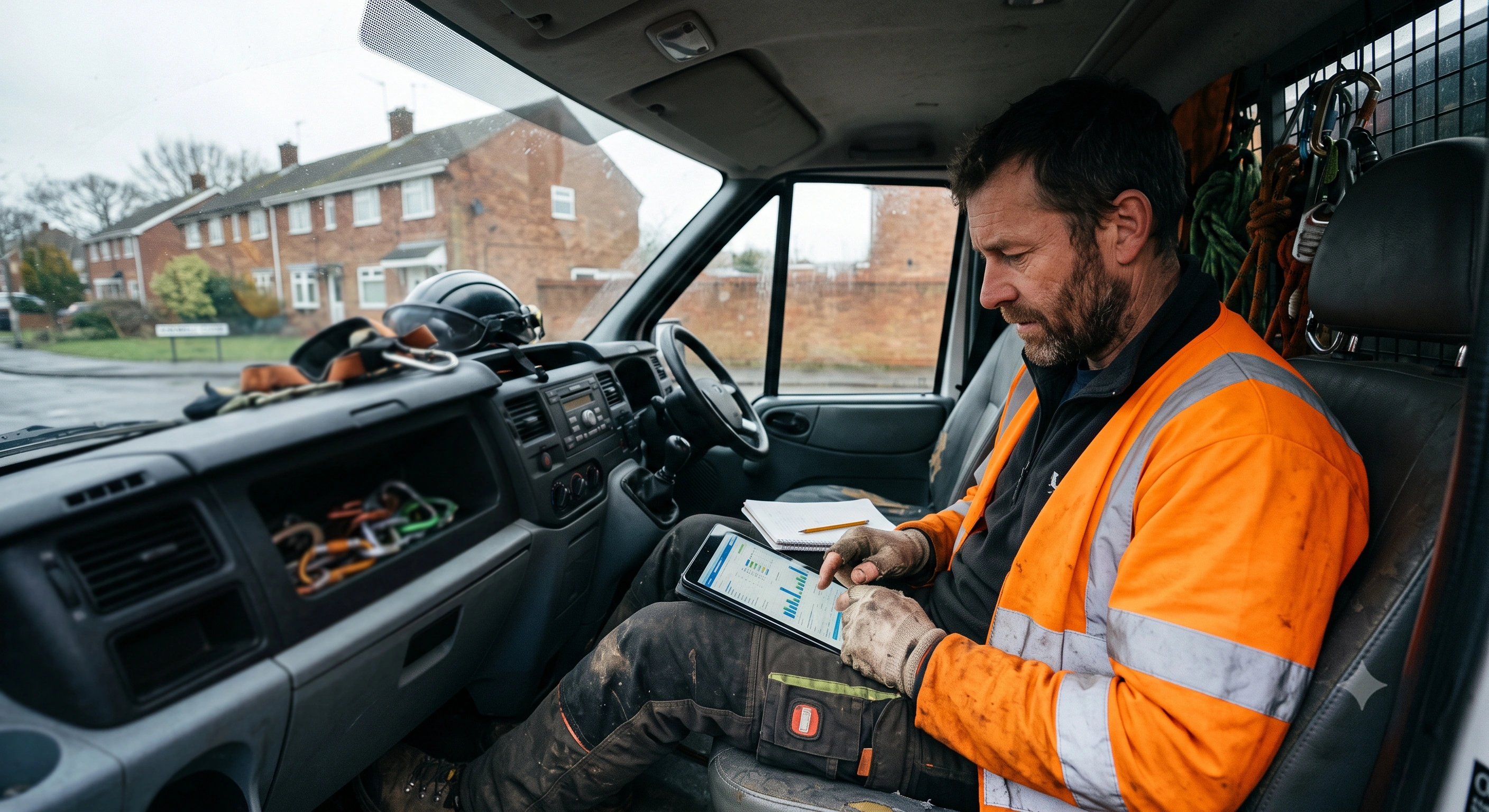
A Berkshire tree surgery business launched Google Local Service Ads in January 2026 with a £500 weekly budget. Within eight weeks, their cost per lead dropped to £38, and half their new enquiries came through paid channels. The owner had initially set aside just £200 monthly—a figure that would have left the campaign invisible in competitive search results.
A realistic tree surgeon advertising budget ranges from £800 to £2,000 per month for paid channels, with most established businesses allocating 5–10% of annual turnover to marketing. Effective campaigns combine Google Local Service Ads (£1,800–£2,400 monthly), search engine optimisation (£400–£1,200 monthly), and targeted Facebook advertising (£150–£600 monthly). Spending patterns shift seasonally—budget peaks in autumn when homeowners schedule crown reductions before winter, then contracts in late spring when demand softens.
Tree surgeon advertising budget refers to the monthly or annual expenditure allocated to customer acquisition channels—paid search advertising, local service platforms, search engine optimisation, social media campaigns, and business profile management—calibrated to average job value, service area density, and seasonal demand patterns typical to arboricultural services in the UK market.
Key Takeaways
- Most UK tree surgery firms spend 5–10% of revenue on marketing. This splits across paid advertising, SEO, and profile work.
- Google Local Service Ads require £1,800–£2,400 monthly (£450–£600 weekly) to stay visible in competitive postcodes.
- Organic lead generation through Google Business Profile and SEO costs £400–£1,200 per month but takes three to six months before enquiries arrive consistently.
- Cost per lead varies: £25–£80 for Google Ads, £15–£50 for Facebook, £10–£30 for mature SEO-driven enquiries. Your conversion rate—not just lead cost—determines true acquisition expense.
- Starting budgets of £800–£1,000 monthly allow testing across two channels before scaling winners.
What Does a Realistic Tree Surgeon Advertising Budget Look Like in 2026?
The 5–10% revenue rule works as a practical baseline. A business turning over £120,000 annually should allocate £6,000–£12,000 to marketing—£500 to £1,000 monthly. This covers all customer acquisition, not just paid ads. Larger firms often push towards 10%; lean start-ups stay closer to 5% during the first two years.
Two spending tiers dominate the market. New entrants typically commit £800–£1,200 monthly to test one or two channels and establish baseline performance data. Established businesses with documented conversion rates invest £1,500–£2,500, spreading budgets across Google Local Service Ads, search campaigns, and ongoing SEO work. These figures reflect 2026 UK market conditions, where competition for "emergency tree removal" and "tree surgeon near me" searches has intensified in suburban and semi-rural areas.
Size, geography, and season drive decisions. A sole trader covering three Devon postcodes may find £600 monthly sufficient if storm-damage work arrives through word of mouth. A five-person crew serving Greater Manchester needs £2,000+ to compete against twenty rival firms. Budget swells in autumn when homeowners book crown reduction and felling work; it contracts in late spring when enquiry rates drop.
How Much Do Google Ads and Google Local Service Ads Cost for Tree Surgeons?
Google Local Service Ads demand £1,800–£2,400 monthly (roughly £450–£600 weekly) for real visibility in competitive UK markets. This secures 30–60 leads per month at £30–£80 per lead, depending on postcode density and season. You pay only when a homeowner contacts you directly through the booking interface—no charges for impressions or clicks that lead nowhere.
Traditional Google Ads search campaigns work differently. Keywords like "emergency tree surgeon" and "tree removal cost" cost £1.50 to £6.00 per click in urban areas. A £1,000 monthly budget generates 165–650 clicks, converting at 5–12% into actual enquiries. Cost per lead typically lands between £25 and £80, shaped by ad quality, landing page conversion, and geographic targeting precision.
Google Business Profile optimisation costs nothing except time. Complete all profile fields, upload recent job photos, collect reviews, post weekly updates. This foundation must be solid before paid advertising begins. A profile with fewer than ten reviews and sparse service descriptions wastes paid traffic; prospects click through, see limited proof of competence, and return to search results.
Lead generation expenses for Local Service Ads often fall after three months of consistent spend and strong review accumulation. Cost per lead drops to £20–£45 as Google's guarantee badge—earned through background checks and licence verification—builds trust faster than text ads alone, lifting conversion rates by 15–30%.
What's the Difference Between Google Search Ads and Local Service Ads for Tree Services?
Google Search Ads display text listings at the top of results, charging per click whether or not the visitor enquires. You control ad copy, keywords, and landing page destinations. The catch: campaigns demand ongoing optimisation—adjusting bids, testing headlines, refining negative keyword lists to exclude noise like "tree surgeon salary" or "tree surgery course."
Local Service Ads appear above search ads. They show a green Google Guarantee badge, star ratings, and a direct booking button. Google vets participating businesses through background checks and registration verification. Homeowners message or call directly from the ad; Google charges only for these direct contacts. You cannot customise ad text—the platform pulls service categories and your review score automatically.
Pay-per-lead pricing protects budgets from click fraud and window shoppers but sacrifices control. Strong conversion rates from enquiry to booked job favour Local Service Ads due to lower customer acquisition cost. If you struggle to close leads by phone, search ads directing to a detailed landing page with portfolio imagery and transparent pricing may work better despite higher per-lead costs.
The Google Guarantee badge shifts perception. Homeowners see "Google screened" and perceive lower risk, particularly for high-value jobs like oak felling or work near buildings. This trust signal compensates for the lack of ad customisation.
Should Tree Surgeons Invest in Facebook Ads or Focus on Google?
Starting with £5–£20 daily (£150–£600 monthly) on Facebook tests audience response without major commitment. Lead generation costs on Facebook average £15–£50 per enquiry for tree services—lower than Google, but with a critical trade-off: intent. Facebook users scrolling their feed aren't actively searching for tree work; they must be stopped mid-scroll and convinced they have a problem worth solving now.
Google delivers high-intent traffic. Someone typing "tree surgeon Guildford" into search has a tree issue today. Facebook works best for seasonal reminders ("Book autumn tree health checks before winter storms") and showcasing dramatic before-and-after transformations. Video content—a 30-second clip of a large oak section lowered by rigging—performs exceptionally well, generating enquiries at £12–£35 per lead when targeted to homeowners within a ten-mile radius.
Lead quality differs. Google enquiries convert to booked jobs at 25–45% in well-run businesses. Facebook leads convert at 10–25%, requiring more follow-up and longer sales cycles. Homeowners who click a Facebook ad often request quotes from multiple firms; those who search Google and call immediately tend to book faster.
Facebook's targeting precision suits certain campaigns. Target users aged 35–65, homeowners (inferred from interests and behaviour), within a 15-mile radius, showing interest in gardening, property maintenance, or home improvement. This works well for seasonal promotions—hedge trimming discounts in late summer, storm-damage services in autumn—where timing matters more than immediate intent.
How Do Facebook Ad Costs Compare to Google Ads for Local Tree Services?
Cost-per-lead benchmarks tell a partial story. Facebook campaigns for UK tree surgeons generate leads at £15–£50, Google Search Ads at £25–£80, and Google Local Service Ads at £30–£60 (dropping to £20–£45 after three months). Facebook appears cheaper until you account for conversion rates.
If Facebook leads convert at 15% and Google leads at 35%, true acquisition costs flip. A £25 Facebook lead costs £167 per customer (£25 ÷ 0.15). A £60 Google lead costs £171 per customer (£60 ÷ 0.35). The difference nearly disappears, and Google's speed to booking often justifies the slight premium.
Audience intent drives conversion rate gaps. Google users actively seek solutions; Facebook users passively encounter offers. This changes campaign design. Facebook ads must interrupt, educate, and persuade—requiring strong creative, clear value propositions, and often a lead magnet (free tree health assessment, instant quote calculator). Google ads need only confirm competence and prompt action.
| Platform | Cost Per Lead | Typical Conversion Rate | Customer Acquisition Cost | Best Use Case |
|---|---|---|---|---|
| Facebook Ads | £15–£50 | 10–25% | £60–£500 | Seasonal promotions, brand awareness, video content |
| Google Search Ads | £25–£80 | 25–45% | £56–£320 | High-intent keywords, emergency services |
| Google Local Service Ads | £20–£60 | 30–50% | £40–£200 | Consistent lead volume, trust-building |
Takeaway: Google Local Service Ads win for tree surgeons needing predictable lead flow with lower acquisition costs. Facebook suits businesses with strong visual content and capacity to nurture longer sales cycles.
What Should Tree Surgeons Spend on SEO and Long-Term Lead Generation?
Monthly search engine optimisation costs range from £400 to £1,200 for professional services tailored to local tree surgery practices. This covers technical website optimisation (site speed, mobile responsiveness, structured data markup), content creation (service pages, blog articles, case studies), local citation building (directories, industry listings), and ongoing Google Business Profile management.
Here's what matters: SEO takes three to six months to show measurable results. Paid ads work immediately. A new tree surgery website launching SEO in January 2026 might see first-page rankings for "tree surgeon [town name]" by April or May—which means if you need leads in February, you'll have to pay for them. Competitive keywords like "emergency tree removal Manchester" require six to twelve months of sustained effort. Plan your cash flow accordingly.
Google Business Profile optimisation forms the foundation. Complete every profile section. Upload 20+ recent job photos. Collect ten reviews in the first month. Post weekly updates—storm preparation tips, seasonal pruning advice, recent project photos. This costs nothing but delivers 30–60% of total organic enquiries for most tree surgeons. Doing this work is non-negotiable, regardless of whether you invest in broader SEO.
Content marketing extends reach further. Publishing monthly blog articles—"When to Prune Oak Trees in Southern England," "Understanding Tree Preservation Orders," "Cost of Crown Reduction: A Breakdown"—builds authority for the research phase that precedes buying decisions. Homeowners researching tree health issues in March book work in April. Capture them early.
Is SEO Worth It for Small Tree Surgery Businesses or Should They Only Use Paid Ads?
The answer depends on your time horizon. Paid ads generate immediate results: launch Monday morning, receive enquiries by Tuesday. SEO generates compounding returns: rank for fifteen local keywords and receive enquiries indefinitely without per-click costs. You need both, but in different proportions at different growth stages.
Five primary lead sources exist: Google Business Profile, Google Search Ads, Google Local Service Ads, word-of-mouth referrals, and organic website traffic. Here's the risk: businesses relying solely on paid channels see lead flow stop the moment budgets pause. Those investing in SEO build an asset that performs during budget cuts, seasonal slowdowns, or when testing new service areas.
Most tree surgery operations should split 60% of the marketing budget to paid channels (Google Local Service Ads and search campaigns) for predictable monthly volume. Direct 40% to SEO and profile optimisation for long-term cost reduction. After twelve months of consistent SEO work, many shift to 50/50 splits as organic enquiries rise.
Small businesses with tight cash flow should start differently. Prioritise Google Business Profile optimisation and Local Service Ads first. A £600 monthly budget splits into £400 for Local Service Ads and £200 for profile management and basic SEO. Once monthly revenue reaches £15,000, add dedicated SEO investment—the £400–£600 monthly cost becomes negligible against the £3,000–£8,000 saved annually in reduced paid advertising dependency.
How Should Tree Surgeons Split Their Budget Across Different Advertising Channels?
Allocate 40–50% to Google Local Service Ads, 20–30% to Google Search Ads, 10–20% to Facebook campaigns, and 20–30% to SEO and profile optimisation. A £2,000 monthly budget distributes as £900 to Local Service Ads, £500 to search campaigns, £300 to Facebook, and £300 to ongoing SEO. This mix balances immediate lead generation with long-term cost reduction.
Seasonal patterns dominate tree surgery demand. Autumn (September through November) sees peak enquiries—homeowners book crown reduction, deadwood removal, and felling before winter storms arrive. Increase paid advertising budgets by 30–50% during these months, pulling from slower spring periods. Storm season (January–March) warrants emergency-keyword campaign boosts, shifting budgets entirely to "emergency tree removal" and "storm damage tree surgeon" terms. Miss this window and you're leaving money on the table.
Test before scaling. Start with £800–£1,000 monthly split across two channels. Run for eight weeks. Calculate cost per lead and conversion rate to paying customer for each channel. Double the budget on whichever performs better, pause or reduce the other. Retest quarterly as competition and seasonal patterns shift.
Without proper tracking, you're flying blind. Use call tracking numbers (unique phone numbers for each advertising source), CRM systems that tag lead origin, and Google Analytics with goal tracking for form submissions. A £2,000 monthly spend generating 40 leads means nothing if you cannot identify which 15 came from Local Service Ads at £45 each and which 8 came from Facebook at £80 each. You'll keep throwing money at what doesn't work.
What's a Good Starting Budget for a New Tree Surgery Business?
Minimum viable monthly budgets sit between £800 and £1,200 for new tree surgery operations. This allows meaningful testing of one primary channel (Google Local Service Ads at £600–£800 monthly) plus foundational profile and SEO work (£200–£400 monthly). Budgets below £600 spread too thin to generate actionable data or consistent enquiry flow.
Budget constraints force choices. Zero existing enquiry flow and need jobs within two weeks? Allocate 80% to Google Local Service Ads and 20% to profile optimisation. Word-of-mouth and repeat customers providing baseline work? Split funds evenly between Local Service Ads and SEO.
Bootstrap using Google Business Profile and organic methods. Claim the profile and complete every section. Upload 30+ job photos showing diverse work (crown reduction, felling, stump grinding, hedge work). Request reviews from every satisfied customer—target 25 reviews in the first three months. Post twice weekly. This effort alone generates 5–15 enquiries monthly in suburban and semi-rural areas, entirely free.
Local directories amplify this work. Ensure consistent business name, address, and phone number across Checkatrade, Trustmark, Arboricultural Association member directory, Yell, and Thomson Local. Submit to niche platforms like Bark and MyBuilder, though per-lead fees add up and quality varies. These listings feed Google's local ranking algorithm and create additional enquiry paths.
How Can Tree Surgeons Track ROI and Adjust Their Advertising Budget?
Monitor cost per lead, lead-to-customer conversion rate, average job value, and customer lifetime value. A business with a £180 average job value, 30% conversion rate, and £50 cost per lead achieves 1.2:1 return (£180 × 0.30 = £54 revenue per lead, minus £50 cost = £4 net). This signals underperformance; either job value rises, conversion improves, or cost per lead must drop below £35.
Track lead sources using call tracking platforms (ResponseTap, Mediahawk), customer relationship management systems (Jobber, Fergus, Service M8), and Google Analytics with goal tracking configured for contact form submissions and phone clicks. Assign unique tracking numbers to each channel. When a lead calls, the system logs which campaign drove the enquiry. Without this, you cannot separate genuine £20 leads from misattributed cost calculations.
Scale when a channel proves itself. Once cost per customer falls below 25% of average job value and lead volume remains stable week over week, increase budget by 25–50%. A Local Service Ads campaign generating 30 leads monthly at £40 each, converting at 35%, produces 10.5 customers at £114 acquisition cost. If average job value is £500, the 4.4:1 return justifies doubling the budget.
Optimise instead of scaling when cost per lead rises month over month, conversion rates drop below 20%, or lead volume plateaus despite increased spend. Diagnose the problem: ad fatigue (same creative running 90+ days), poor landing page performance (bounce rate above 60%), targeting drift (ads showing outside your service area). Pause budget increases. Test new creative, refine keywords, improve page speed, tighten geographic targeting.
Red flags demand immediate attention: leads requesting services you don't offer (poor keyword targeting), repeated enquiries from the same phone numbers (click fraud), and large gaps between enquiry timestamp and logged contact (team isn't answering). Review search term reports weekly. Add negative keywords for irrelevant searches like "tree surgeon apprenticeship" or "tree surgery equipment hire."
What's a Good Cost Per Lead for Tree Surgeon Advertising?
Industry benchmark ranges for UK tree surgery in 2026: £20–£60 from Google Local Service Ads, £25–£80 from Google Search Ads, £15–£50 from Facebook campaigns, and £10–£30 from mature SEO-driven enquiries. Rural areas with lower competition see costs 20–40% lower. Greater London and Home Counties postcodes push 30–50% higher.
Calculate your acceptable customer acquisition cost this way: multiply your average job value by your target profit margin, then by your close rate. A business averaging £450 per job, operating at 35% gross margin (£157.50 profit per job), closing 30% of leads, can afford £47 per lead (£157.50 × 0.30 = £47.25) while maintaining profitability. Costs above this threshold erode margins. Costs below create scaling opportunities.
Geography matters significantly. A tree surgeon in rural Shropshire generates Local Service Ads leads at £18–£30 because only three competitors exist. The same service in Reading faces twelve competitors, pushing costs to £50–£75. Higher costs don't signal poor performance—they reflect market realities. The question becomes whether local job values justify acquisition costs in your area.
| Lead Source | Urban Cost Per Lead | Rural Cost Per Lead | Lead-to-Job Conversion | Acceptable CAC (£450 avg. job, 35% margin) |
|---|---|---|---|---|
| Google Local Service Ads | £40–£75 | £20–£40 | 30–50% | ≤£47 |
| Google Search Ads | £40–£95 | £25–£60 | 25–45% | ≤£47 |
| Facebook Ads | £25–£65 | £15–£40 | 10–25% | ≤£47 |
| SEO (organic) | £10–£35 | £8–£25 | 35–55% | ≤£47 |
What this means: Urban tree surgeons need to hit £40–£50 per lead on paid channels to stay profitable. Rural operators can stretch to £20–£35 and still break even. But here's the catch—you'll only hit that margin if you convert at least 30% of incoming leads to actual jobs. Miss that conversion rate, and your costs become unsustainable fast.
Not sure what to spend on ads?
Get a straight answer on ad budget
We help UK tree surgeons set a realistic budget and prove cost-per-job before scaling. Book a free, no-obligation strategy call.
Published by Tree Surgeon Leads UK, a specialist marketing and lead generation agency working with UK tree surgeons.
Frequently Asked Questions About Tree Surgeon Advertising Budgets
How much should a tree surgery business spend on advertising per month?
Most UK tree surgery businesses allocate 5–10% of annual turnover to marketing. That translates to £800–£2,000 monthly for operations earning £100,000–£240,000 yearly. New businesses should start with £800–£1,200 to test Google Local Service Ads and profile optimisation, then scale once you've verified which channels actually convert leads into paying customers. Established firms with solid data can justify £2,000–£3,000 monthly spread across multiple channels.
Are Google Local Service Ads worth it for tree surgeons?
Yes. Particularly in competitive suburban and urban markets where homeowners trust the Google Guarantee badge and verified reviews. Tree surgeons typically report £20–£60 cost per lead with 30–50% conversion rates after three months of consistent running. The pay-per-lead model means you only pay when someone actually enquires—no wasted clicks on browsers. Placement above traditional search ads captures high-intent traffic before your competitors even appear on screen.
How long does it take to see results from tree surgeon advertising?
Google Local Service Ads and search campaigns deliver enquiries within 24–72 hours of going live. Facebook ads need one to two weeks of testing before the algorithm optimises targeting and creative. Search engine optimisation? That's a different beast—expect three to six months before you see first-page rankings and meaningful organic enquiry volume. If you need leads this month, start with paid channels. Build SEO in the background.
Should I hire a marketing agency or manage my own advertising budget?
An agency specialising in trades services costs £400–£1,200 monthly but moves faster and smarter than most self-managed campaigns. They arrive with established keyword research, seasonal bid adjustments, and conversion rate optimisation tactics proven across arboricultural businesses. Self-management works if you have in-house marketing experience and real time to invest—but expect a three-to-six-month learning curve before you match agency-level results.
What's the best advertising platform for emergency tree services?
Google Search Ads. Target keywords like "emergency tree removal [location]" and "storm damage tree surgeon," then run campaigns 24/7 with mobile-preferred ads and click-to-call buttons. During storm season (January–March peak), bid aggressively—cost per click can hit £8–£12, but conversion rates often exceed 40% because homeowners need immediate help. Local Service Ads work for general emergency positioning, but they lack the keyword precision that search campaigns provide when someone has a branch through their roof.
How do seasonal changes affect tree surgeon advertising budgets?
Autumn (September–November) demands 30–50% budget increases as homeowners book pre-winter work. Storm season (January–March) warrants aggressive emergency-keyword campaign spending. Spring (April–June) softens demand—cut budgets by 20–30% or redirect cash toward brand building and SEO. Summer hedge-trimming and garden-clearance work justifies moderate Facebook spend targeting homeowners planning outdoor projects. Track your own historical patterns by month so you can forecast seasonal shifts accurately instead of guessing.