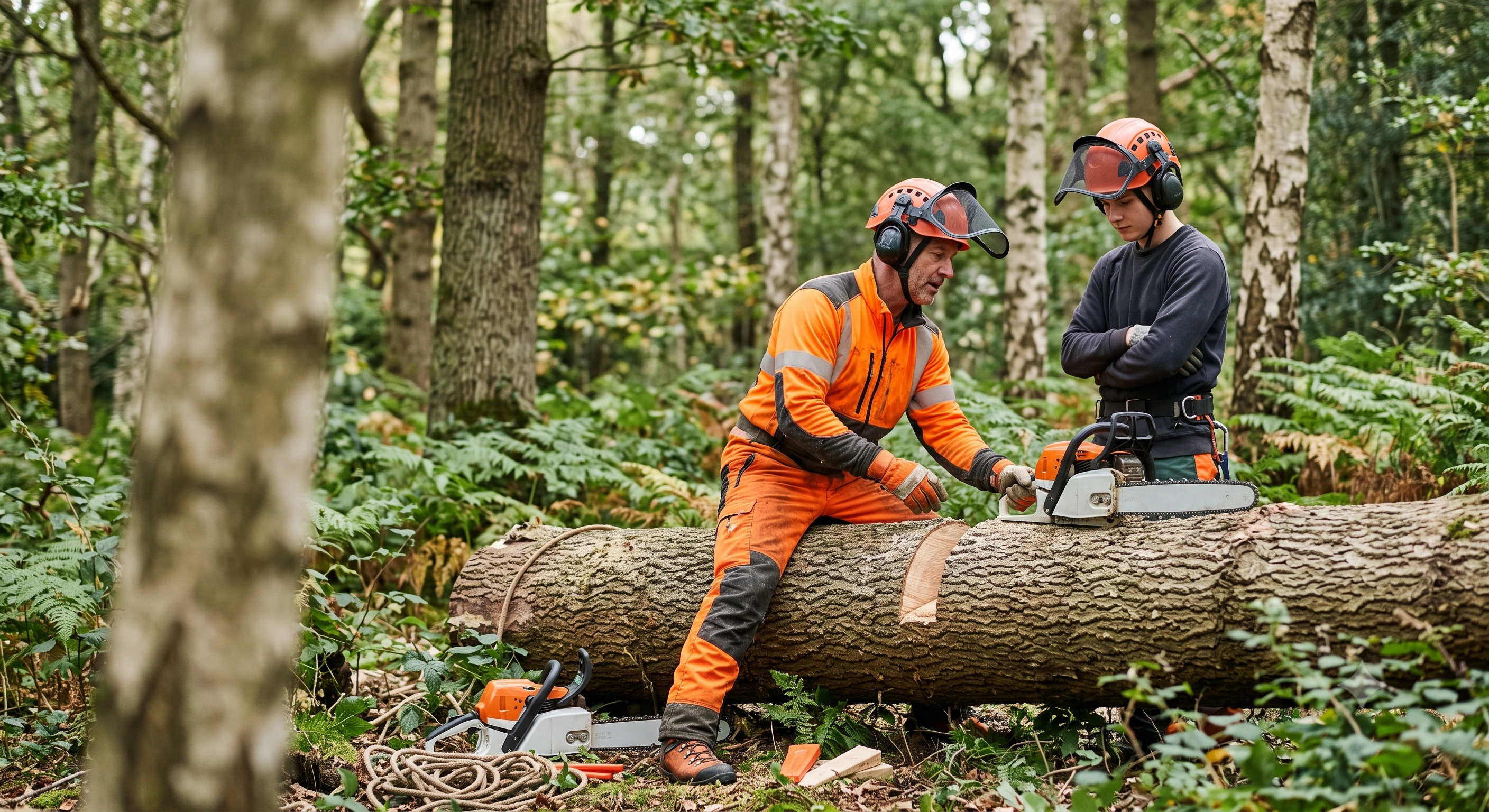
You don't need a licence to call yourself a tree surgeon in the UK—the law doesn't require one. But you will need specific certificates of competence, principally NPTC (National Proficiency Training Council) and Lantra Awards qualifications. Without them, your insurance won't cover you, clients won't hire you, and you can't legally work with a chainsaw or at height. Most professional tree surgeons hold at least CS30 (chainsaw maintenance and cross-cutting), CS31 (felling small trees), and aerial rescue certification before working independently.
Certificate of Competence – a nationally recognised document issued by an awarding body such as City & Guilds, Lantra, or the National Proficiency Training Council, confirming that an individual has met the required standard in a specific arboricultural skill (chainsaw operation, aerial rigging, or use of mobile elevated work platforms).
Key Takeaways
- No official licence exists, but insurance and employer liability rules effectively demand NPTC or Lantra certification for chainsaw work and work at height. Without it, you're uninsurable.
- NPTC CS30, CS31, and aerial rescue qualifications are the minimum standard. Most ground workers start with CS30 and progress through on-the-job training.
- Apprenticeships blend City & Guilds Level 2/3 diplomas in arboriculture with practical experience. They typically take 18 to 24 months.
- International Society of Arboriculture (ISA) certification is recognised internationally and requires refresher assessment every three years.
- Training costs vary: a five-day CS30 course runs roughly £400–600, while aerial qualifications can reach £1,500–2,500. Only use accredited providers.
What Qualifications Do You Actually Need to Work as a Tree Surgeon in the UK?
UK law permits anyone to offer tree-care services without a licence. Where the law bites is insurance. Employers' liability and public liability – both compulsory if you employ staff or work on third-party property – will exclude you entirely unless you hold recognised certificates of competence for every task. An unqualified chainsaw operator injured at work may have their claim rejected; the employer can face prosecution under the Health and Safety at Work Act 1974.
Commercial clients and local authorities specify NPTC or Lantra qualifications in tender documents. Domestic customers increasingly demand proof of training. In practice, City & Guilds NPTC certificates and Lantra Awards function as the real licensing system. You can start without them, but you cannot sustain a business or join a reputable firm.
Do tree surgeons need to be certified?
Certification is not a statutory requirement. It is an insurance and liability necessity. Your public liability policy—typically £5–10 million per event—will contain an endorsement restricting cover to "qualified operatives holding valid certificates of competence." Use a chainsaw without CS30 or CS31 and your insurer will void the policy. Your employer may face criminal prosecution.
What is NPTC certification and why does it matter?
The National Proficiency Training Council sets competency standards for land-based industries in the UK. City & Guilds administers NPTC assessments and issues certificates. Each qualification is task-specific: CS30 covers chainsaw maintenance and cross-cutting; CS31 covers felling trees up to 380 mm diameter; and so on. An accredited assessor observes your work and signs off.
Here's the critical detail: NPTC certificates expire. CS30, CS31, and CS32 require refresher assessment every five years. Aerial qualifications—CS38 and CS39—follow the same cycle. Let your certificate lapse and you cannot legally work in that discipline until you retake the assessment. If you work anyway, your insurance is void and you're personally liable for any injury or damage.
Which Essential Certificates Must You Obtain Before Starting Tree Work?
Ground-based chainsaw work starts with CS30 (chainsaw maintenance and cross-cutting), then progresses to CS31 (felling and processing trees up to 380 mm) and CS32 (felling and processing larger trees). Aerial work demands CS38 (aerial cutting) plus CS39 (aerial rescue). HSE regulations require at least one team member trained in rescue—because if a climber is injured or incapacitated at height, someone must be able to bring them down safely. Lantra Awards offer equivalent qualifications; some employers accept either, others specify one.
Operating a mobile elevated work platform (MEWP)—a cherry picker or spider lift—requires IPAF (International Powered Access Federation) certification for that specific machine category. LOLER Certification (Lifting Operations and Lifting Equipment Regulations 1998) is not a personal qualification; it's a legal duty. Any lifting equipment used to hoist people or loads must be inspected every six or twelve months by a competent person, with records kept. In practice, the employer or self-employed operator who owns the kit carries this responsibility.
What chainsaw certificates do tree surgeons need?
CS30 is mandatory before anything else: two to three days covering pre-start checks, safe starting, cross-cutting, and maintenance. You cannot fell a tree without CS30 first, because CS31 and CS32 assessments assume you already know how to handle the saw. CS31 adds small-tree felling (up to 380 mm diameter) and snedding (removing branches from a felled stem). CS32 extends to larger trees and includes complex hinge cuts and escape-route planning.
Each requires a practical assessment. Refresher courses are shorter—one or two days—but still include observed assessment. Many training centres bundle courses (CS30 + CS31 over five days) to reduce cost.
Do you need special qualifications to use a chainsaw commercially?
Yes. Using a chainsaw in employment or self-employment without appropriate training breaches HSE guidance and voids your insurance. Cutting firewood on your own land for household use doesn't require certification. Charge for the service or work on someone else's property, and you've entered commercial territory. Employers have an absolute duty under the Health and Safety at Work Act 1974 to ensure adequate training. The HSE's Approved Code of Practice AFAG 804 explicitly names NPTC or equivalent certification as the benchmark.
What Academic and Entry-Level Qualifications Help You Become a Tree Surgeon?
There are no mandatory academic entry requirements. Many practising tree surgeons entered the trade with no formal qualifications and learned on the job. That said, GCSEs (or National 5 qualifications in Scotland) in English, Mathematics, and a science subject improve your chances of securing an apprenticeship or trainee ground-worker position with a larger firm. Literacy matters for risk assessments; numeracy matters for measuring tree heights and calculating felling directions.
BTEC Level 2/3 qualifications in Countryside Management, Forestry, or Land-Based Studies offer a classroom route. Colleges such as Merrist Wood (Surrey), Myerscough (Lancashire), and Askham Bryan (York) run one-year or two-year programmes combining theory with practical chainsaw modules. From September 2023, some colleges offer T-Levels in Agriculture, Land Management and Production—a two-year course equivalent to three A-Levels with substantial work placement. Though broader than arboriculture alone, the T-Level covers tree health, woodland management, and machinery operation.
City & Guilds Level 2 Diploma in Arboriculture (typically delivered by land-based colleges) includes tree biology, identification, pests and diseases, chainsaw maintenance, and climbing introduction. The Level 3 Diploma adds business planning, contract management, and advanced rigging. Both embed NPTC assessments, so you leave college with a diploma and several NPTC tickets in one go.
Can you become a tree surgeon without GCSEs?
Yes. Practical ability and attitude matter more than exam results once you're working. Most apprenticeship schemes, however, specify four GCSEs at grade 4/C or above (including English and Maths) as entry criteria, to ensure candidates can complete written coursework. If you lack GCSEs, pursue Functional Skills Level 2 in English and Maths—many adult-education centres offer short evening courses—or apply for ground-worker roles with smaller firms who recruit on attitude and train in-house.
How Do Tree Surgeon Apprenticeships Work in the UK?
A tree surgery apprenticeship typically lasts 18 to 24 months. You work four days a week for the employer (felling, climbing, chipping, site clearance) and spend one day in classroom or workshop, building towards a Level 2 or Level 3 Diploma in Arboriculture and a suite of NPTC certificates (usually CS30, CS31, CS38, CS39). Block-release or day-release attendance depends on your employer and local college availability.
The Royal Forestry Society Certification in Arboriculture (RFS Cert Arb) was once the gold standard apprenticeship-level programme. As of 2026, it has been largely replaced by the reformed Level 2 Arborist apprenticeship standard overseen by the Institute for Apprenticeships and Technical Education. The new standard mandates competence in tree identification, chainsaw use, aerial rescue, and basic rigging, with an end-point assessment including practical observation and professional discussion.
Employers receive government funding to cover most of the training cost (the apprenticeship levy for larger firms, co-investment for smaller ones), so many advertise vacancies with "no cost to the apprentice" – meaning you earn a wage (at least the National Minimum Wage for apprentices: £6.40 per hour in 2026 for those under 19 or in their first year) while you learn. After completing the apprenticeship, most continue with the same employer and work towards CS32, IPAF, and eventually ISA certification.
What does a tree surgery apprenticeship involve?
Expect practical work from day one: raking brash, loading the chipper, setting up traffic management, assisting the climber. You'll start on the ground – which is where most apprentices spend their first six months – before moving into the classroom or onto the rope.
Classroom modules cover tree biology (identification, growth, photosynthesis), legislation (Tree Preservation Orders, Conservation Areas, planning consent), risk assessment, and customer service. Practical assessments run continuously: your employer and a college assessor observe you performing chainsaw maintenance, cross-cutting, and felling under supervision, signing off each unit when you meet the standard.
At the end of the apprenticeship you sit an end-point assessment – a day-long practical test and professional interview conducted by an independent organisation. Pass, and you receive your Level 2 or Level 3 certificate. Fail, and you'll typically retake within six weeks; most apprentices pass on the first attempt, but pressure builds if you don't.
What Advanced Certifications Can You Pursue for Career Progression?
Once you hold core NPTC certificates and have two or three years' experience, the International Society of Arboriculture (ISA) Certified Arborist credential adds international recognition. ISA certification requires passing a multiple-choice exam covering tree biology, diagnosis, pruning standards, risk assessment, and legal responsibilities.
The exam is available worldwide (online or at test centres) and costs approximately £260 for ISA members – membership itself costs around £90 per year. That's £350 upfront, which matters if you're self-funding. ISA certification is valid for three years; to renew, you must earn 30 Continuing Education Units (CEUs) through attending workshops, writing articles, or delivering training. Miss the deadline and you'll need to resit the full exam.
European Tree Worker (ETW) and European Tree Technician (ETT) qualifications, administered by the European Arboricultural Council, require demonstration of advanced rigging techniques, complex dismantling, and emergency procedures. ETW is broadly equivalent to UK Level 3; ETT is a higher technical qualification involving written reports and advanced problem-solving scenarios.
Specialist certificates round out a CV: CS41 (operate and maintain a stump grinder), PA1 and PA6 (purchase, store, and apply pesticides under the Plant Protection Products Regulations), and Powersaws for Professional Tree Care short courses in pole-saw and hedge-trimmer use. If you plan to run your own business, consider the Level 4 Certificate in Arboricultural Management offered by the Arboricultural Association or the ILM Level 3 Certificate in Principles of Management to learn estimating, scheduling, and staff supervision.
Is ISA certification worth it for UK tree surgeons?
ISA certification is not essential for employment in the UK – NPTC credentials satisfy most clients and insurers – but it demonstrates commitment to professional development and opens doors internationally. Some large estate-management firms, golf courses, and conservation charities prefer ISA-certified arborists for consultancy roles: tree surveys, BS5837 reports for planning applications, hazard assessments. If you aspire to that kind of advisory work rather than day-long felling jobs, ISA is the credential that signals you've studied beyond the practical minimum.
The three-year recertification cycle ensures your knowledge remains current, which appeals to clients seeking advice rather than just felling and clearing.
Qualified and ready for more work?
Turn your tickets into a full diary
Your qualifications win trust — we help you win the work. Google and Meta campaigns for UK tree surgeons. Book a free strategy call.
Which Organisations Provide Tree Surgeon Training and Certification in the UK?
Lantra is the Sector Skills Council for land-based industries and an awarding body for qualifications including chainsaw, MEWP, wood chipper, and brushcutter certificates. Lantra Awards are widely accepted by insurers and recognised across England, Scotland, Wales, and Northern Ireland. Training centres approved by Lantra deliver courses to the published standard and assessors are externally moderated. Find accredited centres through the Lantra website.
City & Guilds administers the NPTC suite on behalf of the National Proficiency Training Council. NPTC is a registered charity; City & Guilds handles the paperwork, certification, and quality assurance. Check a centre's approval status on the City & Guilds directory before booking: only centres with current approval numbers can issue valid certificates. Some online listings are out of date – and an unaccredited certificate will be rejected by your insurer.
The Royal Forestry Society continues to support professional development through events, scholarships, and mentoring, although its direct delivery of the RFS Cert Arb qualification ended when the new apprenticeship standard launched. The Arboricultural Association is the UK's leading membership body for tree-care professionals. It publishes best-practice guidance, runs regional training days, and accredits Approved Contractors who meet safety, insurance, and competence standards. Membership (around £180 per year for professional grade) gives access to the Arboricultural Magazine, legal helpline, and discounted training.
Where can I get NPTC certified?
Accredited centres operate across the UK; most are commercial forestry training companies, agricultural colleges, or land-based further-education colleges. Course availability peaks in spring and autumn (fewer in midwinter or high summer).
A typical CS30 course runs over two or three days and costs £400–600 inclusive of assessment and certificate. CS31 adds two days and roughly £300–400. Combined CS30 + CS31 packages cost around £800–1,000. Aerial courses (CS38 + CS39) require five to seven days and can reach £1,500–2,500 depending on group size and venue. These fees include certification but rarely cover accommodation or Personal Protective Equipment (PPE); you must bring your own helmet, visor, gloves, boots, and trousers (or hire from the centre).
Frequently Asked Questions About Tree Surgeon Qualifications in the UK
How long does it take to become a qualified tree surgeon?
An apprenticeship route takes 18 to 24 months to achieve a Level 2 Diploma and core NPTC certificates (CS30, CS31, CS38, CS39). Self-funding individual courses while working as a ground worker compresses that to six to twelve months, depending on course availability and your employer's willingness to release you for training. Here's the catch: speed doesn't equal competence. Full confidence – handling complex dismantles, advanced rigging, business management – typically takes three to five years of varied site experience after initial certification.
Do tree surgeons need public liability insurance?
Yes. Anyone working on a third party's property or undertaking work that could cause injury or damage must hold public liability insurance, typically covering £5 million or £10 million per claim. Insurers will require proof of valid NPTC or Lantra certificates before issuing a policy. If you're self-employed, you arrange your own cover; if you're employed, your employer's policy should cover you – but only while you work within the scope of your certified competence. Most policies exclude cover for tasks for which you hold no certificate. Exceed that boundary and you're uninsured.
What's the difference between an arborist and a tree surgeon?
In the UK the terms are often used interchangeably, but arborist traditionally implies a consultancy or advisory role – tree surveys, risk assessments, BS5837 reports for planning, diagnosis of pests or diseases – while tree surgeon emphasises practical felling, pruning, and removal. An arborist may hold the same NPTC certificates but spend more time writing reports and less time climbing. Some professionals use "consulting arborist" to distinguish office-based work from site operations.
Can I work as a tree surgeon while training?
Yes, as a ground worker or trainee. Ground work – raking, chipping, traffic management, tool maintenance – does not require certification, so employers recruit enthusiastic beginners and train them progressively. Once you have CS30 you can handle a chainsaw on the ground under supervision; after CS31 you can fell small trees; after aerial tickets you can climb. Most employers expect you to attend courses in your own time or on day release, reimbursing fees once you pass.
Do tree surgery qualifications expire?
Chainsaw and aerial NPTC certificates expire after five years. To renew, you attend a one- or two-day refresher course and re-sit the practical assessment. Employers and insurers treat an expired certificate as no certificate – you cannot legally work with that equipment until you've renewed. IPAF MEWP cards expire after five years. ISA Certified Arborist credentials expire after three years unless you earn the required Continuing Education Units. First-aid certificates (often required by employers) expire after three years and require a one-day requalification course.
How much do tree surgeon courses cost?
Budget £400–600 for CS30, £700–900 for CS30 + CS31 combined, and £1,500–2,500 for a full aerial package (CS38, CS39, and often CS31 if not already held). IPAF MEWP training costs around £200–350 for a one- or two-day course. ISA exam and membership together cost roughly £350 in the first year. Apprentices pay nothing for mandated training (covered by levy or co-investment), but self-funded trainees should expect to spend £2,000–3,500 to acquire the core suite of certificates. Some training providers offer payment plans; check whether your employer will reimburse fees on successful completion.
Published by Tree Surgeon Leads UK, a specialist marketing and lead generation agency working with UK tree surgeons.