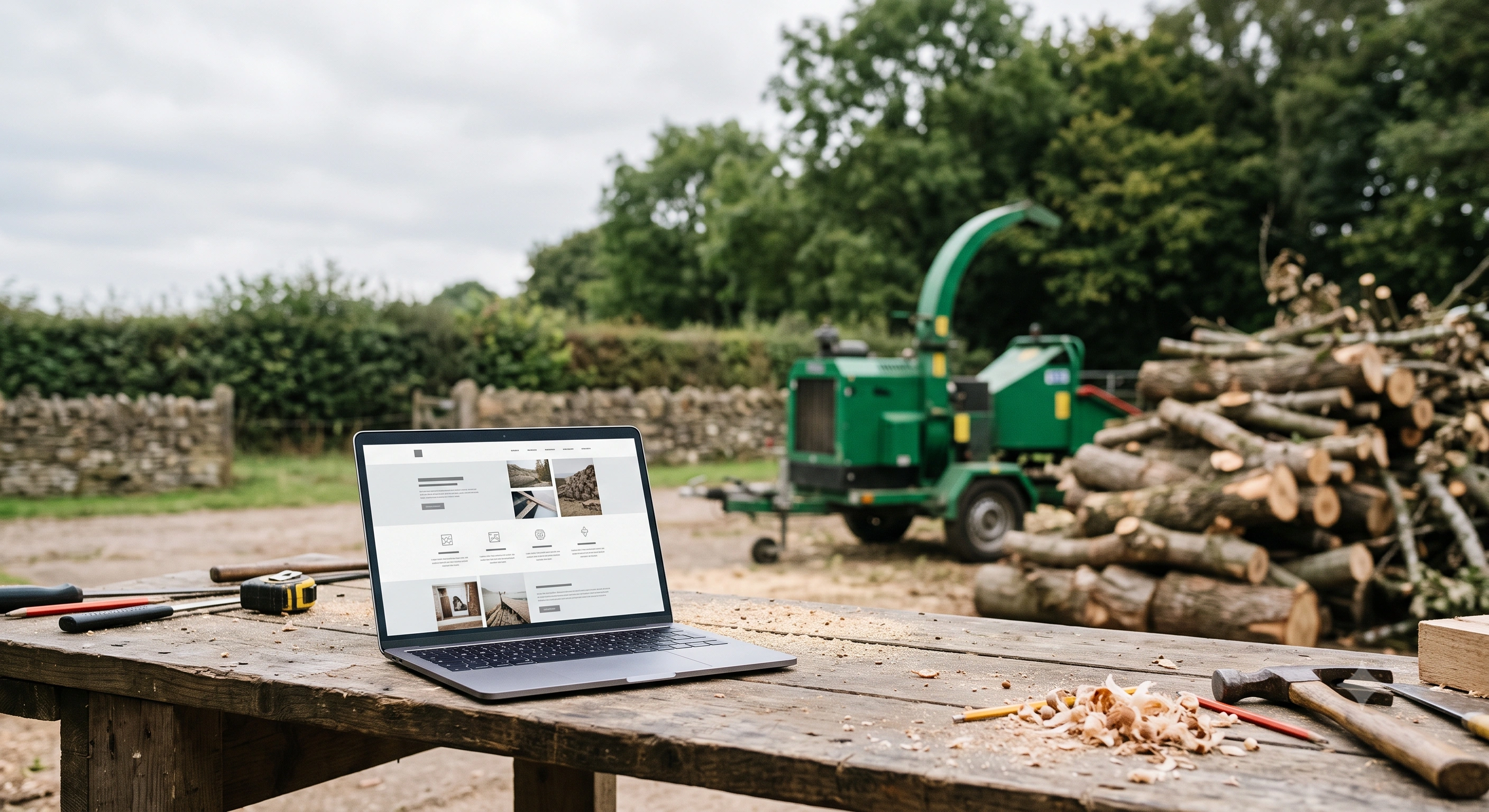
A Gloucestershire tree surgeon lost three enquiries in one week because his website listed only a mobile number. No online booking. No emergency callout page. No county-specific storm-damage content. Each enquiry went straight to a competitor whose site answered "Do I need permission to fell this ash tree?" before the phone even rang.
A tree surgeon website must display your arboricultural credentials prominently, include geo-specific content on local Tree Preservation Orders (TPOs) and Conservation Areas, and provide clear emergency contact routes for storm damage or dangerous tree reports. High-liability tree work is different. Your visitors need reassurance about insurance, compliance with British Standard BS 3998, and boundary-tree protocols—concerns that rarely surface on a plumber's site.
Tree surgeon (also arborist or tree care specialist)—a professional trained in the cultivation, management, and study of trees, shrubs, and woody plants, typically holding certification from the Arboricultural Association or similar body and operating under British Standard BS 3998 for tree-work recommendations.
Key Takeaways
- Display your public liability insurance certificate (minimum £5 million cover), Arboricultural Association membership number, and any Lantra or NPTC qualifications on your homepage and About page.
- Create separate landing pages for each county or borough you serve, covering local TPO registers, Conservation Area maps, and council contact details for tree-work notifications.
- Boundary trees need their own service page. Under common law (Lemmon v Webb [1894] and subsequent cases), trees on or overhanging boundaries require neighbour consent for major work—position yourself as the mediator who handles this friction.
- Emergency storm-damage hotline in the header, prominently. Back it up with a simple quote-request form asking whether the tree sits under a TPO or within a Conservation Area.
- Blog monthly on seasonal topics—storm preparation in autumn, oak processionary moth alerts in spring, ash dieback updates. These posts capture "tree surgeon near me" searches when demand actually peaks and people are searching, not when you feel like writing.
What Makes a Tree Surgeon Website Different from Other Contractor Sites?
Tree surgery lives at the intersection of horticulture, public safety, and property law. A joiner shows finished kitchens; you must prove you understand the difference between a section-fell and a straight drop. You know when a Forestry Commission felling licence is required—anything over 5 cubic metres per calendar quarter outside permitted exemptions. You carry appropriate cover for third-party property damage.
British Standard BS 3998 (Tree Work—Recommendations) sets the only recognised specification for tree operations in the UK. When you mention BS 3998 compliance on your Services page, you're signalling professional competence to local-authority tree officers, insurance assessors, and solicitors instructing expert witnesses in boundary disputes. General builders rarely cite standards. You must.
Tree Preservation Orders and Conservation Areas add a regulatory layer most trades never touch. A homeowner who hires you to remove a protected oak without council consent faces an unlimited fine under section 210 of the Town and Country Planning Act 1990. Miss this detail, and your client—not you—takes the legal hit. Your website should include a TPO-checker prompt ("Not sure if your tree is protected? We'll check the local register free of charge") to capture cautious enquiries and position you as the compliant choice.
Do tree surgeons need different credentials than general contractors?
Absolutely. General building regulations cover scaffolding, but felling, crown reduction, and stump removal require specific competence certificates. The Health and Safety Executive's Arboriculture and Forestry Advisory Group publishes guidance notes (AFAG 303, 304, 401) that shape insurer requirements and local-authority procurement.
Display your NPTC tickets on an "Our Team" or "Qualifications" page: CS30 (chainsaw maintenance), CS31 (felling small trees), CS38 (aerial tree rescue). These codes mean nothing to the general public. Add a plain-English line underneath: "All our climbers hold NPTC CS38 (emergency rescue) and CS39 (aerial cutting) certificates, meeting HSE and insurance standards."
Arboricultural Association Approved Contractor status isn't compulsory, but it carries weight. It requires annual audit of insurance, qualifications, and safe-working procedures. If you hold it, feature the AA logo and approval number in your site footer and on your Contact page. Basic membership alone is less rigorous but still worth displaying.
What Essential Pages Does Every Tree Surgeon Website Need?
A converting tree-surgery site requires six core pages: Home, Services (with sub-pages for each operation type), About, Emergency, Areas We Cover, and Contact. Optional but highly effective: Case Studies (before/after gallery with tree species and reason for work), Blog (seasonal advice, pest alerts, storm prep), and Resources (downloadable TPO guides, Conservation Area maps, Forestry Commission felling-licence explainer).
Homepage
Open with your unique selling point in the first sentence—"Covering Somerset and North Devon: certified arborists, BS 3998 compliant, emergency callouts within two hours." Above the fold, include three trust signals: years trading or number of jobs completed (realistic—"over 400 trees safely felled since 2018"), insurance amount, and your highest-value credential (AA Approved Contractor, Lantra Professional Tree Inspection, or similar). Add a postcode-lookup tool or dropdown menu for Areas Covered. Visitors want confirmation you serve them before they read further.
Services page
Break into sub-pages or tabbed sections: Tree Felling & Removal, Crown Reduction & Thinning, Stump Grinding, Hedge Management, Tree Surveys & Reports, Emergency Storm Damage. Each sub-page should answer three questions: When is the service needed (crown lifting to achieve 5.2 m clearance over a highway)? What does BS 3998 say (crown thinning typically removes no more than 30 per cent of foliage)? How do you minimise disruption (brash chipped on-site, log rounds cut to firewood length if the client requests)?
Include a sentence on permissions: "We check the local TPO register and advise on notification requirements before any work begins."
About page
Name your principals. Show their qualifications—headshot plus NPTC ticket list or AA membership card. Summarise your service area. Skip the generic "passion for trees" language. Instead: "Founded in 2015 after ten years working for a county-council arboriculture team, we've handled everything from routine pruning to emergency storm-clearance contracts for parish councils and housing associations." One or two client testimonials (real names, towns) add credibility.
Emergency page
Dedicated /emergency-tree-work/ or /storm-damage/ landing page captures high-intent traffic during and after severe weather. Your emergency mobile number should appear in 28pt font or larger. Confirm your typical response time: "We aim to assess dangerous trees within two hours of your call, seven days a week." Clarify what counts as emergency (split stem overhanging a house, uprooted tree blocking a road) versus routine work that can wait.
Local authorities and insurance loss adjusters search "emergency tree surgeon [town]" when roads close after gales. This page should rank for those terms and answer them immediately.
Areas We Cover
Create a dedicated page listing every town, village, and postcode district you serve, organised by county. One or two sentences per area highlighting local factors: "In Bath and North East Somerset, many properties fall within the city's Conservation Area; we're experienced in submitting the required six-week notifications to the council's tree officer." This structure gives you natural keyword targets and helps Google understand your service radius.
Contact page
Offer multiple routes: phone (mobile and landline if you have one), email, and a quote-request form. The form should ask property postcode, brief description of the tree and work needed, whether the tree is protected by a TPO or in a Conservation Area (Yes / No / Not sure), preferred contact method, and urgency (routine / this month / emergency). Embed a Google Map centred on your base town, and list your registered business address (required by the Consumer Contracts Regulations 2013).
Should tree surgeons have separate pages for residential and commercial clients?
Not essential. Beneficial if you work regularly for local authorities, schools, housing associations, or estates. Commercial clients search different terms—"arboricultural contractor," "BS 5837 tree survey," "grounds maintenance contract"—and care about different credentials: Constructionline registration, CHAS or SafeContractor accreditation, £10 million liability cover, risk assessments and method statements.
A dedicated /commercial-tree-services/ page addresses procurement language without confusing domestic visitors. Residential pages, by contrast, should answer "How much does it cost to remove a conifer?" and "Do I need permission?" in plain English.
Commercial tree work often involves pre-development surveys to British Standard BS 5837 (Trees in Relation to Design, Demolition and Construction). If you offer BS 5837 surveys, create a separate landing page explaining the Retained/Removed category system, root-protection-area calculations, and Arboricultural Impact Assessments. Architects and planning consultants search "BS 5837 tree survey [county]"—SEO gold if you're qualified to produce them.
What certifications should be displayed on a tree surgeon website?
Your homepage footer and About page should list:
- Arboricultural Association membership or Approved Contractor status with your logo and membership number visible
- NPTC certificates for the work you actually do. CS30, CS31, CS32, CS38, CS39 cover aerial work; CS36 and CS37 are for hand-held tools; CS40 for wood chippers. If you don't hold a certificate, don't list it.
- Lantra Awards for Professional Tree Inspection (PTI) or equivalent qualifications
- Public liability insurance certificate showing amount and insurer name. A downloadable link builds confidence faster than a phone call to verify. Redact the policy number if you prefer, but keep the expiry date visible—it proves your cover is current.
- Employers' liability insurance certificate. This is legally required if you employ anyone, and some councils expect it even for subcontractors.
- Forestry Commission felling licence number if you hold a standing licence for your own woodland. Rare, but credible if you have it.
- Pre-qualification logos like SafeContractor, CHAS, or Constructionline if you tender for public-sector or large commercial work
Don't display logos for schemes you haven't joined. Trading Standards and the Advertising Standards Authority watch this closely, and competitors will report false claims. The fine and reputational damage aren't worth it.
How Do Property Boundaries and Tree Ownership Affect Your Website Content?
Boundary trees—those whose trunk straddles the legal line between two properties—belong to both owners under English common law. Neither can fell, lop, or top the tree without written consent from the other (Lemmon v Webb [1894] 3 Ch 1). A homeowner who instructs you to remove a boundary tree unilaterally exposes both of you to civil claims for trespass and damages. Your website must make clear that you check ownership and secure written agreement before cutting.
Create a dedicated "Boundary Trees & Neighbour Disputes" service page. Start with the legal position in plain language: "If a tree's trunk crosses the boundary line, both property owners share ownership and must agree to any major work." Then explain what you'll do: inspect the tree, measure the trunk position relative to the boundary (even a 50 mm overlap counts), advise both parties in writing, and proceed only with written consent from all owners. Offer a boundary-tree inspection and mediation service—site visit, impartial report, written recommendation—for £150–£250 as a standalone product. Solicitors handling neighbourly disputes sometimes request a joint arboricultural inspection; make it obvious on your website how to book one.
"Under common law established in Lemmon v Webb (1894), a tree growing on the boundary line is common property. Neither owner may remove it without the other's consent, and both share responsibility for any damage it causes."
Can a tree surgeon remove a tree on a property line without both owners' permission?
No. It's trespass and potentially criminal damage. The client who instructed you faces a civil claim from the neighbour for the tree's amenity value—which can easily reach thousands of pounds for a mature specimen. Courts use the Capital Asset Value for Amenity Trees (CAVAT) method to calculate damages. You risk being joined as a co-defendant if the neighbour discovers you knew the tree was shared.
Your Terms & Conditions should include this clause: "The client warrants that they own any tree to be worked, or that they have obtained written consent from all co-owners, and agrees to indemnify us against any claim arising from disputed ownership." This doesn't replace your duty to ask—it clarifies who's contractually responsible if something goes wrong.
When a client admits the tree is on or near the boundary, make your quote conditional: "Price valid subject to confirmation of ownership and written neighbour consent. We'll prepare a short letter for your neighbour explaining the proposed work; we need their signature before we start." Keep template letters on your Resources page—they save the client effort and show you know what you're doing.
What happens if tree work violates a Tree Preservation Order?
The property owner commits a criminal offence under section 210 of the Town and Country Planning Act 1990. The fine is unlimited. The local planning authority can serve an enforcement notice requiring remedial planting. Courts have issued five-figure fines for felling protected oaks and mature limes, even when the owner claimed they didn't know the tree was protected.
You're not automatically liable if the owner instructed you without disclosure. In practice, though, enforcement officers ask why you didn't check. Many public liability policies exclude claims arising from illegal acts—so if your work triggers a TPO prosecution, your insurer may refuse to cover the owner's claim against you for failing to advise. Best defence: prove you checked the register and advised in writing.
Add one sentence to every quote or acceptance email: "We have checked [Council Name]'s online Tree Preservation Order register as of [date] and found no TPO affecting this tree at [address]. If you believe a TPO or Conservation Area designation applies, please tell us before we start work." Save a PDF screenshot of the search result to your job file—two minutes of work that eliminates most disputes.
On your FAQ or Services page, invite anxious clients to ask: "Unsure whether your tree is protected? Send us the postcode and a photo—we'll check the council register and confirm within 24 hours, free of charge." This low-friction offer captures email addresses, builds trust, and often leads to a quote.
What Local SEO Strategies Work Best for Tree Surgeon Websites?
Tree surgery is local work. Someone in Hereford won't hire a contractor from Hertfordshire, and Google understands that. Your site needs to signal geographic relevance through content, structured data, and listings.
Service-area pages: Build one landing page for each town or district you cover—/tree-surgeon-bristol/, /tree-surgeon-bath/, /tree-surgeon-wells/. Each should include:
- Town name in the H1 and opening sentence: "Tree Surgeon in Bath: Crown Reduction, TPO Applications, Emergency Storm Damage"
- Local geography or landmarks: "Serving properties from Lansdown to Odd Down, including the World Heritage Site and Conservation Area"
- Council-specific details: "Bath and North East Somerset Council maintains a [link] public TPO register; Conservation Area notifications go to the Tree Officer at [council address]"
- Two or three local case studies or named testimonials: "We reduced a 20 m lime in a Sydney Place garden last summer, working within Conservation Area consent requirements"
- Schema markup: LocalBusiness with geo coordinates and areaServed property
These pages feel repetitive to write, but they convert "tree surgeon near me" and "[town name] tree surgeon" searches better than almost anything else. Aim for 400–600 words per page, keep the structure consistent, and refresh them once a year with changes to local TPO policy or your services.
Google Business Profile optimisation: Claim and verify your profile (search "Google Business Profile" and sign in with your email account). Choose "Tree Service" as your primary category, or "Arborist & Tree Surgeon" if that fits better. Add secondary categories for "Stump Grinding Service" or "Logging Contractor" if you offer them and they get local search volume. Complete every field—services list, service area (list each town), business hours, emergency hours if you offer them, and attributes (women-led, veteran-led, online estimates—check what applies). Upload at least ten photos: your team working, equipment (MEWP, chipper, climbing gear), before-and-after jobs, your yard or depot. Post weekly during storm season—"Available for emergency callouts tonight in Somerset—call [number]"—to signal active management and bump up your local ranking.
Local citations and directories: Add your business (name, address, phone—NAP—identical across every platform) to Yell, Scoot, Checkatrade, Bark, MyBuilder, Rated People, TrustATrader, and the Arboricultural Association's Find a Professional directory. Some charge for leads, but free listings still pass geographic trust to Google. The AA directory matters most—tree officers and insurance assessors check it first when they need a contractor.
Review acquisition: After completing work, send a brief email or text: "Thank you for choosing us to [describe the work]. If you're happy with the result, we'd be grateful for a review on our Google profile: [short link]. Takes two minutes and helps other local homeowners find us." Target two to five new reviews per month. Reply to every review—thank the positive ones, address negative ones calmly and offer to resolve offline. Google favours businesses that engage with feedback.
How important are reviews for tree surgeon websites?
Vital. Tree work costs £400–£2,000 or more for removing a mature tree. It's visible to neighbours. Strangers arrive with chainsaws and chippers. Trust barriers are high. According to BrightLocal's 2025 Local Consumer Review Survey, 43 per cent of consumers check online reviews before hiring a local tradesperson, and 89 per cent say the recency of reviews matters. A tree surgeon with fifteen reviews from 2021–2022 and none since looks inactive, or worse, like they've had bad jobs they're hiding.
Embed a Google Reviews widget or Trustpilot carousel on your homepage (most platforms provide code). Include two or three full testimonials on your About or Testimonials page—name, town, and date—ideally with before-and-after photos (with client permission under GDPR). Video testimonials beat text every time. A homeowner standing in their garden saying "They took down a dangerous ash in one day, cleaned up beautifully, very reasonable" converts more prospects than ten anonymous stars.
Negative reviews are inevitable. Reply within 24 hours, acknowledge the complaint, and propose a remedy: "We're sorry the cleanup didn't meet your expectations. We'd like to return and remove the remaining brash at no charge—call [number] to arrange a time." Never argue, never blame the client, never accuse them of lying. Readers judge you on your response more than the complaint itself.
Need a site that actually wins work?
Get a website built to convert
We build fast, mobile-first websites for UK tree surgeons that turn visitors into enquiries. Book a free call.
What Legal Compliance and Insurance Information Should Appear on Your Tree Surgeon Website?
British consumer-protection and trading-standards law requires certain business information to be "readily available" online. Your website must display:
- Business name and legal status (sole trader, partnership, limited company—if limited, include registered number and place of incorporation, typically "Registered in England and Wales, company number 01234567")
- Registered business address (not a PO Box; a geographic address where legal documents can be served)
- Contact email address (a generic enquiries@ or info@ address satisfies the requirement)
- VAT registration number if your turnover exceeds the threshold (£90,000 from 1 April 2024)
These details typically go in the footer or on a dedicated "Legal" or "Terms & Conditions" page. Fail to display them, and you've breached the Electronic Commerce (EC Directive) Regulations 2002 and the Consumer Contracts Regulations 2013—opening yourself to enforcement action by Trading Standards and giving clients grounds to cancel contracts after the fact.
Insurance certificates: Upload a redacted copy of your public liability certificate (hide the policy number and premium, but leave the cover amount, insurer name, and expiry date visible) as a PDF on your About or Contact page. Many local authorities and commercial clients won't even quote without seeing proof of cover; having it available as a one-click download saves time and signals professionalism. Employers' liability insurance (compulsory if you employ anyone, even casually) should be displayed at your business premises—if you work from home, keep it in your vehicle and mention on your site: "Employers' liability certificate available on request or shown at quotation visit."
Health and safety policy: The Health and Safety at Work etc. Act 1974 requires employers with five or more employees to prepare a written health-and-safety policy. Solo operators aren't legally required, but publishing a one-page summary reassures clients and helps with local-authority procurement: "We conduct risk assessments before every job, maintain all equipment to manufacturer specifications, and require PPE (helmet, visor, gloves, chainsaw trousers, steel-toe boots) on every site." Link to the HSE's Arboriculture information page as evidence you follow official guidance.
GDPR compliance: Your website collects personal data—names, emails, phone numbers, addresses—through quote-request forms. UK GDPR and the Data Protection Act 2018 require you to publish a privacy policy explaining what data you collect, why, how long you keep it, and who you share it with. Template policies are free from the Information Commissioner's Office. Key points to cover:
- "We collect your name, contact details, and property address to provide a quotation and perform the tree work you request."
- "We do not share your data with third parties except where required by law or to fulfil the contract (for example, sharing your address with our waste-disposal contractor)."
- "We retain quotation records for six years to comply with HMRC requirements; job records including photos and correspondence are kept for ten years in case of insurance claims."
- "You may request a copy of your data or ask us to delete it by emailing [data-protection contact]."
Add a sentence to your quote form: "By submitting this form, you consent to our processing your data as described in our [link]privacy policy[/link]." This gives you valid consent for marketing follow-up, though best practice is a separate tick-box: "I'd like to receive seasonal tree-care tips and special offers by email."
Do tree surgeons need special disclaimers about property damage or third-party liability?
Not legally mandated, but highly advisable. Tree work carries real risk: branches fall unpredictably, stumps conceal underground services, and routine pruning can go catastrophically wrong if decay hides inside the trunk. A short disclaimer on your Terms & Conditions or quote-acceptance page manages expectations:
"We take every reasonable precaution to protect your property and surrounding areas during tree work. However, tree surgery involves inherent risks, including possible damage to lawns, driveways, fences, and underground services. We will discuss access routes and potential risks with you before starting work. Our public liability insurance (£10 million cover) responds to claims arising from our negligence, but clients remain responsible for damage resulting from undisclosed site hazards (unmarked cables, hidden septic tanks, fragile structures not identified at quotation stage)."
This doesn't exclude liability—you cannot contract out of negligence—but it reminds clients to disclose obstacles upfront. Pair it with a pre-work checklist: "Please mark or tell us the locations of: underground cables, water pipes, septic tanks, oil tanks, garden lighting, irrigation systems, fragile greenhouse glass, etc."
Boundary trees require extra care. Add: "If your tree is on or near a property boundary, you are responsible for obtaining your neighbour's written consent before we begin work. We can provide a template letter and will wait for signed consent before proceeding."
How Can Tree Surgeon Websites Convert Visitors Into Paying Clients?
A technically flawless website that doesn't convert enquiries into jobs is expensive decoration. Conversion rate—the percentage of visitors who submit a form, call, or book a quote—varies by industry, but 2–5 per cent is typical for local trades. A site receiving 500 visits per month should generate 10–25 enquiries; fewer than that suggests something is broken: unclear navigation, buried calls-to-action, price anxiety, or trust gaps.
Clear calls-to-action on every page: Your homepage, Services sub-pages, and Area pages should each include at least one prominent button or link above the fold (visible without scrolling). Use action verbs: "Get a Free Quote," "Request a Callback," "Check if Your Tree is Protected." Make buttons contrast sharply (yellow or orange on a green/blue background). Avoid "Learn More" or "Click Here"—instead try "Book Your Emergency Callout" or "Download Our TPO Guide."
Emergency callout priority: Position your emergency phone number in the site header (the strip across the top, visible on every page). Make it click-to-call on mobile: <a href="tel:+441234567890">Emergency: 01234 567 890</a>. During and after named storms (the Met Office typically issues warnings 48–72 hours ahead), add a banner: "Storm Isha cleanup: we're taking emergency calls 24/7—ring now for immediate assessment." Urgent jobs convert at 50 per cent or higher because the client has no time to shop around.
Quote request forms that qualify leads: Name / Email / Phone / Message generates enquiries, but many will be tyre-kickers, outside your service area, or asking for work you don't do. Add qualifying fields:
- Postcode or town: auto-reject or deprioritise enquiries outside your radius
- Type of work needed: dropdown—Tree removal, Crown reduction, Stump grinding, Hedge work, Survey/report, Storm damage, Other
- Is the tree protected?: Yes / No / Not sure—flags TPO research required
- Urgency: This week / This month / Just exploring options
Twenty seconds to fill, and you've got the information needed to triage. You can respond to in-area, urgent, high-value jobs within an hour and batch-process lower-priority enquiries at day's end.
Instant quote tools—handle with care: Some tree-surgery sites offer "Get an instant estimate" calculators: select tree height, diameter, access difficulty, and receive a price range. They can boost conversion (people love instant answers), but they're dangerous. Tree work pricing depends on variables no online form captures: hidden decay, overhead cables, ground conditions, disposal method, whether you need a road closure or MEWP hire. An "instant quote" of £600 that becomes £1,400 after site visit breeds resentment and lost jobs. If you offer an estimator, frame it as a rough guide—"Based on typical jobs of this size, budget £800–£1,200; we'll confirm after a free site visit"—and always follow up in person.
Seasonal content that captures intent spikes: Search volume for "tree surgeon" and "emergency tree removal" peaks after storms, while "crown reduction" and "tree pruning" peak in late autumn and late winter (before and after bird-nesting season—1 March to 31 August in England under the Wildlife and Countryside Act 1981). Publish blog posts timed to these cycles:
- September: "Preparing Your Trees for Autumn Gales: What to Look For"
- November: "Can I Prune My Trees in Winter? Yes—and Here's Why It's the Best Time"
- February: "Book Your Spring Tree Work Now—Before Bird Nesting Season Starts 1 March"
- May: "Ash Dieback Update 2026: How to Identify Infected Trees and What to Do"
- July: "Oak Processionary Moth Alert: Sightings in [Your County]—Do Not Touch"
Target long-tail keywords ("when to prune apple trees UK," "ash dieback symptoms," "storm damage tree removal") and end with a call-to-action: "Worried about a tree on your property? Call us for a free assessment: [number]."
What's the best way to offer quotes on a tree surgeon website?
Offer a free, no-obligation site visit rather than remote quotes. Tree work cannot be accurately priced from a photo: you need to see access (can a chipper reach the rear garden, or will brash need carrying through the house?), assess the tree's condition (a hollow trunk changes felling technique and time), check for hazards (overhead wires, boundary fences, neighbouring conservatories), and judge ground protection needs (will a loaded MEWP damage the lawn, requiring bog mats?). A quote revised upward after site visit frustrates clients and wastes your time.
Your website should say: "All quotes require a free, no-obligation site visit. We'll assess the tree, discuss your requirements, and provide a fixed written price—usually within 24 hours of the visit. No charge, no pressure."
Offer multiple ways to get in touch: phone (especially valued by older homeowners who'd rather talk), email (lets people enquire after hours), and a web form (quickest friction-free option—many won't call but will spend 30 seconds filling a form). The speed advantage matters. Respond to forms and emails within two hours on weekdays. Most competitors lag here, so you'll often reach the client first, when they're still deciding.
Emergency callouts—a split trunk, dangerous lean, storm damage blocking the drive—demand a different approach. Quote over the phone but stay honest: "Based on what you've described, we estimate £X to make the tree safe and clear debris. Once we're on site, if it's more complex than expected, we'll tell you before we start." Charge a premium for emergency work (1.5× to 2× your standard rate is both normal and expected). You're dropping other jobs to respond immediately; the premium reflects that.
Frequently Asked Questions About Tree Surgeon Websites
What's the difference between a tree surgeon and an arborist?
Largely the same thing in British usage, though the emphasis shifts slightly. "Tree surgeon" is the traditional term—what homeowners understand as climbing, felling, and pruning. "Arborist" (from Latin arbor, tree) leans toward the diagnostic and scientific side: tree health, risk assessment, consultancy work. Most professionals use both interchangeably. You'll see "qualified arborist" on credentials and business cards to signal expertise, but "tree surgeon" on the van livery and Google ads because that's what homeowners actually search for. If you hold qualifications (NPTC, Arboricultural Association membership, Lantra PTI), "arborist" adds credibility. If you focus on practical felling and removal, "tree surgeon" speaks more clearly to the public. Use both naturally across your site to capture every search variation people might type.
Do I need to show my contractor licence number on my website?
Britain has no universal contractor licensing system like some US states or Australia. Still, several numbers matter legally. If you're VAT-registered, display your VAT number (it's required). Limited companies must show the registered company number and registration country ("Registered in England, company number 01234567"). Arboricultural Association members should display their membership number and logo (check your membership terms first). A waste carrier licence, issued by the Environment Agency, is compulsory if you transport brash and timber off-site—include the number on your site and keep the certificate in your vehicle. Householders sometimes ask to see it, and operating without one carries unlimited fines.
Should my tree surgeon website include information about Tree Preservation Orders and property-line disputes?
Yes. These are the two areas clients worry most about, and they're also where legal risk concentrates. A "Tree Law & Permissions" page or FAQ section explaining TPOs, Conservation Area rules, Forestry Commission felling licences (needed for felling over 5 m³ per quarter unless exemptions apply), and boundary ownership will capture long-tail searches like "can I cut down a tree with a TPO" or "tree on boundary line who owns it." More importantly, it positions you as knowledgeable and trustworthy when clients read it. Link to your local council's TPO register, the Forestry Commission's felling-licence guidance, and the Planning Portal's protected trees advice. Links to .gov.uk domains signal authority to Google and strengthen your page's credibility.
How do Tree Preservation Orders affect my website content?
TPOs create a strong content opportunity. Write hyperlocal guides—"Tree Preservation Orders in Bristol: What Homeowners Need to Know"—and link to your council's TPO map. Many councils publish interactive GIS maps; take a screenshot (blur any property address), embed it in a blog post with a caption: "Bristol City Council's TPO map shows protected trees as green dots. Check yours at [council link]." This hyper-local content ranks well and reaches homeowners at the research stage, before they've decided to act and before they've called competitors.
Include a safety clause in every quote: "We have checked [Council]'s TPO register and found no TPO on this tree as of [date]. If a TPO exists but wasn't shown on the register, or if the property sits in a Conservation Area, you may need consent or to submit a six-week notification. We'll guide you through it." This reassures the client and protects you if an unrecorded TPO surfaces later—councils sometimes lag updating their online registers after issuing new orders.
What insurance information should be on a tree surgeon website?
Display your public liability cover clearly. State the amount, insurer name, and expiry date—"£10 million public liability insurance with [Insurer Name], expiring [Month Year]"—on your About page, homepage footer, or an Insurance & Accreditation page. Offer to email the certificate or provide a PDF download. Local authorities, schools, housing associations, and commercial property managers often won't even request a quote without proof of £10 million cover and employers' liability insurance. Making these documents easy to access saves time and signals you're professional and compliant.
Employers' liability insurance is legally compulsory under the Employers' Liability (Compulsory Insurance) Act 1969 if you employ anyone—part-time groundworkers, subcontract climbers, apprentices. Display the certificate at your workplace (or vehicle if you have no fixed office) and state on your site: "Employers' liability certificate available for inspection." If you're truly a sole trader with no employees or labour-only subcontractors, say so: "Sole trader, no employees." This clarifies why you don't carry EL cover (you're not required to).
Professional indemnity insurance is optional for most tree surgeons but valuable if you offer consultancy—tree surveys, BS 5837 inspections, expert-witness testimony. It covers claims from professional advice (you declared a tree safe, it later failed and caused damage, and the client sues for negligent survey). If you carry PI, mention it on your Services page under Tree Surveys or Arboricultural Reports.
Published by Tree Surgeon Leads UK, a specialist marketing and lead generation agency working with UK tree surgeons.
Frequently Asked Questions
How much does a tree surgeon website cost to build?
A basic five-page site (Home, Services, About, Areas, Contact) built on WordPress costs £800–£2,000 from a freelance designer or small agency. Add service-area landing pages (£100–£150 each), blog setup, quote forms, and Google Business Profile integration, and you'll budget £2,500–£4,000 for a lead-ready site. DIY builders like Wix or Squarespace run £10–£30 per month and let you build over a weekend, though SEO tools and customisation are tighter. Ongoing costs add up: domain (£10–£15/year), hosting (£50–£150/year), SSL certificate (usually free). If you want monthly blog posts or SEO work, add £200–£600/month.
What's the most important page on a tree surgeon website?
Your homepage and service-area landing pages. The homepage must load fast—under three seconds—and say clearly what you do and where you serve in the first sentence. Add trust signals (credentials, insurance details, years in business, reviews) and make contact obvious (prominent phone number, quote button). Service-area pages capture "tree surgeon [town]" searches and convert well because those visitors have decided they need a tree surgeon; they're now choosing which one. If you cover a 30-mile radius with a dozen towns, those dozen pages will collectively drive more traffic and leads than anything else on your site.
Should I list prices on my tree surgeon website?
Guide prices or starting-from prices can help qualify leads—people with unrealistic budgets drop off early—but they also invite price-shopping and may cost you higher-value jobs if competitors stay quiet and then dazzle clients at the site visit. Try a middle ground: publish fixed prices for simple work (small conifer removal, hedge trimming by the metre, stump grinding per stump) and add "All larger trees quoted after a free site visit." This shows you're transparent without locking yourself into a figure that may prove unviable once you see the reality. Never undercut your own prices in writing—clients will hold you to it even when the job becomes more complex on the day.
How do I get my tree surgeon website to rank on Google?
Google rewards pages that match search intent and demonstrate expertise. For local tree surgery, that means:
- Service-area pages targeting "[town] tree surgeon" with 400+ words of local content—TPO rules, council contacts, case studies from the area
- Google Business Profile fully filled out, with weekly posts and consistent new reviews
- Local citations on Yell, Checkatrade, AA Find a Professional with matching name, address, phone
- Blog posts answering real questions: ash dieback risks, TPO rules, storm prep, bird-nesting season timing
- Links from local organisations—sponsor a parish council or cricket club? Ask them to link to your site
- Mobile-friendly design; over 70 per cent of "tree surgeon near me" searches happen on phones
- Fast loading times: compress images, upgrade hosting if needed, enable caching
SEO compounds over time. A brand-new site may take three to six months to rank; an established site with steady content and strong reviews can dominate local search within weeks. One blog post every month for a year beats twelve posts in January then silence.
Can I use stock photos on my tree surgeon website, or do I need my own?
Your own photos win. Team at work. Equipment. Finished jobs. They build trust in ways stock images simply cannot. Clients see generic stock photos instantly—the perfectly lit canopy, models in pristine hi-vis, American trees—and your credibility takes a hit before they've read a word.
Stock images aren't forbidden. Use them for blog headers or to populate a new site before you've accumulated job photos. Just choose wisely: realistic, British. Look for oak, ash, beech, sycamore—not redwoods. Overcast skies, not harsh Mediterranean sun. Brick or stone houses, not white clapboard. Green countryside that could actually be your service area. Unsplash, Pexels, and Pixabay all let you filter by location; search "UK" or "England" and be selective. The goal is plausibility. If someone scrolling your site thinks "that could be my garden," you've chosen right.
Here's the thing: the moment you finish a job, photograph it. Before, during, after angles. Then swap out the stock images. Clients expect to see real work. That said, you need written consent first—email or text asking permission to use photos, and keep that agreement on file. UK GDPR requires it, and it's also respectful.