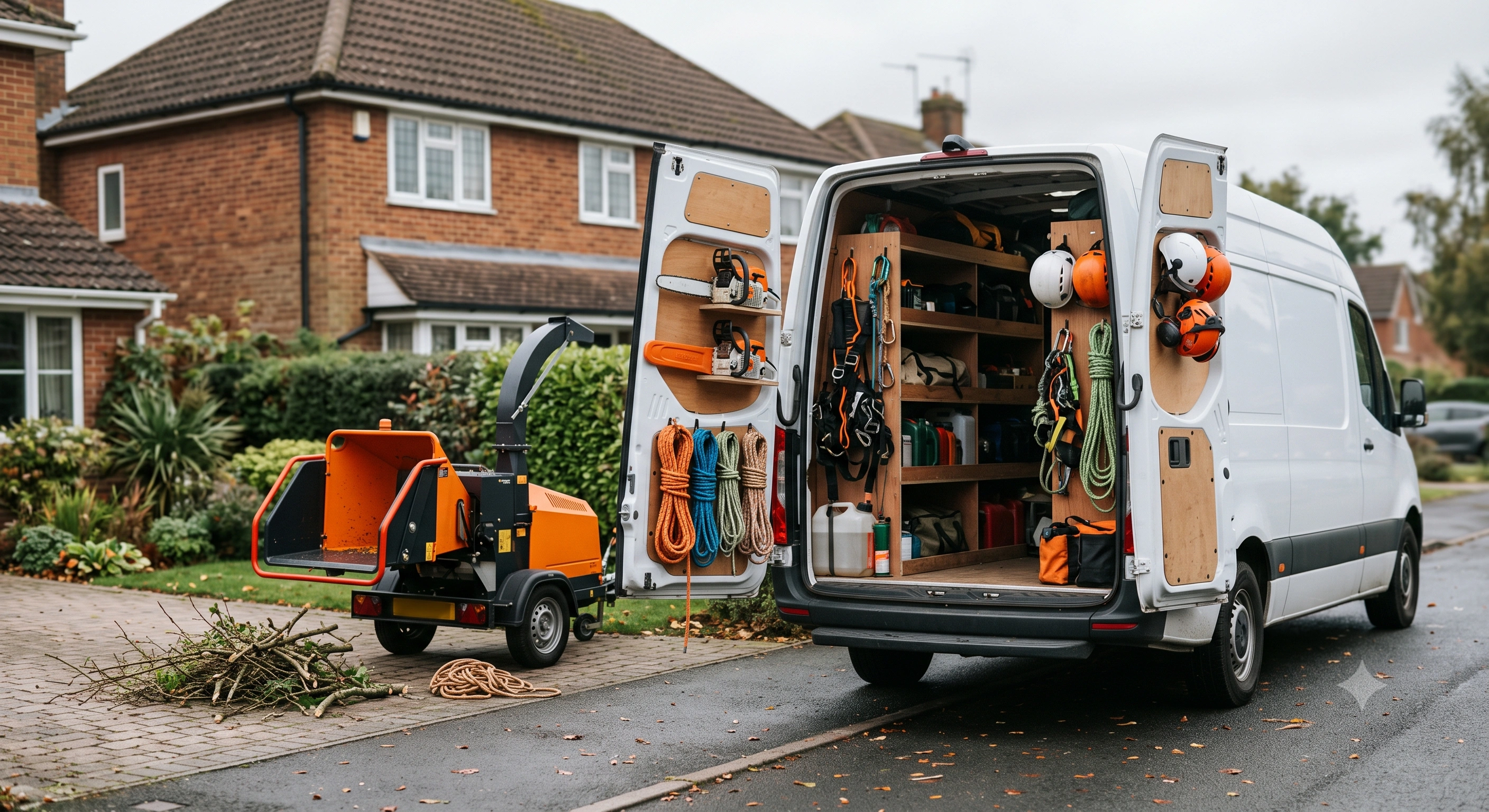
A qualified tree surgeon needs life-support rope certified to 24kN minimum breaking strength, an EN397-compliant helmet with face shield, chainsaw protection gear (trousers, gloves, boots), a harness meeting EN361, and documented inspection records kept under the Lifting Operations and Lifting Equipment Regulations 1998. Every piece must suit its intended purpose and remain maintained to PUWER standards.
Life-support rope – a static or semi-static climbing line designed to hold a climber's full weight during ascent, descent, and work positioning, certified to minimum 5,400 lbs (24kN) breaking strength under European PPE Directive 89/686/EEC. This rope forms the foundation of every arborist's safety system. Here's the practical consequence: you'll need thorough examination every six months under LOLER, which means scheduling downtime or maintaining backup rope to keep working while inspection happens.
Key Takeaways
- Life-support ropes must meet or exceed 24kN (5,400 lbs) breaking strength. LOLER requires thorough examination every six months—miss this and your equipment becomes legally unfit for use.
- Hard hats must comply with EN397, chainsaw trousers with EN381, harnesses with EN361. Non-compliant gear on site exposes you and your employer to HSE enforcement.
- Safe Working Load (SWL) marking is mandatory on all lifting equipment and rigging hardware used in tree work. The SWL differs from breaking strength and represents what the equipment can actually handle under normal conditions.
- Daily visual inspection and weekly detailed checks for ropes, karabiners, and harnesses. Skipping these checks is how equipment failures catch climbers by surprise.
- Overhead power line exclusion zones require 75 metres clearance from uninsulated lines, 20 metres from insulated cables. Electrocution remains a leading cause of preventable fatalities in arboriculture.
What Equipment Do You Actually Need to Start Tree Surgery?
Core climbing equipment centres on three points of connection: rope, harness, attachment hardware. Your rope must be a dedicated life-support line rated 24kN minimum, manufactured to EN892 or EN1891 standards. The harness needs EN361 certification with dorsal and ventral attachment points, leg loops that distribute weight during prolonged suspension, and clearly legible serial numbers for inspection records.
Karabiners and connectors require EN362 certification with minimum 20kN gate-closed rating. Screw-gate or twist-lock mechanisms prevent accidental opening. Every karabiner used in a life-support role must display its rated strength, batch number, and CE marking.
Cutting tools follow a hierarchy based on height and access. Ground-level work uses petrol or battery chainsaws (EN ISO 11681 compliant) with chain brakes, throttle lockouts, rear hand guards. Pole saws extend reach to roughly five metres and must incorporate quick-stop mechanisms. Hand saws and secateurs handle detail work where powered tools risk damaging retained branches or structures.
Beyond climbing gear, personal protective equipment matters enormously. Chainsaw operators require Type A chainsaw trousers (EN381-5, Class 1 minimum for 20 m/s chain speed), reinforced boots with steel toe caps and cut-resistant panels (EN ISO 17249), gauntlet-style gloves with knuckle protection. Helmets integrate EN397 impact protection, EN166 face shields (minimum optical class 1), and ear defenders rated SNR 25dB or higher for prolonged chainsaw use.
The Provision and Use of Work Equipment Regulations require every tool to be suitable for its intended use and maintained in safe working order. That means written maintenance schedules, replacement intervals based on manufacturer guidance, documented pre-use checks.
What is the Most Important Piece of Tree Surgery Equipment?
The life-support rope. It prevents fatal falls when everything else fails. A helmet protects against impact, a saw enables work—but the rope sustains life aloft. British Standard BS EN 1891 defines requirements for low-stretch kernmantel rope used in arboriculture: elongation under load must not exceed 5 per cent to prevent dangerous bounce, and the sheath must resist abrasion from bark and branch unions.
Rope certification requires testing to destruction. The 24kN minimum equates to supporting roughly 2,400 kilograms in static load—far exceeding any single climber's weight to provide safety margin for shock loads during falls or dynamic rigging. Manufacturers mark each rope with batch numbers, date of manufacture, compliance standards; these markings must remain legible throughout service life.
Verification starts at purchase. Inspect packaging for CE marks, check the manufacturer's declaration of conformity, retain both documents with the equipment log. Some operators photograph the rope label and serial number at first use, creating a visual inspection baseline they can reference later.
How Much Does a Full Tree Surgery Equipment Kit Cost?
Entry-level setups for occasional domestic work start around £2,000 to £3,000. That typically includes a basic EN361 harness (£120–£200), 45 metres of 11mm life-support rope (£180–£250), essential karabiners and friction hitch system (£80–£150), a helmet with integrated visor and ear defenders (£60–£100), chainsaw protection clothing (£300–£450), a mid-range 35cm petrol chainsaw (£250–£400).
Professional kits used daily range from £5,000 to £8,000 or higher. These incorporate mechanical ascenders (£100–£200 each), descenders with panic-lock functions (£80–£150), dedicated rigging ropes and blocks (£300–£600), multiple saw sizes (£800–£1,500 combined), battery-powered pole saws (£400–£700), specialist gear such as throw lines, throw weights, pulley systems (£200–£400).
Cost-per-use calculations favour quality. A £300 professional harness lasting five years of daily use costs roughly 12p per working day. A £100 budget harness replaced annually costs 38p per day—and offers lower comfort during long suspensions. Durability, ergonomics, safety margins all improve with investment in recognised brands that supply detailed inspection and retirement guidance.
Which Safety Regulations Govern Tree Surgery Equipment in 2026?
The Lifting Operations and Lifting Equipment Regulations 1998 apply to equipment used to lift or lower loads—including rigging blocks, pulleys, slings, rope systems employed in tree dismantling. LOLER mandates equipment be fit for purpose, appropriately marked with Safe Working Load, positioned to prevent injury, subject to thorough examination at intervals not exceeding six months. Miss these examinations and your equipment legally cannot be used, regardless of its condition.
The Provision and Use of Work Equipment Regulations (PUWER) require equipment suitable for its intended task, maintained in safe condition, operated only by trained personnel. PUWER intersects with LOLER when rigging systems lift timber: the rope and blocks fall under both sets of regulations.
The Health and Safety Executive enforces these standards in Great Britain. Inspectors issue improvement or prohibition notices when equipment lacks certification, thorough examination records are absent, operators work without competence evidence. Penalties include unlimited fines for companies and, in severe cases resulting in injury or death, custodial sentences for directors under corporate manslaughter provisions.
What are the LOLER Requirements for Tree Surgery Lifting Equipment?
Safe Working Load marking must appear on every block, pulley, shackle, sling used in rigging. The SWL represents maximum load the equipment can handle under normal conditions—not its breaking strength. Typical rigging blocks display SWL in kilograms or tonnes, often as a stamped or cast figure on the frame.
Thorough examination intervals cannot exceed six months. A competent person—someone with theoretical knowledge, practical experience, awareness of relevant standards—conducts the examination and issues a written report. That report must identify the equipment by serial number, record defects, specify whether equipment remains fit for use.
Record-keeping obligations fall on the equipment owner or employer. Examination reports must remain accessible for inspection and be retained for at least two years after equipment leaves service. Many contractors store digital copies indexed by equipment serial number and examination date, streamlining compliance during HSE visits or client audits.
What Personal Protective Equipment is Required for Tree Surgery?
Head protection under EN397 specifies impact resistance of at least 440 newtons, penetration resistance against sharp falling objects, a chin strap that releases under strain to prevent strangulation. Arborist helmets integrate mounting points for face shields and ear defenders, combining multiple protections in a single assembly.
Face shields meeting EN166 guard against wood chips, sawdust, small flying debris. Optical class 1 lenses provide the clearest vision with minimal distortion—essential when judging cut angles and branch movement. Mesh visors improve airflow during summer work but offer lower impact protection than polycarbonate screens; operators often switch seasonally.
Chainsaw protection clothing incorporates layers of loose-weave fibres that bind and clog a moving chain within milliseconds. EN381-5 defines classes based on chain speed: Class 1 protects against 20 metres per second, Class 2 against 24 m/s, Class 3 against 28 m/s. Most domestic petrol saws run at or below Class 1 speeds. Professional models demand Class 2 or 3 protection.
Hearing protection becomes mandatory when noise exposure reaches 85 decibels over an eight-hour period. Petrol chainsaws typically produce 100–115 dB at the operator's ear. Ear defenders rated Single Number Rating (SNR) 25 or higher reduce exposure into the safe range, but only when worn continuously during saw operation. Even brief periods without defenders can exceed cumulative exposure limits.
"Chainsaw operators require Type A chainsaw trousers (EN381-5, Class 1 minimum for 20 m/s chain speed), reinforced boots with steel toe caps and cut-resistant panels (EN ISO 17249), and gauntlet-style gloves with knuckle protection."
What Type of Helmet Do Tree Surgeons Need?
Type specifications under EN397 distinguish between impact from above (top impact) and lateral blows (side impact). Tree work involves both: falling branches strike from overhead, while lateral impacts occur during rigging or moving through dense canopies. Helmets marked "Tree Surgeon" or "Arborist" typically meet enhanced multi-directional impact standards.
Integrated systems combine helmet, visor, ear defenders in a single assembly with shared mounting points. This design prevents gaps between components and reduces snagging risk on branches. Attachment points must allow the visor to flip up without removing the helmet and ear defenders to rotate clear when verbal communication is needed.
Ventilation matters during extended summer climbs. Helmets incorporate vents that permit airflow without compromising impact protection. Poorly ventilated models cause heat stress, reducing concentration and increasing error risk. Some designs use moisture-wicking internal padding that operators can remove and launder.
Is Respirator Fit-Testing Required for Arborists?
Wood dust inhalation poses real long-term respiratory risks. Hardwood dust is classified as carcinogenic under Control of Substances Hazardous to Health Regulations (COSHH). When cutting generates visible dust clouds—stump grinding or sawing dry timber are the obvious culprits—respiratory protection becomes mandatory, not optional.
A tight-fitting respirator (half-mask or full-face) requires formal fit-testing as part of regular duties. A qualified fit-tester runs the test to ensure the mask seals properly against your face shape. Here's the catch: facial hair, even stubble, breaks the seal completely. The mask becomes useless protection.
Under COSHH, fit-testing happens initially and then periodically—typically every two years, or whenever you switch respirator models or experience significant weight change that alters facial contours. Loose-fitting powered hoods skip fit-testing altogether, but they cost more and demand battery management during work.
How Often Should Tree Surgery Equipment Be Inspected?
Start each day with a visual inspection before the first climb. Examine rope for cuts, abrasion, heat damage, and contamination by oils or chemicals. Any sheath damage exposing core fibres, glazing from friction heat, or stiffness suggesting chemical degradation means the rope retires immediately. Karabiners get checked for gate function, frame cracks, and corrosion on moving parts. Harness stitching, buckles, and webbing need close attention for fraying, cuts, or UV degradation.
Weekly inspections go deeper. Run rope through your hands metre by metre, feeling for internal damage, lumps, or soft spots that signal core failure. Test karabiner gate spring tension and smooth locking-mechanism operation. Check harness load-bearing seams under magnification or strong light to catch early stitch wear before it becomes catastrophic.
LOLER and PUWER require logging and documentation. Each inspection generates a written record: equipment serial number, inspection date, inspector name, findings, and action taken. Most operators keep pre-printed checklist cards with each equipment set, then transfer findings to a central register monthly. This creates the audit trail an HSE inspector will ask to see.
What are the Signs that Tree Surgery Ropes Need Replacing?
Sheath integrity is the first visual clue. Fraying or fuzziness covering more than 10 per cent of the rope's length signals excessive wear. Glazing—that shiny, hardened surface from friction heat—means the rope has been loaded beyond safe limits. Discolouration, especially dark staining from oils, solvents, or acids, compromises synthetic fibres' strength directly.
Feel the rope. A rope that feels lumpy, unusually stiff, or soft when squeezed likely has core damage. Run it through a loosely closed fist, feeling for inconsistencies. Sudden changes in diameter indicate broken core strands.
Manufacturers typically cite age limits (five to ten years depending on material and use intensity) and usage hours. A rope used daily in professional tree work might retire after two years despite appearing intact, while one used monthly for small jobs could serve five years. Detailed usage logs tell you more than your eyes can—they're more reliable than visual inspection alone for making retirement decisions.
How Do You Inspect a Chainsaw Before Use?
Chain tension adjustment comes first. The chain should pull freely around the bar with slight resistance. When you pull it away from the bar's underside, no more than three drive links should lift clear. Over-tension increases wear and heat; under-tension risks derailment during cutting.
Bar oil and fuel mixture are next. Two-stroke petrol saws need precise fuel-to-oil ratios—typically 50:1 for modern low-emission engines. Straight petrol destroys the engine within minutes. Fill the bar oil reservoir completely before work starts; the automatic oiler feeds oil during operation, but an empty reservoir causes rapid wear to bar and chain.
Safety features demand testing before you cut anything. Push the front hand guard forward—the chain brake must engage instantly. The throttle lockout should prevent accidental trigger engagement. The kill switch must stop the engine within one second. Any failure here means the saw stays on the truck until it's repaired.
Need help specifying equipment for your tree surgery business or crew?
Our team advises arboricultural contractors across the UK on equipment selection, compliance records, and safety management systems. We can review your current setup and identify gaps before an HSE inspection does.
What Safety Distances Must Be Maintained Around Overhead Power Lines?
The Health and Safety Executive specifies a 75-metre exclusion zone for uninsulated overhead power lines carrying any voltage. Work closer than this requires a formal permit from the electricity network operator. The permit process involves site surveys, risk assessments, and often temporary de-energisation of lines or installation of insulating barriers.
Insulated overhead power lines reduce the exclusion zone to 20 metres. Don't assume that insulation offers the same protection as underground cables—it doesn't. Substantial safety margins remain mandatory. Before assuming the reduced distance applies, verify line insulation status with the network operator directly.
Electricity at Work Regulations 1989 prohibit approaching closer than specified distances without written authorisation. The network operator assesses your work plan, may require specific control measures (watchers, barriers, restricted equipment dimensions), and issues a permit valid for defined dates and conditions. Working outside permit terms breaches regulations and voids liability insurance.
Can Tree Surgeons Work Near Power Lines?
Qualified line clearance arborists hold additional training in electrical hazards, minimum approach distances, and emergency procedures if equipment contacts energised conductors. Industry bodies such as the Arboricultural Association deliver this qualification, supplementing standard tree surgery training with electrical safety modules.
Approach distances vary by voltage: low-voltage lines (up to 1,000V) require greater caution than they appear to deserve because insulation may be degraded or absent entirely. High-voltage lines (above 1,000V) impose equipment restrictions—no metal ladders, fibreglass pole saws only, designated earthed work zones.
Emergency response protocols must be rehearsed before work begins. If a saw, rope, or climber contacts a live conductor, the procedure is straightforward: do not touch the equipment or person, call 999 immediately, request fire and ambulance with electrical rescue capability, and wait for professional rescue. Attempting a rescue without insulated equipment and training typically results in a second casualty.
What Are Safe Working Loads and Why Do They Matter?
Safe Working Load represents the maximum mass that lifting equipment can handle under ideal conditions without risk of failure. Manufacturers establish SWL through destructive testing, then apply a safety factor—typically 5:1 or 10:1 depending on equipment type. A rigging block with 10kN breaking strength might carry a 1kN (approximately 100kg) SWL.
Why distinguish between SWL and breaking strength? Dynamic forces during rigging multiply static weight by factors of two to five. Shock loads occur when a branch suddenly drops or swings. A 200kg log generates a 1,000kg force if it free-falls one metre before the rope arrests it. Working within SWL provides margin for these real-world dynamics that aren't obvious in a static calculation.
LOLER requires SWL to appear prominently on the equipment body. Rigging plates, blocks, and shackles display stamped or cast figures. Synthetic slings use sewn-in labels. When markings become illegible through wear, the equipment must be withdrawn from service immediately—operators cannot estimate or assume SWL values and remain compliant.
How Do You Calculate Safe Working Load for Tree Rigging?
Load force factors account for drop distances and rope elasticity. The formula F = mg(1 + √(1 + 2h/e)) calculates dynamic force, where m is mass, g is gravitational acceleration, h is drop height, and e is rope elongation. Practically speaking: keep drop heights under one metre, use low-stretch rigging rope (under 5 per cent elongation), and maintain a 5:1 safety margin between calculated force and equipment SWL.
Block and pulley systems reduce load on anchor points but increase load on the hauling line itself. A 2:1 pulley system halves the force needed to lift a log but doubles the rope length that must be pulled. More complex systems (3:1, 5:1) multiply forces through the system in ways that can overload individual components if calculations are sloppy.
Environmental derating factors reduce SWL in adverse conditions. Wet rope loses roughly 10 per cent of its strength. Knots reduce rope strength by 40–60 per cent depending on type; a figure-eight knot is less damaging than a bowline, but both substantially weaken the line. Freezing temperatures or heat above 30°C affect synthetic materials' load-bearing properties, requiring further derating.
What Maintenance Extends the Life of Tree Surgery Equipment?
Rope cleaning is where the work begins. Dirty ropes wear faster because embedded grit acts as an abrasive between sheath and core. Wash in lukewarm water with mild detergent, use gentle agitation, rinse thoroughly, and air dry. Machine washing is permissible using a delicate cycle and mesh laundry bag, but avoid fabric softeners or bleach that degrade synthetic fibres.
Drying requires patience. Hang rope loosely in a well-ventilated space away from direct sunlight and heat sources. UV radiation breaks down nylon and polyester fibres; prolonged exposure causes brittleness and colour fading. Accelerated drying with heaters or radiators risks heat damage that may not be visible but weakens the core.
Even during use, UV exposure accumulates damage. Ropes stored outdoors or left rigged overnight accrue UV damage. Some manufacturers specify maximum UV exposure hours over the rope's lifetime. Operators working in bright conditions or at altitude (where UV intensity increases significantly) should retire ropes earlier than those used in shaded lowland sites.
Chainsaw maintenance splits into daily, weekly, and seasonal tasks. Daily maintenance includes chain sharpening (every tankful of fuel or when cutting slows noticeably), air filter cleaning, and external debris removal. Weekly tasks add spark plug inspection, bar groove cleaning to prevent oil starvation, and sprocket wear assessment. At 50 hours or seasonally, address carburetor adjustment, fuel filter replacement, and engine mount cracks.
Metal components fail at stress points. Karabiner gates wear where they contact the frame during repeated opening and closing; visible grooves signal retirement is due. Harness buckles develop cracks at bend points—even hairline cracks compromise strength and require replacement. Aluminium components corrode when exposed to salt or certain chemicals, forming white powdery residue that indicates structural degradation.
How Should Tree Surgery Ropes Be Stored?
Keep synthetic fibres cool and dry. The sweet spot is 10°C to 25°C with humidity below 70 per cent. Why this matters: damp air feeds mildew on natural fibres and eats away at synthetic ones. Extreme heat—near boilers or baking in a van cab all summer—softens thermoplastic fibres until they've lost their strength.
Coiling or hanging? That depends on rope type. Twisted ropes (three-strand) like loose coils; tight spirals create permanent kinks. Kernmantel ropes are more forgiving either way, though hanging wins if you want to dodge kinking altogether. The real enemy is tight bends that leave memory—permanent curves that catch in your descender and slow your descent unpredictably.
Keep ropes away from acids, alkalis, solvents, oils, fuels. Battery acid vapour alone degrades nylon. Petrol and diesel wreck most synthetics. A dedicated rope bag or storage container prevents accidental spills during transport or site moves.
What Training and Certification Do Tree Surgeons Need?
The National Proficiency Tests Council (NPTC) sets the UK standard. CS30 is the entry ticket—chainsaw maintenance and cross-cutting in two to three days. CS31 adds felling and processing trees up to 380mm diameter. For climbing work, CS38 (free-fall aerial cutting) and CS39 (rigging techniques) are the core qualifications, typically five days of instruction plus assessment each.
Lantra Awards and the Arboricultural Association run the training courses. Course length varies wildly: a CS30 foundation takes two to three days, but stacking CS38 and CS39 together means five days minimum. Refresher training every five years keeps your ticket current and your knowledge aligned with new standards—this matters because standards do change, and outdated technique can invalidate insurance cover.
First aid training matters more than many realise. The Forestry and Arboriculture Safety and Training Council pushes for all tree workers to hold a valid outdoor-specific first-aid certificate. You'll learn catastrophic bleeding control, spinal injury management, and how to communicate with emergency services when you're working miles from any postal address and the helicopter can't see the grid reference you're reading.
Do You Need Public Liability Insurance to Operate Tree Surgery Equipment?
Insurance isn't legally mandatory. Clients, though, increasingly won't hire you without it. Most policies offer £5 million or £10 million public liability cover against third-party injury or property damage claims.
Insurance policies come with teeth. They demand current British or European standard equipment, maintenance by the manufacturer's book, and valid NPTC tickets. Work without certification or with non-compliant gear and your cover evaporates—you're personally liable for any claim.
Employers' liability insurance kicks in the moment you hire even one person. The legal minimum is £5 million (though £10 million is standard). You must display the certificate at every workplace and keep it ready for HSE inspection.
Published by Tree Surgeon Leads UK, a specialist marketing and lead generation agency working with UK tree surgeons.
Kitted out but diary still quiet?
Get more tree work coming in
Great kit deserves a full diary. We run Google and Meta campaigns for UK tree surgeons only — exclusive leads. Book a free strategy call.
Frequently Asked Questions
What is the minimum breaking strength for tree surgery rope?
Life-support rope must hit 24kN (5,400 lbs) minimum under European PPE Directive 89/686/EEC testing. That strength gives you a safety buffer to absorb shock loads during falls or dynamic positioning work. Manufacturers test sample batches to destruction and certify the breaking strength on each production run.
How often must tree surgery lifting equipment be inspected under LOLER?
Every six months, maximum. A competent person must inspect all lifting equipment—rigging blocks, pulleys, slings, rope systems used for lowering or raising loads—and produce a written report. Find a defect and the equipment goes out of service until it's fixed and re-examined.
What protective clothing is legally required for chainsaw use?
Head protection (EN397), eye protection (EN166), hearing protection rated SNR 25dB or higher, chainsaw protective trousers or chaps (EN381-5, Class 1 minimum), gloves, and boots with cut-resistant panels and steel toe caps (EN ISO 17249). The Provision and Use of Work Equipment Regulations mandate all of it during every chainsaw operation.
Can tree surgeons work within 75 metres of overhead power lines?
Only with a written permit from the electricity network operator. Under the Electricity at Work Regulations 1989, the operator assesses your work, may demand specific controls or temporary de-energisation, and issues a permit tied to specific dates and conditions. No permit when one's required is a legal breach.
How long does tree surgery rope last before it needs replacing?
Manufacturers typically specify five to ten years from manufacture date, but that's a ceiling, not a rule. Daily-use professional rope often retires after two years. Rope used occasionally might serve five years or more if stored properly and kept away from contaminants. Don't wait for the calendar—fraying, glazing, discolouration, or internal lumps mean retirement now, regardless of age.
What does Safe Working Load mean on rigging equipment?
Safe Working Load is the maximum mass the equipment can handle safely under normal use without failing. Manufacturers determine SWL through destructive testing and apply a safety factor—typically 5:1 or 10:1. LOLER requires SWL to be clearly marked on every block, pulley, shackle, and sling used in lifting operations.