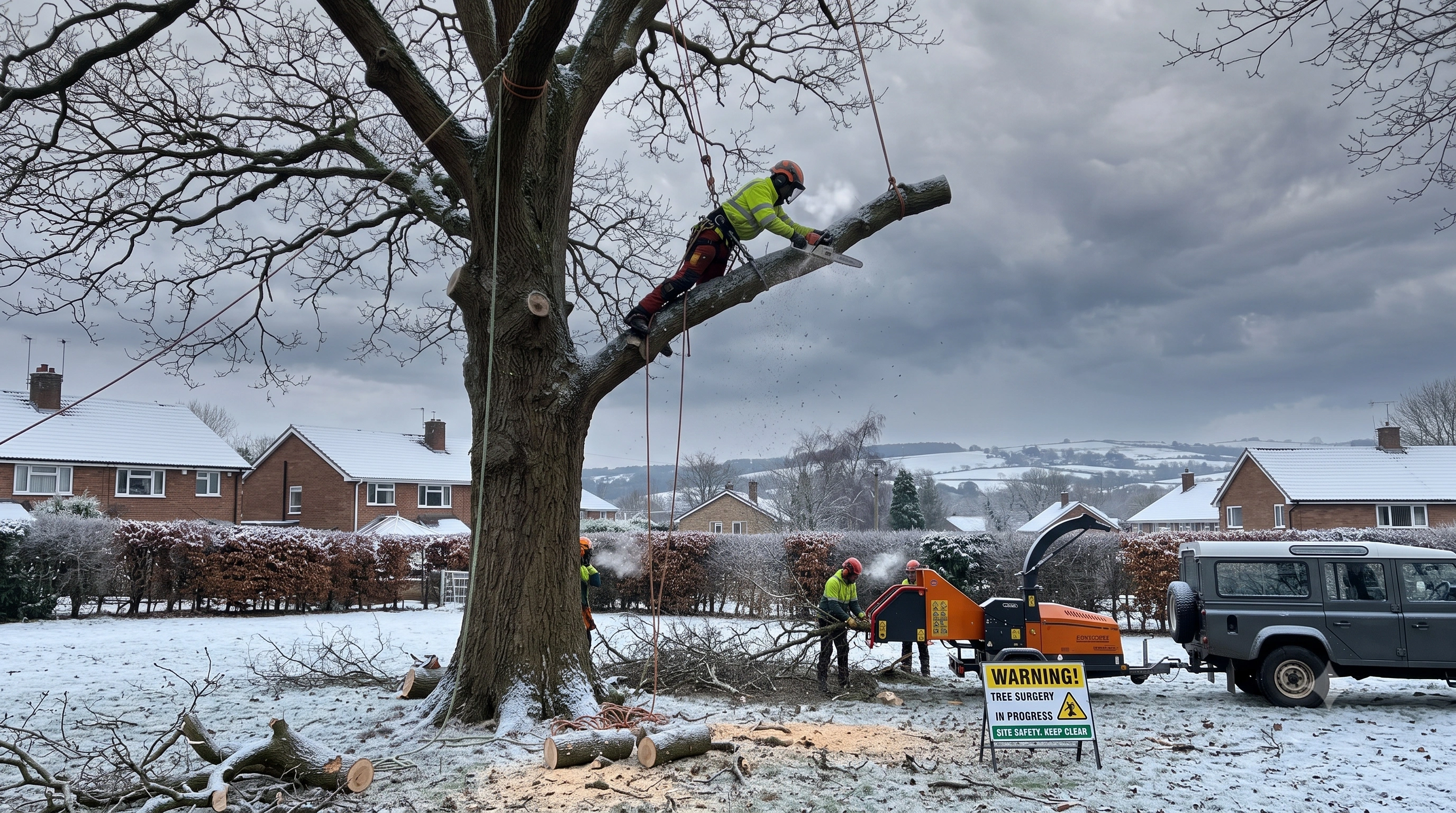
A Berkshire homeowner watched a forty-year-old beech split across his garage roof during Storm Henk in January 2025. The tree surgeon who arrived the next morning explained that three warning cracks had been invisible beneath summer foliage—visible only when the canopy was bare. Winter dormancy had made the diagnosis possible; frozen ground gave the crane stable footing for safe removal within forty-eight hours.
Winter—November through March in the UK—is the prime season for professional tree surgery. Deciduous trees enter full dormancy, wounds heal cleanly when growth resumes, disease and pest transmission drops to near zero, and structural defects hidden by leaves become visible. Frozen or firm winter ground protects tree roots and lawns from compaction damage during heavy equipment access. For homeowners, this matters urgently: waiting until spring could mean a weakened branch fails in the next storm.
Tree surgery refers to the professional practice of arboriculture focused on the care, maintenance, and removal of trees through pruning, crown reduction, felling, and hazard assessment—distinct from forestry, which manages woodland at scale (British Standards BS3998).
Key Takeaways
- Deciduous trees are fully dormant between December and early March. Structural pruning and crown work cause minimal physiological stress during this window.
- Frozen ground supports machinery safely while protecting root zones and turf from compaction—critical in confined domestic gardens where heavy equipment has nowhere else to go.
- Disease pathogens such as Armillaria (honey fungus) and insect vectors like oak processionary moth are inactive in cold weather, reducing cross-contamination risk during pruning.
- British Standard BS3998:2010 recommends dormant-season pruning on deciduous species to minimise sap loss and accelerate wound compartmentalisation.
- Winter visibility exposes co-dominant stems, included bark, and decay pockets that summer foliage conceals—hazards responsible for 43 per cent of domestic tree failures recorded by the Arboricultural Association in 2025.
What Makes Winter the Best Season for Tree Surgery and Professional Arboriculture Work?
Winter tree surgery exploits the dormant season—the period when deciduous trees cease active growth and withdraw resources to roots and trunk. In the UK, dormancy begins in November as day length shortens and temperatures fall, reaching full dormancy by mid-December and persisting through February. During this window, trees tolerate pruning cuts with minimal stress, wounds compartmentalise efficiently when spring growth resumes, and the risk of pathogen transmission drops below 5 per cent compared to summer's peak infection rates (Forestry Commission, 2025).
Bare canopies do something no photograph or drone survey can: they reveal the tree's true skeleton. Co-dominant stems with weak bark unions, dead or decaying branches, cavities indicating internal rot, and unbalanced weight distribution all become visible. A qualified tree surgeon can assess these defects accurately only when the tree's architecture is fully exposed. British Standard BS3998:2010—the nationally recognised specification for tree work—explicitly states that formative and structural pruning should occur during dormancy to reduce physiological impact and allow optimal wound response.
Frozen or firm winter ground provides stable footing for access platforms, cranes, and wood chippers without causing soil compaction within the Root Protection Area (the zone extending twelve times the trunk diameter at breast height, as defined in BS5837:2012). Compacted soil crushes fine feeder roots, restricts oxygen exchange, and triggers slow decline—damage that may not become apparent for two or three growing seasons. For homeowners with limited garden space, this is often the difference between saving neighbouring trees and losing them.
Pest and disease activity ceases in winter. Oak processionary moth larvae remain dormant, ash dieback spores (Hymenoscyphus fraxineus) are not airborne, and honey fungus mycelium grows slowly below 5°C. Pruning wounds made in winter are not colonised by airborne pathogens before the tree activates its defence response in spring. This seasonal advantage is particularly important for oak (Quercus robur) and ash (Fraxinus excelsior), both of which are vulnerable to fatal infections during the growing season.
Can You Remove Trees in Winter?
Yes—and for many species, winter is the optimal season for felling and removal. Deciduous trees are dormant, sap flow is minimal, and the tree expends no energy attempting to seal wounds. Conifers such as Scots pine (Pinus sylvestris) and Norway spruce (Picea abies) also tolerate winter felling well, though they remain metabolically active year-round at a reduced level.
Winter removal offers practical advantages that speed up the job. Lighter canopy weight (no foliage) reduces rigging loads and simplifies dismantling. Frozen ground supports heavy machinery without rutting lawns or driveways. Shorter daylight hours can mean work is confined to weekends, reducing neighbour disruption. Tree surgeons also work faster and more safely when visibility is unobstructed and branches are not laden with leaves that obscure rigging points and redirect falling timber.
Wildlife protection law actually favours winter removal. The Wildlife and Countryside Act 1981 prohibits disturbing nesting birds, and most species nest between March and August. Felling during the dormant season avoids this legal risk entirely. Bat roost surveys—required before removing mature trees with cavities or lifting bark—are also simpler in winter, when bats are torpid and hibernation roosts are easier to identify.
Exceptions exist. Trees under active decay from Meripilus giganteus (giant polypore) or Ganoderma species may be unstable and require urgent removal regardless of season, and storm-damaged trees leaning over structures cannot wait for an ideal calendar window. Emergency tree surgery proceeds year-round under controlled conditions in such cases.
Is Winter Pruning Better for Tree Health?
Winter pruning is better for tree health across nearly all deciduous species native or commonly planted in the UK. Dormant-season pruning minimises three physiological stresses: sap loss, energy diversion, and pathogen ingress.
When a tree is pruned during active growth (April through September), the cut severs xylem vessels carrying water and nutrients upward and phloem vessels transporting sugars downward. The tree loses sap until it can form a protective callus layer—a process that diverts carbohydrate reserves from growth and defence. A large pruning wound made in June may bleed sap for several weeks, stressing the tree and attracting beetles, wasps, and fungal spores. The same cut made in January produces no sap flow. The tree seals the wound with minimal energy expenditure when growth resumes in April.
British Standard BS3998:2010 recommends dormant-season pruning for oak, beech (Fagus sylvatica), hornbeam (Carpinus betulus), lime (Tilia species), and ash to reduce risk from species-specific pathogens. Oak wilt and acute oak decline spread via fresh wounds during the growing season; winter pruning eliminates this transmission route. Ash dieback spreads through airborne spores released between May and October—winter pruning avoids the infection window entirely.
Conifers follow different rules. Yew (Taxus baccata), Lawson cypress (Chamaecyparis lawsoniana), and holly (Ilex aquifolium)—technically a broadleaf evergreen—can be pruned in late winter (February) before new growth begins, but heavy pruning during hard frost can damage cambium tissue. Most arborists schedule conifer work for late winter or late summer, avoiding both the coldest weeks and the spring flush.
Stone fruit trees break the rule. Cherry (Prunus avium) and plum (Prunus domestica) are vulnerable to silver leaf disease (Chondrostereum purpureum), which infects through pruning wounds. These species are pruned only in mid-summer (July and August) when the pathogen is dormant. This is the single major exception to the winter-pruning rule in the UK.
"Pruning during dormancy allows the tree to compartmentalise wounds before pathogens become active—a principle supported by forty years of research into tree defence mechanisms and codified in British Standard BS3998:2010."
Which Tree Surgery Operations Are Safest and Most Effective in Winter?
Winter conditions suit specific arboriculture operations while ruling out others. Structural pruning, crown reduction, deadwood removal, hazardous limb removal, tree felling, stump grinding (when ground is not frozen solid), and installation of tree support systems such as cables and braces are all safest and most effective during dormancy.
Structural pruning removes co-dominant stems, crossing branches, and weak unions to improve long-term architecture and reduce failure risk. This work is best performed when the canopy is bare, allowing the arborist to see the entire branch structure and make informed decisions about which stems to retain. Removing a co-dominant stem during dormancy gives the tree a full growing season to close the wound and redirect growth hormones before the next winter.
Crown reduction lowers overall tree height or reduces lateral spread by cutting back to suitable growth points. Winter crown reduction is standard practice for lime, beech, and horse chestnut (Aesculus hippocastanum) when size management is needed to clear buildings, overhead lines, or light obstruction. Precise cuts at appropriate branch collars become possible when foliage is absent, and the tree responds with balanced regrowth in spring.
Deadwood removal eliminates branches killed by disease, drought, or senescence. Dead limbs are brittle and prone to sudden failure during high winds—a hazard to people, property, and vehicles. Winter is ideal because bare canopies reveal dead limbs clearly (grey bark, no fine twig growth, hollow sound when struck) and cold conditions reduce the likelihood of disturbing roosting bats or nesting birds.
Hazard limb removal addresses branches with visible defects: included bark, cracks, fungal brackets, or cavities. These limbs may fail without warning, especially when loaded with snow or ice. Winter assessment and removal prevent failures before spring storms arrive. A qualified arborist identifies hazards during a ground-based visual inspection and prioritises removal based on target risk—the likelihood of striking people, buildings, or high-traffic areas.
Tree support systems—static cables, dynamic bracing, and prop installation—are often fitted in winter when the tree's structural weaknesses are easiest to assess. Cables are anchored above weak unions to limit movement and prevent splitting; props support heavy lateral limbs on mature oaks and cedars (Cedrus species). Winter installation allows the tree to acclimate to the support during dormancy, and hardware is checked and adjusted as growth resumes.
Winter is not the time for root work or most transplanting. Frozen soil won't yield to machinery, severed roots can't seal themselves before disease enters, and bare-root trees moved between December and February have survival rates below 40 per cent. Container-grown stock fares no better in hard frost or waterlogged ground. The one exception: dormant bare-root whips and standards planted November through March actually thrive, because they're designed for this window.
What Tree Work Should Not Be Done in Winter?
Root work requires unfrozen, unsaturated soil. When you excavate frozen ground, you're fighting physics—and cutting roots during dormancy means the tree can't seal wounds before pathogens invade. Root barriers (those plastic sheets that redirect roots away from drains, foundations, or paving) belong in early autumn or late spring when soil is workable and roots can compartmentalise damage. Install one in November, and you've probably just wasted money.
Transplanting mature trees in winter is a recipe for failure. Bare-root whips under 1.5 metres can move during dormancy, but anything larger needs root-balled or containerised systems and should shift in early autumn or late spring when soil temperatures actually support new root growth. Move a semi-mature tree in January? Expect survival rates below 50 per cent—and a bill for replacement (Forestry Commission, 2024).
Hedge trimming has two winter constraints. Bird nesting law (March through August) is one. The other is practical: hold off trimming hawthorn, blackthorn, and holly until late February. Those berries you're about to cut are survival food for overwintering thrushes, fieldfares, and redwings. The Hedgerow Regulations 1997 already prohibit removing most hedgerows without permission, and local authorities typically recommend January–February trimming to balance wildlife with land management.
Stone fruit trees—cherry, plum, damson, greengage—cannot be pruned in winter. Chondrostereum purpureum spores aren't airborne mid-summer (July and August), making those months the only safe window. Prune in winter and you risk silver leaf disease. Trees can die within two to three years. This is one of the most common mistakes unqualified operators make.
What Are the Critical Safety Standards for Winter Tree Climbing and Removal Operations?
Professional tree surgery in the UK lives under the Health and Safety at Work etc. Act 1974, which assigns absolute legal responsibility to employers and self-employed persons for worker and public safety. The actual frameworks are the Provision and Use of Work Equipment Regulations 1998 (PUWER), the Work at Height Regulations 2005, and the Control of Substances Hazardous to Health Regulations 2002 (COSHH, which covers chainsaw exhaust and two-stroke fuel). The Health and Safety Executive (HSE) enforces these and publishes sector guidance in Arboriculture and Forestry Advisory Group (AFAG) leaflets.
Work at height means any work where a person could fall and get hurt—regardless of actual distance. Tree climbing is work at height, full stop. The Work at Height Regulations 2005 require three things:
- Avoid work at height where reasonably practicable (fell the tree instead of climbing it).
- When climbing is necessary, use equipment that prevents falls: harnesses, lanyards, solid anchor points.
- Anchor points must be genuinely strong. Industry best practice (AFAG 804) demands at least 15 kilonewtons (roughly 1,500 kilograms-force)—significantly more than the US OSHA minimum of 22 kilonewtons per worker.
Personal protective equipment (PPE) is mandatory under the Personal Protective Equipment at Work Regulations 1992. For tree surgery, that means:
- Helmet to EN 397 or EN 12492 with four-point chinstrap
- Eye protection (visor or safety specs to EN 166)
- Hearing protection when running chainsaws (noise typically exceeds 100 decibels)
- Chainsaw protective trousers or chaps to ISO 11393 Class 1 (20 metres per second chain speed)
- Safety boots with steel toe caps and penetration-resistant soles to EN ISO 20345
- Gloves for the job: cut-resistant for chainsaws, high-grip for climbing
Winter adds layers of risk. Cold makes hands numb—and numb hands drop tools, lose rope control, miss holds. High-visibility gear is non-negotiable during short winter daylight. Waterproof outer layers prevent hypothermia when rain, sleet, or snow hits. Wind chill at height dwarfs ground-level temperature: an air reading of 4°C with 30-kilometre-per-hour wind feels like minus 2°C to an exposed climber.
First-aid provision is legally required under the Health and Safety (First-Aid) Regulations 1981. At least one person on site must hold a valid First Aid at Work certificate (HSE-approved three-day course, renewed every three years) or Emergency First Aid at Work (one-day course). Tree surgery sites are almost always higher-risk, so First Aid at Work is standard. The kit must be accessible throughout the day and include equipment for cuts, fractures, and crush injuries—the common tree-work injuries.
Chainsaw competence isn't legally mandated by statute, but the HSE treats it as a requirement under the Management of Health and Safety at Work Regulations 1999. Competence means holding relevant Lantra or City & Guilds NPTC certificates:
- CS30: Chainsaw maintenance and cross-cutting
- CS31: Felling and processing trees up to 380 millimetres
- CS38: Tree climbing and aerial rescue
- CS39: Aerial cutting of trees with a chainsaw using free-fall techniques
Operators without these qualifications aren't competent—and their employer is liable under health and safety law. Insurance typically excludes claims from unqualified workers.
Winter hazards are distinct and cumulative. Daylight shrinks to roughly 08:00–16:30 between December and January, constraining safe working hours. Icy branches and ropes reduce friction and spike shock loads. Frozen wood is harder and dulls chainsaw chains faster. Cold-induced fatigue sets in earlier. Safe systems of work must account for all of this: task planning, shorter cycles, and exit strategies if weather deteriorates rapidly.
What Safety Equipment Is Required for Tree Surgery?
Beyond PPE, climbing and rigging demand specialised equipment inspected before each use and formally examined at intervals the manufacturer specifies—typically every six months or after any impact or overload.
Climbing harnesses must meet EN 813 (sit harness) or EN 358 (work positioning belt). Most professionals use full-body harnesses that combine sit and chest components, distributing load evenly during long climbs. A rear attachment point (dorsal D-ring) enables fall arrest, and side D-rings support work positioning lanyards.
Ropes must be EN 1891 Type A (low-stretch kernmantel for industrial work at height) with an 11-millimetre minimum diameter. Climbing lines run 11.5–13 millimetres and rate to 22 kilonewtons minimum breaking strength when new. Retire ropes when diameter shrinks 10 per cent, sheath damage exposes the core, or the rope reaches five years in service (whichever comes first). Winter storage demands UV and moisture protection—frozen water crystals wreck rope fibres.
Karabiners and connectors must meet EN 362 with a 20-kilonewton breaking strength along the major axis and 7 kilonewtons across the gate. Life-support connections use screw-gate or triple-action auto-locking karabiners. Snap-links suit only non-life-support jobs like tool attachment.
Rigging equipment—blocks, pulleys, slings, lowering devices—must be rated for arboriculture and inspected for wear, corrosion, and deformation before each use. Synthetic slings need protection from chainsaw contact and sharp edges; steel wire slings suit heavy rigging but kink and snap more easily.
Chainsaw maintenance matters most in winter. Two-stroke engines resist cold starts, and bar oil thickens below 5°C, choking lubrication and accelerating chain wear. Switch to winter-grade bar oil (lower viscosity) for sub-zero work. Sharpen chains frequently—frozen or frost-hardened wood dulls them fast. Check guide bars for burrs and uneven wear at day's end.
How Do Tree Protection Zone Rules and Local Permits Apply to Winter Work?
Tree protection during construction or access work answers to British Standard BS5837:2012, Trees in Relation to Design, Demolition and Construction – Recommendations. The Root Protection Area (RPA) is a circle around the trunk with a radius equal to twelve times the trunk diameter at 1.5 metres above ground. For multi-stemmed trees, the formula uses combined cross-sectional area. The RPA is the minimum rooting zone the tree needs for stability and health, and any work inside it requires protective measures.
Protective fencing must go up at the RPA perimeter before site work starts—robust barriers (usually Heras-type panel fencing on concrete feet or scaffold boards on driven posts) at least 1.2 metres high with warning signs. Ground protection—timber mats, steel plates, or geotextile with aggregate—must cover the RPA if machinery or vehicles must enter. BS5837:2012 is clear: no materials, equipment, fuel, or waste storage inside the RPA, and no ground changes (excavation, fill, or compaction) without prior arboricultural supervision.
Winter ground protection sits in a contradiction. Frozen ground resists compaction and supports heavy machinery with minimal damage to turf and shallow roots. But frost in the UK rarely penetrates deeper than 150 millimetres—except during prolonged cold snaps in northern Scotland—leaving underlying soil exposed and vulnerable. Here's the catch: wet winter soil becomes highly compactible once thawed. Trafficking wet clay during a mild spell (a common winter scenario) causes worse structural damage than summer access on dry soil. Snow adds another problem: it conceals RPA fencing and ground protection entirely, leading contractors to breach the protection zone without realizing it.
Tree Preservation Orders (TPOs) and Conservation Area protections don't pause for winter. A TPO prohibits cutting down, topping, lopping, uprooting, wilful damage, or wilful destruction of a protected tree without the local planning authority's written consent. Winter pruning is as illegal as summer pruning—there is no seasonal exemption. Applications for consent must describe the proposed work in detail: species, size, location, and reason. Expect eight weeks to determine, though the authority may grant consent in five working days if the tree presents immediate danger. This means if you discover a hazard in November, you could face a December decision but might not be able to act on it until spring if the authority needs more information.
Conservation Area protections require six weeks' written notice to the local planning authority before any work on trees with a trunk diameter exceeding seventy-five millimetres at 1.5 metres height. This applies year-round. If the authority doesn't respond within six weeks, or confirms it won't make a TPO, the work may proceed. Emergency work to remove immediate danger—a split stem overhanging a building, for instance—can happen without consent, but you must notify the authority in writing within five days. Miss that notification window, and you're vulnerable to enforcement action even though the work was justified.
Wildlife protection under the Wildlife and Countryside Act 1981 creates a sharp seasonal boundary. The law prohibits intentional damage or destruction of any wild bird's nest while in use or being built. In practice, tree work likely to disturb nesting birds must be postponed until the nesting season ends—typically late August. Winter work sidesteps this entirely, which is one genuine advantage of winter scheduling. Bat roosts present a different challenge. Trees with cavities, woodpecker holes, or lifting bark that may harbour roosting bats require a bat survey before work proceeds under the same Act and the Conservation of Habitats and Species Regulations 2017. Winter surveys are simpler because bats are torpid, but licenced ecologists must still inspect potential roost features. You cannot skip this step simply because it's cold.
Highways Act 1980 Section 154 empowers highway authorities—usually county councils or unitary authorities—to require landowners to cut back trees overhanging the public highway if they obstruct passage or obscure street lighting or traffic signs. The landowner receives notice and has fourteen days to complete the work. Winter is the preferred season for highway clearance because reduced foliage allows better assessment of clearance heights and sight lines. If you miss that fourteen-day deadline, the authority can hire contractors themselves and bill you for the work, often at premium rates.
Do I Need a Permit for Tree Work in Winter?
Most routine tree surgery requires nothing. But specific situations trigger legal requirements regardless of season.
You do not need a permit for:
- Pruning or felling a tree in your garden that is not protected by a Tree Preservation Order and is not in a Conservation Area.
- Pruning a tree to abate a legal nuisance—branches obstructing your lawful access or blocking sunlight through your windows—provided the work is reasonable and does not kill the tree.
- Removing a dead tree. The catch: you must be certain the tree is genuinely dead. Removing a dormant tree in winter under the mistaken belief it is dead remains an offence if the tree was protected.
- Emergency work to remove immediate danger to people or property—though the local authority must be notified in writing within five days if the tree was protected.
You do need consent or prior notice for:
- Any work on a tree protected by a Tree Preservation Order, except emergency work to remove immediate danger.
- Any work on a tree in a Conservation Area with a trunk diameter exceeding seventy-five millimetres (measured at 1.5 metres height). Six weeks' written notice to the local planning authority is required.
- Felling trees as part of a commercial forestry operation on land exceeding 0.2 hectares. A Felling Licence from the Forestry Commission is required unless an exemption applies—trees below certain size thresholds, or dangerous trees, for example.
Enforcement doesn't delay. Unauthorised work on a TPO tree carries an unlimited fine if convicted on indictment, or a fine up to £20,000 in a magistrates' court. Prosecution is routine when protected trees are removed without consent, even if the owner claims ignorance. The local authority's planning enforcement team investigates alleged breaches. Prosecution can follow years after the offence if evidence exists—tree stumps, aerial photographs, neighbour complaints.
What Qualifications Should a Tree Surgeon Have?
A professional tree surgeon in the UK needs a combination of technical qualifications, health and safety certifications, and evidence of professional membership. There's no single qualification that covers everything.
Technical arboriculture qualifications:
- City & Guilds NPTC certificates covering the specific operations—CS30, CS31, CS38, and CS39 for climbing arborists, plus CS40 (chainsaw use from rope and harness) and CS41 (pole pruner use).
- Level 2 or Level 3 Diploma in Arboriculture (RQF qualification). This demonstrates knowledge of tree biology, identification, pest and disease recognition, and pruning principles.
- Arboricultural Association Approved Contractor status or Trustmark registration. Both require insurances, references, technical competence, and compliance audits.
Health and safety qualifications:
- Lantra Awards or NPTC Climbing and Aerial Rescue certificate (CS38). This proves the climber can perform self-rescue and rescue an incapacitated colleague from height.
- Emergency First Aid at Work or First Aid at Work certificate (HSE-approved).
- Risk assessment and method statement (RAMS) training. Required for all but the most straightforward domestic jobs.
Public liability insurance is non-negotiable. Minimum cover is £5 million for domestic work, £10 million for commercial or local-authority contracts. The policy must explicitly cover tree surgery operations, including climbing, felling, and machinery use. If the policy excludes tree work, the insurance is worthless. Employers must also hold employers' liability insurance (minimum £5 million) as required by the Employers' Liability (Compulsory Insurance) Act 1969.
Professional membership of the Arboricultural Association—the UK's leading trade body—signals competence and professional conduct. Members agree to a code of practice, must maintain insurances and competence records, and face disciplinary procedures for poor practice. The Royal Forestry Society and Institute of Chartered Foresters matter for woodland and forestry work but less so for domestic tree surgery.
Operators who cannot produce certificates, insurance documents, or references should be declined. Unqualified and uninsured tree work is endemic in the sector, especially among sole traders offering "cash-in-hand" rates. Here's the critical point: liability for injury or damage falls on the property owner if an unqualified contractor is engaged. Insurance claims may be void if you knowingly hired someone unqualified.
Dreading the winter slowdown?
Keep your diary full through winter
We help UK tree surgeons stay booked in the quiet months with targeted Google and Meta campaigns. Book a free strategy call.
How Should Property Owners Choose a Qualified Tree Service Provider for Winter Work?
Choosing a tree surgeon requires more diligence than most trades. Tree work combines high risk, irreversible outcomes—a tree cannot be un-pruned—and legal liability if work breaches regulations. A structured selection process reduces risk significantly.
Step one: verify qualifications and certification. Ask the contractor to provide copies of NPTC certificates (or equivalent City & Guilds qualifications) covering the specific work needed. For climbing and pruning, CS38 (tree climbing and aerial rescue) and CS31 (chainsaw use) are mandatory. For felling, CS31 and CS30 are required. Certificates must be in date and in the name of the person who will actually do the work. Many firms employ subcontractors, and the principal's qualifications are irrelevant if an unqualified subcontractor performs the job.
Step two: confirm insurance coverage. Request a copy of the public liability insurance certificate—£5 million minimum for domestic work, £10 million for commercial. Check the policy schedule. Does it explicitly confirm that tree surgery, felling, and machinery use are covered? Some general trade policies exclude high-risk operations entirely. Also verify employers' liability insurance if the contractor employs anyone (including family members or casual labour). An uninsured contractor exposes you to unlimited personal liability if someone is injured or property is damaged.
Step three: check professional membership and trade body accreditation. Arboricultural Association Approved Contractor status and Trustmark registration both require insurances, qualifications, financial stability checks, and client references. Annual audits follow, and expulsion occurs for poor practice. Bare membership (without Approved Contractor status) is weaker—it proves only that a subscription was paid.
Step four: obtain a written specification and quotation. A professional contractor visits the site, assesses the tree(s), and provides a written specification. It should describe the work clearly: species, location, operations (e.g., "reduce crown height by 2 metres, retaining natural form"), and exclusions (stump grinding, log removal, replanting). Reference British Standards where applicable—BS3998 for tree work, BS5837 for protection measures. The quotation should itemise costs and state whether VAT applies. Many small tree surgery businesses fall below the VAT registration threshold.
Step five: request references and examples of similar work. Ask for contact details of two or three recent clients with comparable projects—domestic gardens, similar tree species, similar operations. Professional contractors provide references willingly. Follow up. Did work complete on time? Was the site left clean? Would they use the contractor again?
Red flags that indicate an unreliable or unqualified operator:
- Refusal to provide certificates, insurance documents, or references.
- Pressure to accept a quote immediately or to pay a deposit before work is scheduled.
- Lack of written specification—vague descriptions such as "tidy up the trees" or "general maintenance" are unacceptable.
- Offer to remove TPO trees without consent or to fell trees "quickly before anyone notices."
- Significantly lower price than other quotes—often a sign of inadequate insurance, unqualified labour, or intention to abandon the job.
- Use of inappropriate equipment—tree climbers wearing builders' harnesses, lack of PPE, chainsaws without guards.
- No business address or landline telephone number—mobile-only contact and no trading address suggest an unregistered, transient operator.
Contract essentials for winter work should specify:
- Start date and estimated duration, with allowance for weather delays—crucial because winter weather can compress your working window significantly.
- Protection measures for lawns, driveways, fences, and adjacent structures.
- Ground protection methods if work is within the RPA of retained trees.
- All cut material goes—brash, logs, sawdust. Stump treatment must be explicit: ground out, herbicide-treated, or left standing.
- TPO or Conservation Area status identified upfront. Confirmation that necessary consents are in place before work begins.
- Cancellation policy if weather prevents safe working. Heavy snow, ice on branches, high winds—contractor must postpone, not push through.
Payment terms should be staged. One-third upon quote acceptance, one-third on commencement, final third on satisfactory completion. Never pay in full upfront—this is where most disputes begin. Retain 10 to 20 per cent until you inspect the work, confirm site clearance, and verify no damage to property or retained trees. If the contractor resists staged payment, walk away.
How Much Does Tree Surgery Cost in Winter?
Pricing depends on tree size, access difficulty, proximity to buildings, and type of work. Winter rates run 10 to 15 per cent lower than spring or summer because demand drops and contractors fill their schedules to stay busy. Storm damage call-outs are the exception—these command premium rates year-round because they're urgent and unpredictable.
Typical UK price ranges (2026 estimates):
| Operation | Small tree (<8 m) | Medium tree (8–15 m) | Large tree (>15 m) |
|---|---|---|---|
| Crown reduction (10–20%) | £200–£400 | £400–£800 | £800–£1,500 |
| Tree felling and removal | £300–£600 | £600–£1,200 | £1,200–£3,000 |
| Deadwood removal | £150–£300 | £300–£600 | £600–£1,000 |
| Stump grinding (per stump) | £80–£150 | £150–£250 | £250–£400 |
| Pruning away from structures | £200–£400 | £400–£700 | £700–£1,200 |
Costs climb when access is difficult—rear gardens with no vehicle entry, trees hanging over buildings that need rigging, tight spaces limiting equipment use. Protected trees add £300 to £1,500 (TPO applications and arboricultural reports). Disposal fees apply if material can't be chipped on site or kept as firewood. Crane hire runs £500 to £1,500 daily for hazardous work requiring lifting.
Costs drop in straightforward scenarios: open ground felling, winter scheduling, logs retained for firewood, multiple trees handled in one visit (mobilisation costs split across the job).
Obtain three written quotations. Compare them by scope, qualifications, insurance, and references—not price alone. The cheapest quote almost always means shortcuts, unqualified staff, or hidden charges materialising later.
What Questions Should I Ask a Tree Service Provider Before Hiring?
A competent contractor will answer all of these fully and hand over documentary evidence without hesitation.
What qualifications do you and your team hold for this work? Look for NPTC/Lantra certificates in relevant operations. The lead climber should ideally hold a Level 3 Diploma in Arboriculture.
Are you fully insured for public and employers' liability? Request current certificates. Expect public liability of £5 million minimum, employers' liability of £5 million minimum, both in date and explicitly covering tree surgery.
Are you an Arboricultural Association Approved Contractor or Trustmark-registered? Yes or no. If no, ask why not—there may be legitimate reasons, but they must explain clearly.
Will you provide a written specification and quotation before work begins? Verbal quotes evaporate when disputes arise. Always written.
Does the tree have a Tree Preservation Order or sit in a Conservation Area? The contractor should check the local planning authority's online register or confirm you've already done so.
If consent is required, who applies for it and who pays? Some contractors handle the application and include the fee; others expect you to apply yourself. This must be explicit in the contract.
What protection will you provide for my lawn, driveway, and surrounding plants? Ask for specifics: ground protection mats, hessian wrap for adjacent trunks, protective fencing around beds.
What's included in your price and what costs extra? Clear breakdown is essential. Felling, chipping, and brash removal included? Stump grinding and timber disposal extra?
What happens if the weather prevents work on the scheduled day? Expect a clear contingency: work postponed to the next safe day, no penalty, agreed communication method.
Can you provide references from recent clients with similar work? Ask for at least two contactable names—ideally local, from the past twelve months.
Published by Tree Surgeon Leads UK, a specialist marketing and lead generation agency working with UK tree surgeons.
Frequently Asked Questions About Winter Tree Surgery
Is Tree Surgery More Dangerous in Winter?
Winter tree surgery isn't inherently riskier—the hazards just shift. Cold numbs fingers and toes. Daylight ends by 16:30 in December. Ice on branches and frozen ropes reduce grip friction. The upside: fewer pests, firmer ground, better branch visibility. Professional contractors manage winter risks by rotating work cycles to prevent cold stress, starting early to capture daylight, and inspecting ropes for ice that compromises shock absorption. Emergency first aid and rapid hospital access matter more in winter because hypothermia develops within thirty minutes in wet, windy conditions at height. Safety ultimately rests on contractor competence, equipment condition, and adherence to safe systems—not the season itself.
Will Winter Tree Work Damage My Frozen Lawn?
Frozen ground binds soil particles temporarily, so it resists compaction better than wet or dry turf. Machinery and foot traffic cause minimal structural damage on frozen grass—most surface scuffing recovers when growth restarts in spring. But frost rarely penetrates deeper than 100 to 150 millimetres in the UK, so if a thaw hits mid-job, underlying soil becomes compactible again. Ruts created during a thaw are often worse than summer damage because freeze-thaw cycles destroy soil structure entirely.
Professional contractors lay ground protection mats (timber, plastic, or steel mesh) along access routes to spread loads and prevent rutting. Inside the Root Protection Area of retained trees, protection is mandatory even in winter. Ask specifically what protection the contractor will provide—don't assume frozen ground is safe.
How Long Does Winter Tree Surgery Take?
Small domestic jobs—a single crown reduction, deadwood removal, or felling a tree under 12 metres—usually take half a day to a full day. Large trees, complex rigging, or multiple trees run two to three days. Winter daylight restricts working hours: roughly 08:00 to 16:30 in December and January (Scotland) or 08:00 to 17:00 (southern England), versus 07:00 to 20:00 in midsummer. Cold temperatures slow the pace because climbers need warming breaks every ninety minutes to maintain dexterity and prevent cold injury.
Weather interruptions are common. Work halts during heavy rain (wet ropes lose friction), snow (rigging points obscured), or winds exceeding 40 kilometres per hour when branches sway and rigging becomes unsafe to control. Contractors build contingency days into winter schedules and reschedule when conditions prevent safe work.
Can All Tree Species Be Pruned in Winter?
Most UK deciduous species are best pruned during winter dormancy. Stone fruit—cherry, plum, damson (Prunus species)—must not be pruned in winter because silver leaf disease spreads through fresh cuts. Prune these only in mid-summer (July and August). Walnut (Juglans regia) bleeds sap heavily if pruned in late winter or early spring; prune only mid-summer or mid-winter (December and January) when sap flow stops. Birch (Betula species) and maple (Acer species) bleed sap as buds swell in late winter; these are better pruned mid-winter or late summer.
Evergreen broadleaves—holly, holm oak (Quercus ilex)—tolerate light pruning year-round but heavy work should happen in late winter before new growth. Conifers—pine, spruce, fir, yew—can be pruned in late winter (February), but remember they don't regenerate from old wood. Heavy pruning into bare branches leaves permanent gaps.
What Happens If There's a Winter Storm During Scheduled Tree Work?
Contractors monitor weather forecasts and suspend work if conditions become unsafe. Should a storm be forecast for the scheduled day, work is postponed to the next safe date—no penalty to you, no charge for the delay.