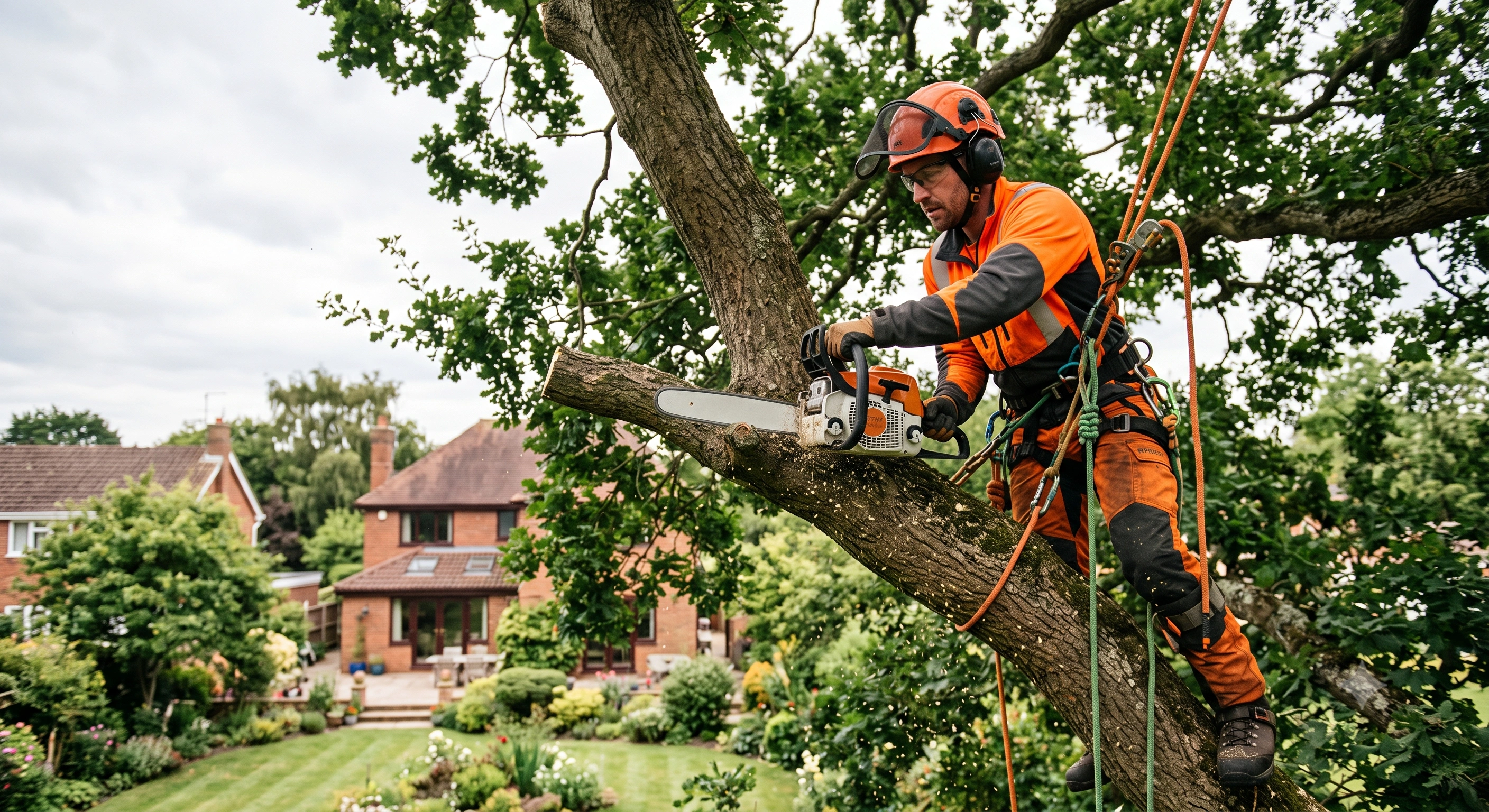
A homeowner in Surrey noticed a 15-metre oak dropping heavy branches near a children's play area. The local landscaper refused the job, citing safety regulations and insurance limits. Within 48 hours, a certified tree surgeon assessed the tree, identified advanced decay in the crown, and scheduled a controlled sectional removal using specialist rigging equipment—work no general gardener could legally or safely perform.
Tree surgeon – a qualified arborist specialising in the practical maintenance, pruning, removal, diagnosis, and treatment of trees, particularly where technical skill, safety equipment, and specialist knowledge are required; commonly used in the UK and Europe interchangeably with "arborist", though the term emphasises complex, hazardous, or surgical interventions rather than routine care.
A tree surgeon is an arborist who handles specialised tree care tasks that go beyond basic gardening: removing dangerous trees, treating disease, performing advanced pruning, bracing structurally compromised specimens, and responding to storm damage. The profession carries no formal legal definition in UK statute, but it is distinguished by industry certifications—most notably from the International Society of Arboriculture—and adherence to British Standards such as BS 3998 for tree work. Tree surgeons typically hold qualifications in arboriculture or forestry, carry specialist insurance, and maintain continuing professional development to stay current with safety regulations and best practice.
Key Takeaways
- Tree surgeons perform complex, hazardous tree work: removal, sectional dismantling, advanced pruning, disease treatment, bracing, emergency storm response. General landscapers cannot legally touch most of these jobs.
- No statutory licensing exists in the UK, but industry certification from the International Society of Arboriculture and adherence to British Standards (BS 3998, BS 5837) separate qualified professionals from amateurs.
- Most hold a Level 2 Diploma in Arboriculture minimum; many progress to Level 3 or degree-level qualifications in forestry and must earn continuing education credits to maintain certification.
- Costs: £150–£400 for pruning a medium tree; £800–£3,000 for removing a large one. Price depends on access, complexity, and how the debris gets disposed of.
- Professional tree surgeons carry public liability insurance (£5 million minimum typical) and employers' liability cover, which shields you from financial risk if something goes wrong during the work.
What Does a Tree Surgeon Actually Do?
Tree surgeons perform a wide range of specialist services that require technical training, safety equipment, and years of hands-on experience. The work is physically demanding and often involves working at height with chainsaws, rigging equipment, and climbing gear.
Core services include:
- Tree pruning and crown work: reducing weight and wind resistance, removing deadwood, shaping crowns to improve structure and health. They also perform formative pruning on young trees in line with BS 3998 standards.
- Tree removal and dismantling: felling trees where space permits, or sectional dismantling using rigging and lowering systems when buildings, fences, or utilities are at risk.
- Tree health assessment and treatment: diagnosing disease, pest infestation, and structural defects. They may apply treatments where feasible or recommend removal if decay poses a genuine safety risk.
- Tree planting and establishment care: selecting species appropriate to soil type and site conditions, planting to BS 8545 standards, and providing aftercare while root systems establish.
- Emergency storm response: making dangerous trees safe after high winds, removing fallen specimens from buildings or roads, assessing remaining trees for stability.
- Tree bracing and cabling: installing dynamic or static support systems to prolong the safe useful life of trees with structural weaknesses, co-dominant stems, or heavy limbs.
- Stump grinding and removal: mechanically grinding stumps below ground level to allow replanting or landscaping, or full extraction where root disease is present.
Tree surgeons also conduct pre-development tree surveys to BS 5837 standards, produce arboricultural impact assessments for planning applications, and advise on tree retention and protection measures during construction projects.
What's the difference between a tree surgeon and an arborist?
In the UK, the terms "tree surgeon" and "arborist" are used interchangeably. That said, "tree surgeon" often implies hands-on practical work—climbing, cutting, rigging—while "arborist" may include consultancy, surveying, and advisory roles. The distinction is more one of emphasis than formal definition.
Here's the thing: the medical analogy is useful. An arborist is a general practitioner who diagnoses tree health and recommends treatment. A tree surgeon is the specialist who performs the intervention—sectional dismantling, advanced pruning, or structural support. In practice, most professionals do both.
Terminology varies by region. The United States favours "arborist" and rarely uses "tree surgeon". Continental Europe keeps "tree surgeon" firmly in place. Regardless of the label, qualified professionals in both camps pursue certification from bodies such as the International Society of Arboriculture, the Arboricultural Association, or equivalent national organisations, and adhere to the same safety and technical standards.
| Aspect | Tree Surgeon | General Landscaper |
|---|---|---|
| Qualifications | Level 2/3 Diploma in Arboriculture, ISA certification | No formal arboricultural qualification |
| Insurance | £5–10 million public liability, specialist tree cover | General landscaping cover (often excludes tree work) |
| Work at height | Trained and equipped for climbing, aerial rescue | Typically ground-based work only |
| Chainsaw use | CS30, CS31, CS38 chainsaw certificates (HSE recognised) | May hold basic certificate or none |
| Scope of work | Complex pruning, removal, disease diagnosis, bracing | Hedge trimming, light pruning from ground or ladder |
Bottom line: If the job involves working above 5 metres, removing a tree near a building, or assessing structural defects, you need a certified tree surgeon with appropriate insurance and qualifications. General landscapers lack the training, equipment, and cover to perform this work safely or legally.
Is "Tree Surgeon" a Legally Regulated Title?
No legal definition of "tree surgeon" exists in UK statute, and there is no statutory licensing regime for tree work. Unlike solicitors, architects, or gas engineers, anyone can describe themselves as a tree surgeon without formal qualification or registration. This absence of regulation means responsibility falls squarely on you to verify credentials.
Industry bodies—the Arboricultural Association, the International Society of Arboriculture, and Lantra Awards—maintain voluntary registers of qualified professionals, but membership is not compulsory.
Key regulatory touchpoints include:
- Health and Safety at Work etc. Act 1974: employers and self-employed tree surgeons must ensure safe working practices, including risk assessments, appropriate equipment, and training.
- Provision and Use of Work Equipment Regulations 1998 (PUWER): chainsaw users must hold relevant certificates (CS30 for basic use, CS31 for felling small trees, CS38 for aerial cutting).
- Work at Height Regulations 2005: work above 2 metres requires planning, supervision, and use of fall-protection equipment. Miss this and you're liable for HSE prosecution.
- Tree Preservation Orders and Conservation Areas: under the Town and Country Planning Act 1990, cutting, uprooting, or damaging a protected tree without local authority consent is a criminal offence, punishable by fines up to £20,000.
Professional indemnity and public liability insurance are not legally mandated but are practically indispensable. Most reputable tree surgeons carry a minimum of £5 million public liability cover; many hold £10 million. Hire an uninsured operator and you expose yourself to claims for property damage or injury—potentially tens of thousands of pounds.
What Qualifications and Certifications Do Tree Surgeons Need?
While no single qualification is mandatory, the following credentials are widely recognised in the UK tree care industry and signal genuine competence and professionalism:
Educational pathways:
- Level 2 Diploma in Work-Based Trees and Timber (Lantra): entry-level foundation covering chainsaw use, basic climbing, and tree work operations.
- Level 3 Diploma in Arboriculture (City & Guilds, RHS, Myerscough College): advanced technical and practical skills, including advanced climbing, rigging, and tree biology.
- Degree programmes: BSc in Arboriculture, Forestry, or Environmental Science at institutions such as Myerscough College, Bicton College, or the University of Cumbria.
Chainsaw certificates (required for commercial tree work):
- CS30: basic chainsaw maintenance and cross-cutting.
- CS31: felling and processing trees up to 380 mm.
- CS38: using a chainsaw from a rope and harness (aerial cutting).
- CS39: using a chainsaw from a mobile elevated work platform (MEWP).
Industry certifications:
- ISA Certified Arborist: internationally recognised credential requiring a written examination covering tree biology, diagnosis, pruning, safety, and ethics; must be renewed every three years with continuing education units.
- Arboricultural Association Approved Contractor: companies (not individuals) are assessed on standards of work, insurance, health and safety policies, and staff qualifications.
- European Tree Worker (ETW): practical assessment of climbing, rigging, and safe work practices; offered by the European Arboricultural Council.
Expect your arborist to keep learning. ISA-certified arborists must complete 30 continuing education units every three years—covering pest and disease updates, new climbing techniques, or changes in British Standards. This matters to you because it means the person assessing your tree is working with current knowledge, not practices from a decade ago.
How do you become a certified tree surgeon?
Most tree surgeons start young and build their qualifications over several years:
- School leaver or career changer: begin with a Level 2 qualification (often taken as an apprenticeship or part-time college course while working for a tree care company).
- Chainsaw certificates: obtain CS30, CS31, and CS38 certificates through a Lantra-approved training provider. Each course runs 2–5 days and is non-negotiable—you cannot legally operate a chainsaw without them.
- Climbing and rigging under supervision: spend 2–3 years working in the field before you're trusted to work alone. This is where competence actually builds.
- Advanced qualifications: pursue Level 3 Diploma or European Tree Worker assessment. The ISA Certified Arborist exam requires three years' experience or a degree in arboriculture—a significant commitment.
- Specialist skills: add MEWP operation (CS39), stump grinding, or tree inspection qualifications as needed for the work they want to do.
Apprenticeships typically last 18–24 months combining paid work with day-release or block-release study. Graduates with relevant degrees may enter at a higher level, often moving into consultancy, planning, or senior technical roles within a few years.
What Services Can You Expect from a Tree Surgeon?
Tree pruning and crown work
Pruning improves tree health, reduces hazard, and enhances appearance. Here are the main techniques:
- Crown reduction: cutting back the height or spread to suitable growth points. Useful when a tree is blocking sunlight from your house, pressing on power lines, or simply too large for the space it occupies.
- Crown thinning: selective removal of small branches to increase light and air movement. This reduces fungal infection risk and wind-throw—a real concern for mature trees in exposed locations.
- Deadwooding: removing dead, dying, or broken branches that pose a falling hazard. Not cosmetic—it's essential maintenance on older trees.
- Crown lifting: removing lower branches to provide clearance for vehicles, pedestrians, or sightlines along a driveway or boundary.
Work should follow BS 3998 standards, which specify target branch sizes, cutting positions, and the maximum foliage loss in a single operation. Topping (indiscriminate cutting of the main stem) or excessive thinning weakens trees and accelerates decay—a false economy that creates a hazardous, short-lived specimen.
Tree removal
Trees come down when they are dead, diseased beyond treatment, structurally unsound, or causing unacceptable damage to buildings or infrastructure. In open ground, the tree may be felled in one piece. In confined spaces—between houses, over garages, near fences—sectional dismantling is required: the surgeon climbs the tree and lowers each section using rigging equipment to prevent damage to property or injury to people below.
After felling, stumps must be dealt with. Mechanical grinding removes them to 150–300 mm below ground, allowing replanting or turfing. Full extraction is necessary if root disease such as honey fungus is present—otherwise the fungus spreads underground to neighbouring trees.
Tree health assessment and treatment
A trained tree surgeon diagnoses common pests and diseases—ash dieback (Hymenoscyphus fraxineus), oak processionary moth, honey fungus (Armillaria), bacterial canker—and advises on management or removal. Here's the reality: most fungal diseases cannot be cured, only slowed by removing infected tissue, improving drainage, or reducing stress on the tree. Pesticides have limited value in arboriculture.
If the tree is structurally sound but shows minor defects, remedial pruning or bracing may extend its safe useful life. Advanced decay or significant structural risk usually means removal is the only responsible option.
Tree bracing and cabling
Dynamic or static support systems may be installed in trees with structural weaknesses—co-dominant stems, heavy horizontal limbs, or previous storm damage. Bracing rods (rigid steel or synthetic) are inserted through stems to prevent splitting. Cabling involves flexible steel cables in the upper crown to limit movement and redistribute loading.
These are not permanent solutions. Systems require annual inspection and do not eliminate risk, but they can preserve veteran or significant trees that are otherwise sound enough to keep.
Emergency and storm-damage response
After severe weather, tree surgeons assess and stabilise dangerous trees—removing hung-up branches, felling specimens uprooted by wind, and cutting away sections resting on buildings or power lines. Emergency work is charged at premium rates: typically £100–£200 per hour, reflecting the urgency and hazard involved. Plan for this cost if you live in an area prone to storms.
Need a professional for your trees?
Find a qualified local tree surgeon
We connect UK homeowners with vetted, insured, qualified tree surgeons. Tell us about your tree and get matched.
How Much Does It Cost to Hire a Tree Surgeon?
Costs vary widely depending on tree size, location, access, and work complexity. These figures are typical for England and Wales as of 2026:
Pruning:
- Small tree (up to 5 metres): £150–£300
- Medium tree (5–10 metres): £250–£500
- Large tree (10–15 metres): £400–£800
- Very large or mature tree (over 15 metres): £600–£1,500
Removal:
- Small tree: £200–£500
- Medium tree: £400–£900
- Large tree: £800–£2,000
- Very large tree or difficult access: £1,500–£5,000+
Stump grinding:
- Small stump (up to 300 mm diameter): £60–£100
- Medium stump (300–600 mm): £100–£200
- Large stump (over 600 mm): £200–£400
What pushes costs up:
- Access: confined spaces, rear gardens with no vehicle access, or trees overhanging buildings increase labour time and cost significantly.
- Protected trees: a Tree Preservation Order means you need local authority consent before work begins. This adds time and sometimes fees.
- Disposal: chipping and removing all waste ("leave site clear") is standard but adds to cost. Some clients retain logs for firewood to reduce the bill.
- Emergency call-outs: expect to pay 50–100% more for work outside normal hours or immediate response to dangerous trees.
When you absolutely need a professional:
- Any work above head height or requiring a ladder
- Chainsaw operation (legal requirement for training and insurance)
- Trees near buildings, power lines, or boundaries
- Disease diagnosis or structural assessment
- Trees subject to a TPO or in a Conservation Area
DIY tree work injures hundreds of people annually—falls from height, chainsaw cuts, crush injuries from falling branches. The cost savings rarely justify the risk.
Tree Surgeon vs. Other Tree Care Professionals: What's the Difference?
Tree surgeon vs. consulting arborist
A consulting arborist typically holds higher-level qualifications (degree, MSc, or professional arboricultural credentials) and specialises in advisory work: surveys, arboricultural impact assessments, expert witness testimony, planning advice. Many instruct tree surgeons rather than doing practical work themselves.
Tree surgeon vs. forester
Foresters manage woodland and commercial plantations for timber production, habitat, and long-term silviculture. Tree surgeons work on individual trees in gardens, streets, parks, and estates, prioritising amenity value, safety, and aesthetics.
Tree surgeon vs. landscaper
Landscapers design gardens, install patios and fencing, maintain lawns, and plant shrubs. Some offer light tree work—hedge trimming, formative pruning of young trees from the ground—but most lack the training, equipment, and insurance for complex pruning, climbing, or removal. Hiring a landscaper beyond their competence is a common source of poor work and insurance disputes.
What distinguishes a professional tree surgeon is certification, insurance, and adherence to British Standards. Arboricultural Association membership, ISA credentials, and documented continuing professional development signal a practitioner committed to safe, competent work.
Frequently Asked Questions About Tree Surgeons
Do I need a tree surgeon or can I do tree work myself?
Hire a professional for any work above 2 metres, any task requiring a chainsaw, or any work on trees near buildings, boundaries, or utilities. DIY tree work causes serious injuries: falls from height, chainsaw cuts, damage to property or power lines. Tree Preservation Orders and Conservation Area trees carry legal weight—unauthorised work is a criminal offence punishable by fines up to £20,000. Tree surgeons carry public liability insurance covering damage and injury; homeowners who attempt complex work themselves bear full liability for any harm caused.
How do I find a qualified tree surgeon near me?
Check the Arboricultural Association's "Find a Professional" directory or the International Society of Arboriculture's verification tool for certified arborists. Ask for proof of qualifications (Level 2 or 3 Diploma, chainsaw certificates, ISA credentials), current public liability insurance (minimum £5 million), and references from recent clients. Obtain at least three written quotes detailing the work, the British Standard to be followed, and waste disposal arrangements. Avoid cold-callers and cash-only operators who cannot provide verifiable credentials or a registered business address.
What's the difference between tree trimming and tree pruning?
Pruning is selective. It follows British Standards (BS 3998) and aims to improve tree health, structure, or safety by removing branches in ways that respect the tree's biology. Trimming is looser—it describes less-precise cutting like shaping hedges or reducing overgrown shrubs.
The difference matters because trees are living things with specific healing mechanisms. When you prune correctly, cuts are made just beyond the branch collar, which allows the tree to compartmentalize the wound and heal properly. Remove no more than 30% of foliage in one operation, or you risk shocking the tree. Bad trimming—topping, indiscriminate lopping—damages wood, promotes decay, and cuts years off a tree's life.
When you get quotes, always specify pruning to BS 3998. This single phrase tells a professional contractor that you understand the work and expect it done right.
Can tree surgeons save a dying tree?
Sometimes. A tree surgeon will diagnose what's killing the tree: disease, pest infestation, soil compaction, drought stress, root damage. If it's mechanical damage, poor pruning, or environmental stress, remedial work—better pruning, soil improvement, support systems—can stabilize the tree and extend its life.
But here's the thing: fungal infections like honey fungus or ash dieback have no cure. Once significant decay takes hold, removal is usually the only safe option. The tree will keep deteriorating, and a weakened tree becomes a hazard. Early intervention changes everything. If you catch decline in its early stages, you have real options. Wait too long, and your only choice becomes removal.
Are tree surgeons insured?
They should be. Reputable tree surgeons carry public liability insurance (usually £5–10 million) to cover property damage, vehicle damage, or injury to third parties. If they employ staff, they'll also have employers' liability insurance. Ask to see the certificate before work starts—it should list the policy number, coverage amount, and expiry date.
Working with an uninsured operator is a financial gamble you don't want to lose. If they damage your neighbour's conservatory or injure someone on the street, you're the one who gets sued. Your homeowner's insurance likely won't cover tree work performed by an uninsured contractor. Membership in professional bodies like the Arboricultural Association requires proof of adequate insurance, which gives you an extra layer of protection.
Published by Tree Surgeon Leads UK, a specialist marketing and lead generation agency working with UK tree surgeons.